
LSA-560
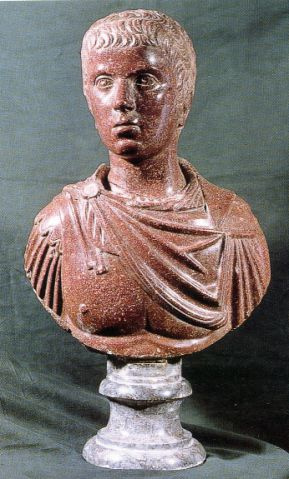
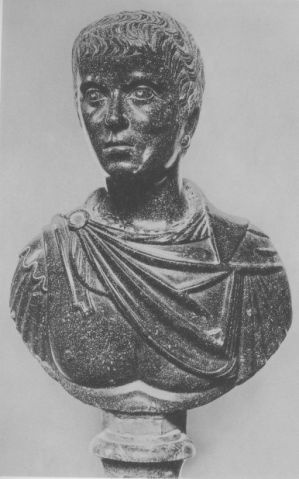
Porphyry bust wearing cuirass. Rome or environs. Fourth century.
Record details
Photographs
Bibliography
- Bracker, J., Adunanza pubblica del 1 luglio 1976, Rendiconti. Atti della Pontificia Accademia romana di archeologia 48, 1975-76, pp. 23-4, 23-4
- Calza, R., Iconografia Romana Imperiale. Da Carausio a Giuliano (287-363 d. C.), Rome 1972, 285-7 no.197 pl.100, 358-9
- Delbrueck, R., Spätantike Kaiserporträts. Von Constantinus Magnus bis zum Ende des Westreichs , Leipzig 1933, 136-7, pls. 48-9, fig. 37
- Donati, A. and G. Gentili, Costantino il Grande. La civiltà antica al bivio tra Occidente e Oriente, Milan 2005, 285 no.123 (P. Liverani)
- Ensoli, S. and E. La Rocca (eds.), Aurea Roma: dalla città pagana alla città cristiana, Roma 2000, 563-4, no. 220 (M. Bergmann and P. Liverani)
- Helbig, W. (ed.), Führer durch die öffentlichen Sammlungen klassischer Altertümer in Rom. Vol. 1. Die päpstlichen Sammlungen im Vatikan und Lateran, Tübingen (4)1964, 1, no. 196 (H. von Heintze doubts antiquity)
- L'Orange, H. P., Das spätantike Herrscherbild von Diokletian bis zu den Konstantin-Söhnen, 284-361 n. Chr. Das Römische Herrscherbild. III. Abteilung ; Bd. 4 , Berlin 1984, 136 (doubts antiquity of bust)
Discussion
DESCRIPTION (object)
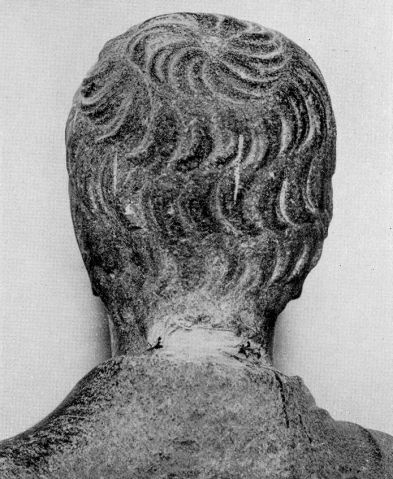
Bust with inserted youthful portrait head. The back of the neck protrudes over the insertion hole. The back of the bust is not hollow, but full. In its center is a shallow vertical and cylindrical depression. The front of the bust is highly polished.
PROVENIENCE
In 1738 recorded in the Barberini collection, under Clemens XIV transferred to the Vatican
DESCRIPTION (subject)
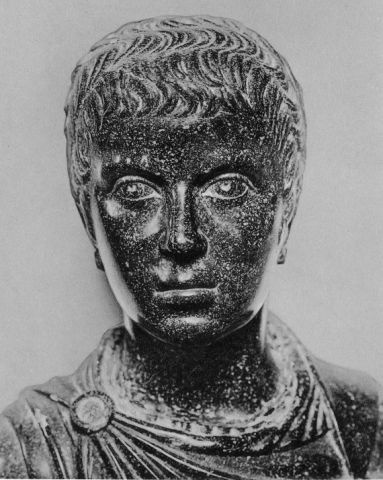
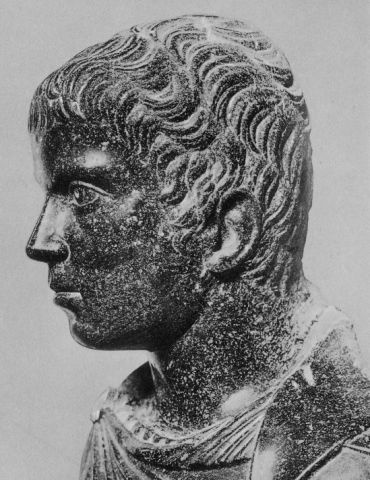
Inserted porphyry head of a youth with short strands of hair arranged in regular rows (back and sides, more irregular on the front).The type of the bust which includes the right arm completely in its rounded contour is unusual, as is the shelf-like definition of the pectorals. There is a contrast between the abstract and linear style of the bust and the classicizing style of the head. This has lead to different opinions.
DATE/HONORAND
Delbrueck and others after him thought, that the classicism of the head is Constantinian and the bust a portrait of the youthful Constantius II. Others have thought, that the whole sculpture (H. von Heintze) or the head only (J.Bracker) was made in the baroque period.
In recent times three aspects have become more clear.
1. The bust itself is ancient, because the motifs and style of its chlamys correspond to that of the bust of Sol in the wreath of the porphyry head from Gamsigrad (LSA-845) and to a later chlamys-statue from Egypt in Vienna (LSA-1009).The Vatican bust has been slightly recarved in the baroque period and polished again. In the process the system of drapery has become irrational.
2. A removal of the head has confirmed that it does not fit into the shallow hole for insertion and was not made for he bust.
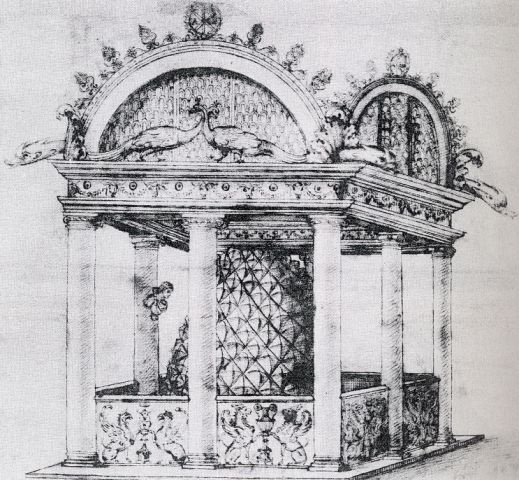
3. The shallow cylindrical depression in the otherwise full back of the bust shows that the bust has been separated from a big cylindrical object, which must be a column. This type of column adorned by a bust (instead of the whole-figure-groups as in LSA-4, LSA-439, LSA-840, LSA-841) is attested in the baldachin of the Pigna-fountain in the forecourt of the Constantinian church of St.Peter in Rome by descriptions and drawings of the 16th century (Huelsen 1904, with pl.5). In this type the bust was supported by a globe. The remains of such a globe can still be seen on the lowest part of the bust in the Vatican. Whether the Vatican bust is one from the baldachin, which was chiseled away from its column, is still unknown, but deserves further investigation (Bracker 1974-75; cp. Bergmann-Liverani 2000). Two columns with clearly related busts in the Louvre, which supposedly represent Nerva and Trajan (Delbrueck 52-54 pl.9-10; Malgouyres – Blanc-Riehl 2003, 51-54 nr. 7-8 fig.16; Laubscher 1999 , 219-221) may be products of the 17th century, which f o l l o w this model.
The head seems indeed to be neither Constantinian nor even ancient in its present form, especially its completely regular rows of sickle-like strands of hair. But the early drawings show a similar head. It may have been inserted already in the early fourth century and recarved in modern times more thoroughly than the bust.
In origin the bust itself was one of the characteristic products of the Egyptian workshops of the tetrarchic period, which may have continued for some more time, until they adopted a classicising style from Constantinople.
Discussion references
- Huelsen, C., Der Cantharus von Alt-St.Peter und die antiken Pigna-Brunnen, Römische Mitteilungen 19, 1904, 87-116 pl.5
- Laubscher, H.-P., 'Beobachtungen zu tetrarchischen Kaiserbildern aus Porphyr', Jahrbuch des Deutschen Archäologischen Instituts 114, 207-252, (1999), fig. 114 (=Huelsen, pl. 5)
- Malgouyres, P. & C. Blanc-Riehl, Porphyre. La pierre pourpre des Ptolémées aux Bonaparte, Paris 2003, 53, fig. 19 (in discussion of portraits on columns)
Cite: Last Statues of Antiquity, LSA-560 (Marianne Bergmann).