
LSA-561
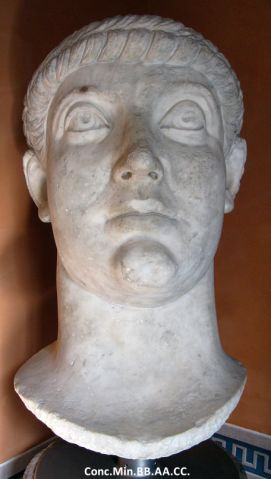
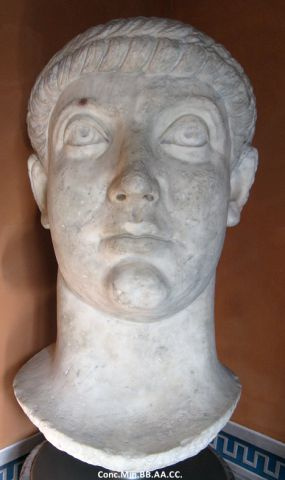
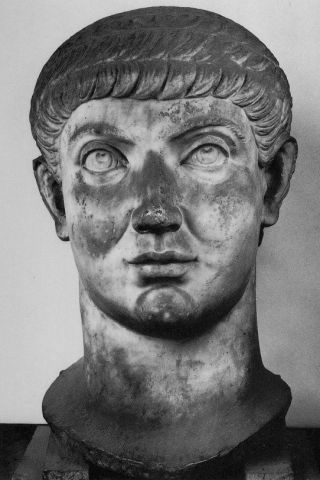
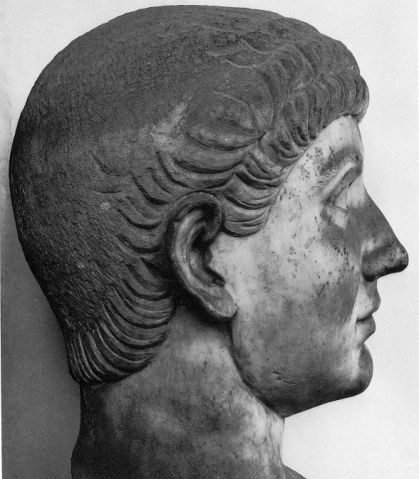
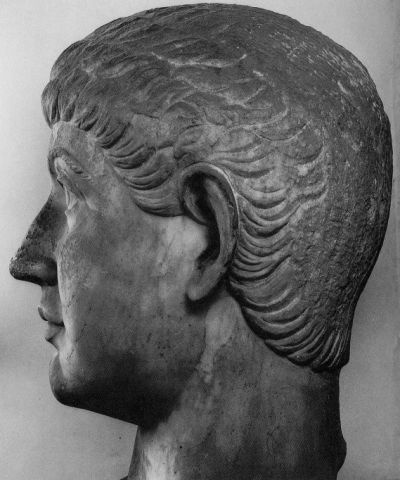
Colossal marble portrait head of prince, Constantius II or Constans? From Rome or its envrions. 330-340.
Record details
Photographs
Bibliography
- Delbrueck, R., Spätantike Kaiserporträts. Von Constantinus Magnus bis zum Ende des Westreichs , Leipzig 1933, 137-9, pl. 50, fig. 38
- Fittschen, K. and P. Zanker, Katalog der Porträts in den Capitolischen Museen und den anderen kommunalen Sammlungen der Stadt Rom, Band I, Mainz 1985, 156-7, no. 125, pl. 156
Discussion
DESCRIPTION (Object)
Colossal head for insertion. H: 96 cm. H (chin to crown): 65 cm. Marble.
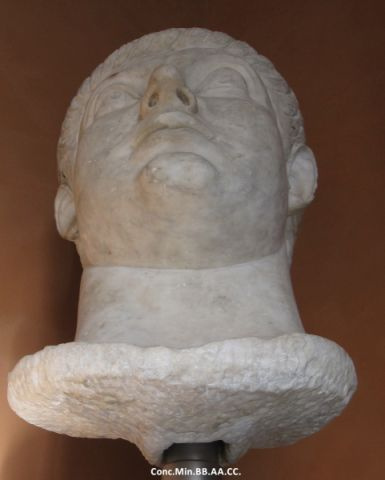
Minor chips and scratches. The head is worked together with a shallow plug. The underside of which is chiselled with a point and has a large square dowel hole.
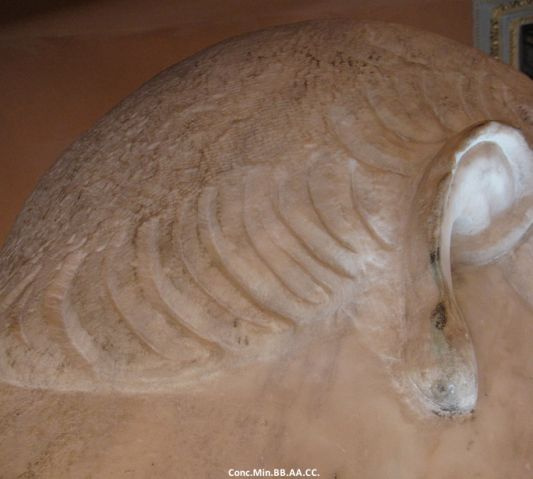
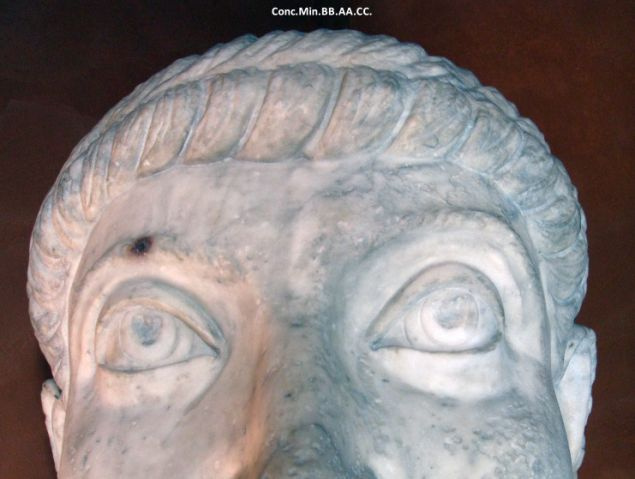
The head has been re-cut from an earlier portrait. The top and central area of the back of the head have been worked over with flat and then claw chisels. They feature no representational detail. Original surface is preserved behind the ears, especially the right one. The eyebrows have been raised, and they eyes enlarged. The edge of the chisel work is visible above the upper eyelids, especially over the left eye. It seems to have been deliberately left to accentuate the arch of the eye. The hair over the brow is recessed in comparison to the hair above it.
The irises are finely engraved and larger than semi-circular; they do not touch the lower lid. The line of the inner canthi is also engraved. The pupils are drilled out in a fat U-shape. Individual strands of hair are rendered with a flat chisel. Groups of three to five strands are separated into locks by drill channels.
PROVENANCE
In the estate of G.B. della Porta (d. 1597) and was inherited either in 1615 by Scipio Borghese or in 1625 by Antonio Borghese. Since 1920 (?) it has been in the Palazzo Conservatori collection.
DESCRIPTION (Subject)
The colossal head portrays a youth with a slight smile. He has short hair which is brushed forward. The locks around the face curve to the proper right until the right temple; from the right ear to the right temple the locks are brushed in the other direction. Behind the first tier of locks over the brow is a second tier of less carefully carved locks which follow the direction of the first tier. The front of the second tier is defined by a hollow, and the back by the tips of a third, not fully worked-out, tier.
The face is long and oval with round cheeks. The brow is unmarked. The eyebrows, in low relief, have a high arch. The eyes are large, with straight lower lids and downward-pointing canthi. The nose is fine and, after a deep dip at the bridge, juts steeply out. The mouth is bow-shaped with upturned corners. The chin is well-defined, round, and projecting. The skin sinks below the eyes and creases around the corners of the nose.
DATE AND IDENTIFICATION
The size of the head indicates that it portrays an Emperor. The Emperor is youthful and shows no obvious signs of having worn a diadem or crown. He has been ascribed to the Constantinian (Delbrueck, Calza, Zanker: Constantius II), Valentinian (Rumpf, Cecchelli: Gratian), and Theodosian (L’Orange, von Sydow) familes.
Zanker points out that the direction of the hair over the brow and the youthful aspect recall two other portraits l>1066">LSA-1066 and LSA-560, and that stylistically the rendering of the face, especially the compartmentalization and the eyebrows, seem similar to that of the colossal Constantine in New York, l>554">LSA-554. This and the lack of headgear make the identification with a son of Constantine most probable. He is unlikely to be Crispus because of his age or Constantinus II because that young man is portrayed in l>559">LSA-559.
Discussion references
- Calza, R., Iconografia Romana Imperiale. Da Carausio a Giuliano (287-363 d. C.), Rome 1972, 288-9, no. 199, pl. 100,361-2 (son of Constantine, Constantinus II)
- Demandt, A. and J. Engemann, (eds.), Konstantin der Grosse, Mainz 2007
, no. I.10.31 (C. Parisi Presicce: Constantius II or Constans) - Donati, A. and G. Gentili, Costantino il Grande. La civiltà antica al bivio tra Occidente e Oriente, Milan 2005, 216-218, no. 14 (C. Parisi Presicce: Constantine or son)
- Ensoli, S. and E. La Rocca (eds.), Aurea Roma: dalla città pagana alla città cristiana, Roma 2000, no.199
- L'Orange, H. P., Das spätantike Herrscherbild von Diokletian bis zu den Konstantin-Söhnen, 284-361 n. Chr. Das Römische Herrscherbild. III. Abteilung ; Bd. 4 , Berlin 1984, 135-6 (Valentinian II)
Cite: Last Statues of Antiquity, LSA-561 (J. Lenaghan).