
LSA-562
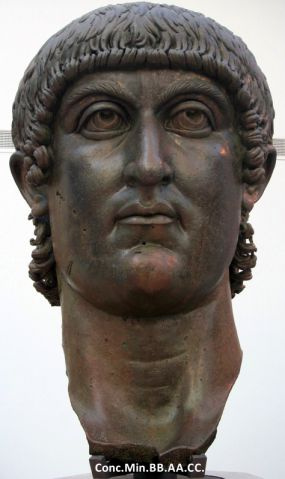
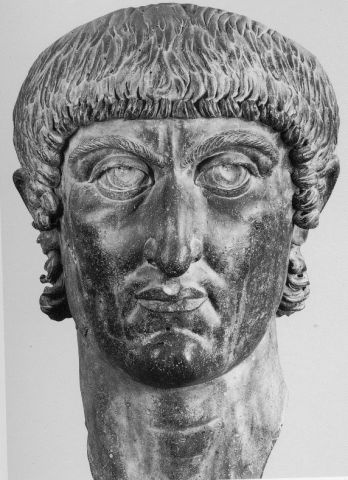
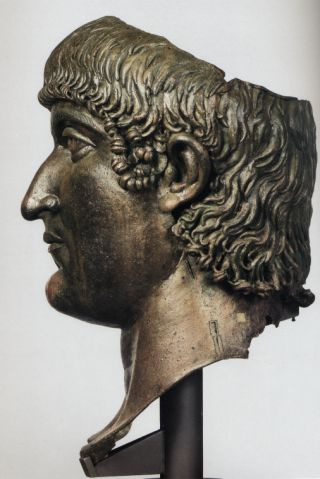
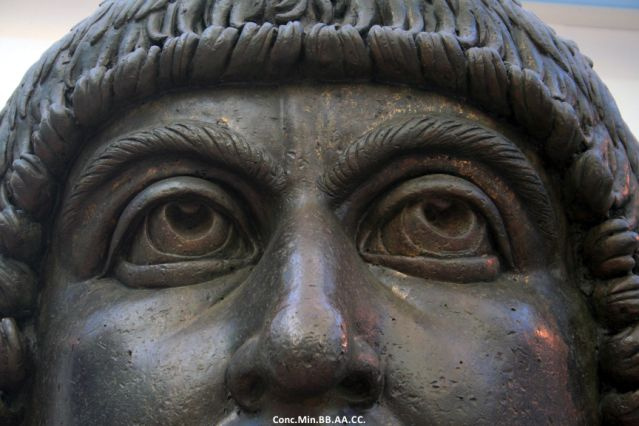
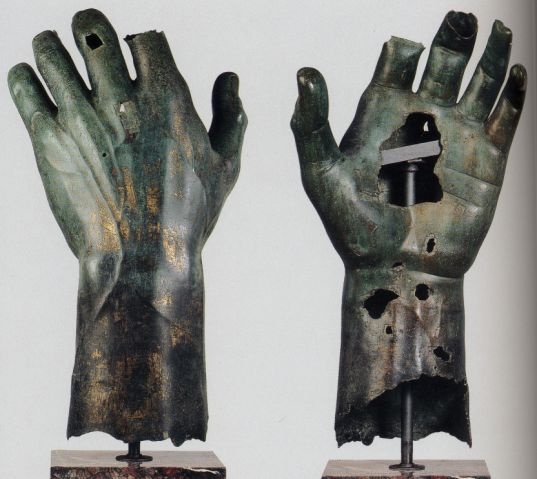
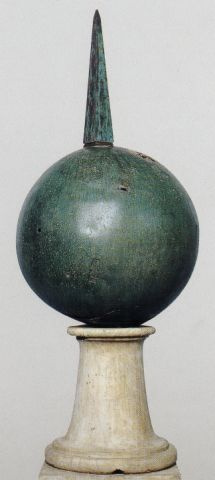
Portrait head, hand, and globe of colossal bronze portrait statue of Constantine? Rome. 330-360.
Record details
Photographs
Bibliography
- Ensoli, S. 'I colossi bronzei a Roma in età tardoantica: dal colosso di Nerone al colosso di Costantino', Aurea Roma: dalla città pagana alla città cristiana, Rome 2000, 71-90, no. 209
- Fittschen, K. and P. Zanker, Katalog der Porträts in den Capitolischen Museen und den anderen kommunalen Sammlungen der Stadt Rom, Band I, Mainz 1985, 152-5, no. 123, pls. 153-4
- Lahusen, G. and E. Formigli, Römische Bildnisse aus Bronze : Kunst und Technik, Munich 2001, 315-317, no. 196
Discussion
DESCRIPTION (Object)
Fragments of colossal bronze statue including separately-worked head. H (of head): 177 cm. H (of chin to crown): 125 cm. L (of hand with forearm): 150 cm. Diam (of globe): 76 cm. Estimated Height of Total Statue: c. 8-10 m depending on whether seated or standing. Gilded bronze
The fragments, which not all scholars believe come from the same statue, include the head with neck, the left hand, the globe, and the right foot. Zanker mentions the right foot; Ensoli does not.
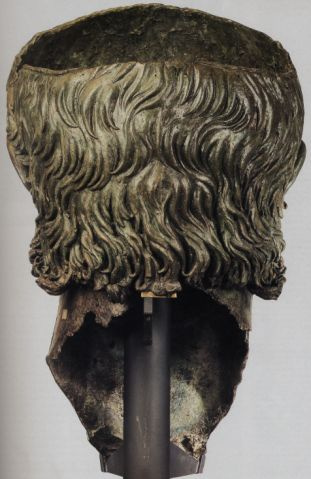
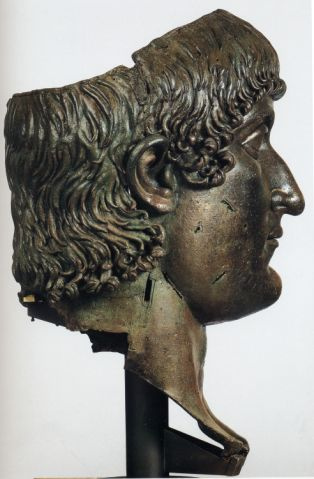
The palm of the left hand is missing the central area, the point of contact with the globe. The pointed element on the globe was added in 1692. The top of the head and areas around the bottom edge at the back are missing. According to Ensoli, an incised line around the missing area at the top of the head indicates that it once wore a crown.
The head was cast in different pieces: the face with the hair over the brow and around the temples; the chin; the throat and back of head. The curls were added separately. The hair of the eyebrows was cold worked with a chisel. The irises and inner canthi are defined by engraved lines. The area within each iris is recessed and features a large crescent-shaped hollow for the pupils.
PROVENANCE
The head was found in or near the Colosseum. Certainly by 1200, the head and the hand holding the globe were mounted on two marble columns in front of the Lateran palace. A 12th century description of the statue notes that then it was decorated with a gold crown with gems, had a left arm, and held a sword or sceptre in the other hand. In 1471 under Sixtus IV all fragments but the foot were moved to the Capitoline.
DESCRIPTION (Subject)
The head and body fragments belonged to a gilded bronze statue that was approximately five times life-size and represented an emperor of mature age. The tight cut around the neck suggests that the body wore a garment such as a cloak. The extant fragments show that he held a globe in his left hand. He probably also wore a crown.
The head turns to the left as the eyes and sterno-mastoids on the neck both indicate. The neck also features two horizontal creases. The face is long and rectangular with a prominent round chin. The brow is low with two sharp vertical creases above the root of the nose. The bushy and protruding eyebrows arch in a high semi-circular fashion. The eyes are large with a heavy upper lids and loose skin beneath them. The nose is long, hooked, and ends in a point. Deep naso-labial folds originate at the nostrils. The mouth is small with creases at the corners. The upper lip is bow-shaped upper lip and the lower lip is less full. Beneath the lower lip, the upper edge of the chin is defined by an arching indentation.
The hair is brushed forward in layers and extends low on the brow. The ends over the brow curl backwards and in front of the ears, the curls are unruly and create sideburns. At the back of the head the hair is long and behind the ears and on the nape, the ends curl upwards.
IDENTIFICATION
The portrait has the physiognomical traits of Constantine but wears a longer hairstyle and seems stylistically more advanced than the colossal marble portrait, LSA-558. It has thus been identified as a son of Constantine (Delbrueck, L’Orange, generally Constantius II) or as a late portrait of Constantine himself (Calza, Zanker)
DATE
Whether a son of Constantine or Constantine himself, all scholars place the head between 325 and 361. This dating reflects both the last portrait type of Constantine, in which he wears a crown and has longer hair and which was created in conjunction with his 20th anniversary, and the advanced reign of Constantius II, who would have turned 40 in c. 357.
CONNECTION TO THE ‘COLOSSUS’
In 2000 Ensoli proposed identifying this bronze statue with the Colossus of Nero which eventually gave its name to the Colosseum. Her proposal is based on five key factors: (1) the front of the head was worked separately from the back and joined around the ears and that the brow hair did match the hair (probably Julio-Claudian) behind it; (2) that medieval authors report that the head and arm were found inside the Colosseum; (3) that medieval authors associated the portrait with the sun god (which was the original Neronian association); (4) that the long nape hair corresponds to Sol; and (5) that this was likely to have been an area in which Constantine was asserted because Maxentius was restoring this area of the city and had re-dedicated the Colossal statue.
Discussion references
- Calza, R., Iconografia Romana Imperiale. Da Carausio a Giuliano (287-363 d. C.), Rome 1972, 231, no. 143, pls. 80, 280-83 and 81, 287 (Constantine)
- Delbrueck, R., Spätantike Kaiserporträts. Von Constantinus Magnus bis zum Ende des Westreichs , Leipzig 1933, 139-44, pls. 52-4, figs. 39-41 (c. 360)
- L'Orange, H. P., Das spätantike Herrscherbild von Diokletian bis zu den Konstantin-Söhnen, 284-361 n. Chr. Das Römische Herrscherbild. III. Abteilung ; Bd. 4 , Berlin 1984, 135, pls. 53c and 55 (Constantinus II)
Cite: Last Statues of Antiquity, LSA-562 (J. Lenaghan).