
LSA-563
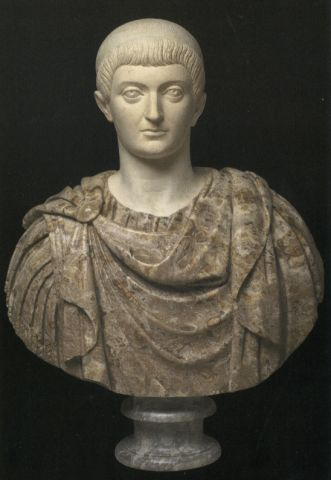
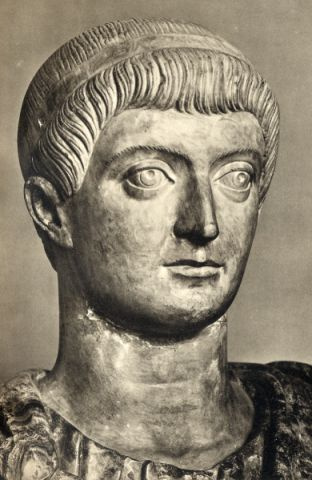
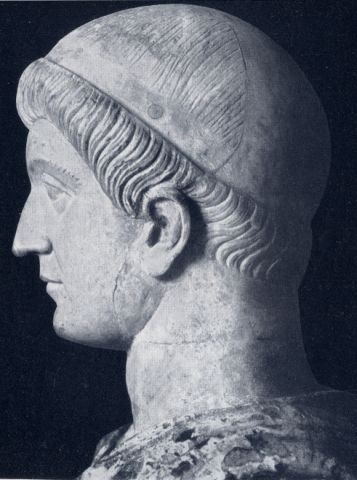
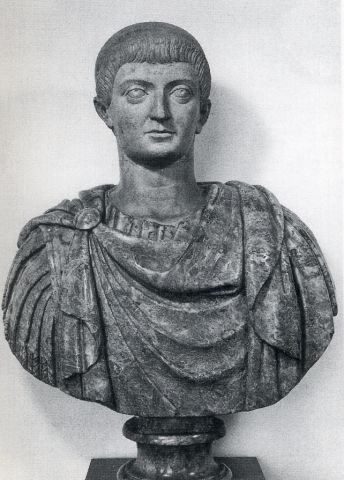
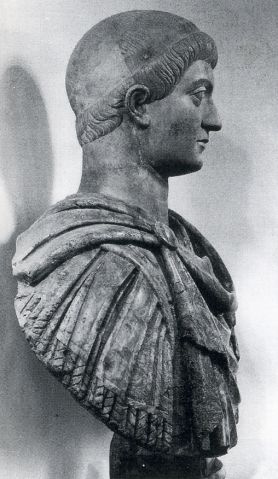
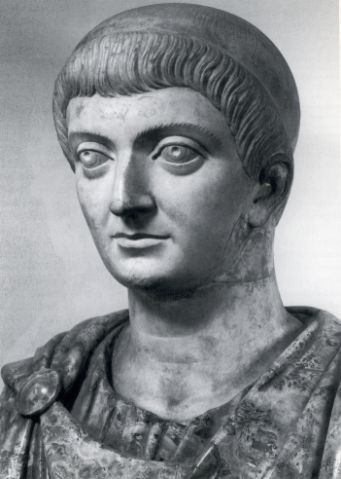
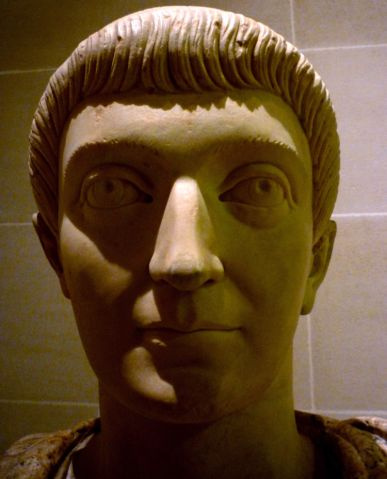
Portrait head of Emperor with diadem. From Rome. Fourth century.
Record details
Photographs
Bibliography
- de Kersauson, K., Les portraits romains II; de l’année de la guerre civile (68-69 après J-C) à la fin de l’Empire , Paris 1996, 522-3, no. 249
- Delbrueck, R., Spätantike Kaiserporträts. Von Constantinus Magnus bis zum Ende des Westreichs , Leipzig 1933, 155-8, pl. 60, figs. 50-51
Discussion
DESCRIPTION (Object)
Head mounted on alien bust. H: 104 cm. H (of head): 33, W (of head): 25, D (of head): 31 cm. Head: Fine-grained white, Carrara marble. Bust: Rose-coloured alabaster.
The head is composed of three fragments: back of the head, throat, and front of the head. It is set into a bust which may be ancient (Roger) but to which it probably never belonged. Most of the ears and the tip of the nose are restoration. The original surface has been lost in the restoration, presumably done by the Campana.
The head has probably been re-cut from an earlier portrait. The hair on the top of the head, above the diadem, is only engraved on the rounded surface of the skull. This is typical of heads that that have been cut down from representations with fuller hair.
The hair is worked with a flat chisel. The irises are engraved and greater than three-quarters of a circle; the inner edge of the canthi and the eyebrows are also carefully engraved. The pupils are large, drilled holes. The inner canthi are elongated.
PROVENANCE
Formerly in the Campana collection. Purchased in 1863.
DESCRIPTION (Subject)
The head portrays an emperor who wears a plain diadem or a band for the superimposition of a crown in another material. The immobile face is devoid of signs of age, and the hair is medium-length and combed forward.
The brow is broad and flat. The eyebrows are fine and arching. The eyes are large, and the nose has a dip at the bridge. The mouth is broad with up-turned corners; the lower lip pouts over an indentation above the rounded and projecting chin. The naso-labial folds and the creases at the corners of the mouth are lightly indicated and suggest round cheeks and a slight smile.
The hair crosses the brow almost horizontally. The locks are thick, longer at the centre, and curving. There is a small part over the inner corner of the right eye; the ends of the locks to the proper right of the parting turn to the right and those to the proper left of the parting turn to the left. w Behind the locks framing the face is a flat band.
DATE AND IDENTIFICATION
The headgear indicates that this is a portrait of an Emperor and probably one who dates after the Vicennalia of Constantine when diadems and crowns became standard. The head has been variously identified as Constans (Delbrueck, Calza, de Kersauson, Roger), Valentinian II (L’Orange), and an early fifth-century emperor (Stichel). The majority of scholars see a physiognomical resemblance between this portrait and the images of Constantine. The two older sons of Constantine, Crispus and Constantinus II, are excluded, respectively, because of the presence of the diadem and the inscribed statue LSA-559. The hair over the brow seems to this author to most closely resemble a defaced portrait from Constantinople LSA-440.
Discussion references
- Calza, R., Iconografia Romana Imperiale. Da Carausio a Giuliano (287-363 d. C.), Rome 1972, 329, no. 234, pl. 114,417-18 (Constans)
- Demandt, A. and J. Engemann, (eds.), Konstantin der Grosse, Mainz 2007
, no. I.9.46 (D. Roger: Constans?) - Donati, A. and G. Gentili, Costantino il Grande. La civiltà antica al bivio tra Occidente e Oriente, Milan 2005, 218, no. 15 (D. Roger: Constans)
- Fittschen, K. and P. Zanker, Katalog der Porträts in den Capitolischen Museen und den anderen kommunalen Sammlungen der Stadt Rom, Band I, Mainz 1985, 160, n. 4
- L'Orange, H. P., Das spätantike Herrscherbild von Diokletian bis zu den Konstantin-Söhnen, 284-361 n. Chr. Das Römische Herrscherbild. III. Abteilung ; Bd. 4 , Berlin 1984, 133-4 (Theodosian period)
- Stichel, R. H. W., Die römische Kaiserstatue am Ende der Antike, Roma 1982, 55, pl. 22a
Cite: Last Statues of Antiquity, LSA-563 (J. Lenaghan).