
LSA-564
One of two bases honouring Zeus and Leto, erected by Diocletian and Maximian. Didyma (Caria). 285-293.
Record details
Photographs
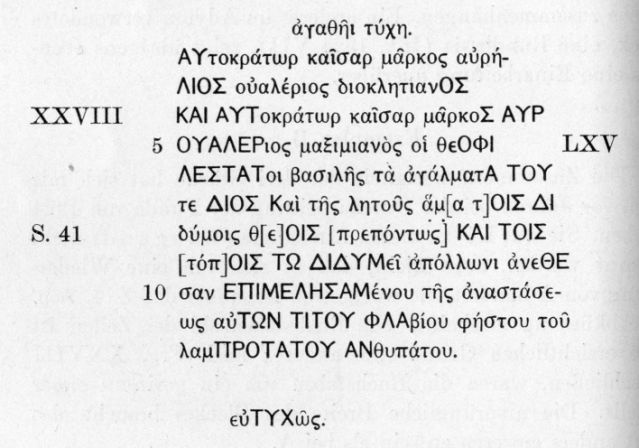
Inscription
Ἀγαθῆι τύχηι. / Αὐτοκράτωρ Καῖσαρ Μᾶρκος Αὐρή/λιος Οὐαλέριος Διοκλητιανὸς, / καὶ Αὐτοκράτωρ Καῖσαρ Μᾶρκος Αὐρ(ήλιος) /(5) Οὐαλέριος Μαξιμιανὸς, οἱ θεοφι/λέστατοι βασιλῆς, τὰ ἀγάλματα τοῦ / τε Διὸς καὶ τῆς Λητοῦς, ἅμ[α τ] οῖς δι/δύμοις θεοῖς, ...(9-10 letters)... καὶ τοῖς /(9) ... οις, τῷ Διδυμεῖ Ἀπόλλωνι ἀνέθε/σαν, ἐπιμελησαμένου τῆς ἀναστάσε/ως αὐτῶν, Τίτου Φλαβίου Φήστου, τοῦ / λαμπροτάτου ἀνθυπάτου./ Εὐτυχῶς
Inscription translation
To Good Fortune. The emperor Caesar Marcus Aurelius Valerius Diocletianus and the emperor Caesar Marcus Aurelius Valerius Maximianus, the emperors most beloved by the gods, set up statues of Zeus and Leto, together with the twin gods ... and the ... to Apollo of Didyma. Overseeing their erection was the clarissimus proconsul, Titus Flavius Festus. With good luck.
Bibliography
- Wiegand, Th., Didyma: Zweiter Teil; Die Inschriften, von Albert Rehm, herausgegeben von Richard Harder, Berlin 1958, 116-7, no. 90
Discussion
INSCRIPTION
In 13 lines:
Ἀγαθῆι τύχηι. / Αὐτοκράτωρ Καῖσαρ Μᾶρκος Αὐρή/λιος Οὐαλέριος Διοκλητιανὸς, / καὶ Αὐτοκράτωρ Καῖσαρ Μᾶρκος Αὐρ(ήλιος) /(5) Οὐαλέριος Μαξιμιανὸς, οἱ θεοφι/λέστατοι βασιλῆς, τὰ ἀγάλματα τοῦ / τε Διὸς καὶ τῆς Λητοῦς, ἅμ[α τ] οῖς δι/δύμοις θεοῖς, ...(9-10 letters)... καὶ τοῖς /(9) ... οις, τῷ Διδυμεῖ Ἀπόλλωνι ἀνέθε/σαν, ἐπιμελησαμένου τῆς ἀναστάσε/ως αὐτῶν, Τίτου Φλαβίου Φήστου, τοῦ / λαμπροτάτου ἀνθυπάτου./ Εὐτυχῶς
'To Good Fortune. The emperor Caesar Marcus Aurelius Valerius Diocletianus and the emperor Caesar Marcus Aurelius Valerius Maximianus, rulers most beloved by the gods, set up statues of Zeus and Leto, together with the twin gods, ... and the ... to Apollo of Didyma. Overseeing their erection was Titus Flavius Festus, of clarissimus rank, governor (proconsul). With good luck.'
Letter height 3 cm.
The letters underlined are the only ones still surviving, and legible by Rehm 1958 no. 90. The completions we present here are on the basis of our inscription's twin LSA-383 (Rehm 1958 no.89). Line 8 is largely missing in both versions (see below, 'Further Discussion').
DESCRIPTION (from Rehm 1958)
Three pieces of a rectangular white marble block with mouldings at the top. Piece (a) (inv. no. 1924 XXVIII), H 34, W 16, D 51 cm, is broken at the right, top and bottom, but preserves the left margin and the beginnings of lines 2-7; at its top the beginning of a moulding survives. Piece (b) (inv. no. 1924 LXV), H 26, W 11 cm, is broken at the left, top and bottom, but preserves the right margin and the endings of lines 3-7; piece (c) (inv. list 1924 p. 41 = 1925 p. 9), H 41, W 30, D 30 cm is broken on all sides but preserves portions of lines 8-13.
Our base's much better preserved twin, LSA-383, has fixing-holes for a bronze statue on its top face; our base must likewise have carried a bronze statue.
PROVENANCE AND CURRENT LOCATION
All three fragments were found in 1924 in the adyton of the Temple of Apollo at Didyma. Fragment (b) was re-used in the pavement of the church later built into this adyton, and removed in 1913; fragment (c) was found built into the east wall of the baptistery.
All three fragments are now in Berlin, Staatliche Museen, Antikensammlung, inv. nos. 1924 XXVIII; 1924, LXV; inv. list 1924 p. 41 = 1925 p. 9
HONORAND, AWARDERS AND DATE
These fragments are from the base of one of two statues set up by the emperors to Leto and to Zeus, parents of the twin gods Apollo and Artemis (lines 5-6), and dedicated in Didyma's famous temple of Apollo; its pair, LSA-383, is much better preserved.
The inscription is from the common reign of the two awarding Augusti, Diocletian and Maximian, which began in 286; it must however date from before 293 when Galerius and Constantius I were installed as Caesars.
FURTHER DISCUSSION
The phrase introduced by ἄμα (line 7) and ending with καὶ τοῖς ... ...οις (lines 8-9) was read by Rehm as a qualification of the statue of Leto, probably depicted with her twin children, the gods Apollo and Artemis, in her arms (Rehm 1958, 116). For the lost portions of lines 8-9, Rehm 1958, 116-7 therefore proposed '... ἅμα τοῖς διδύμοις θεοῖς Λητοΐδαις καὶ τοῖς τόξοις, ... with the Letoids (= the twin children of Leto), and with bows (referring to the silver bow of Apollo)'.
Another possibility is to read ἄμα as an adverb (instead of a preposition as proposed by Rehm); this would mean that statues of the twin gods were set up 'at the same time' as those of Zeus and Leto. If so, there were four similar dedications (Rehm 1938, 80-1).
The role of the governor of Asia, Titus Flavius Festus (lines 11-12; PLRE I, 335, T. Flavius Festus 7), in the erection of the statues is remarkable, since at this date Miletus was within the province of Phrygia and Caria. Festus is known from another cycle of epigrammatic inscriptions in Didyma, celebrating his donation to the city of a fountain enclosure and fountain house (Rehm 1958 no. 159).
Discussion references
- Jones, A. H. M. et al., The Prosopography of the Later Roman Empire. Vol. I 260-395, Cambridge et al. 1971 (1975)
- Rehm, A., Kaiser Diokletian und das Heiligtum von Didyma, Philologus. Zeitschrift für das klassische Altertum 93 (Neue Folge Band 47), 1938, 74-84
Cite: Last Statues of Antiquity, LSA-564 (Ulrich Gehn).