
LSA-566
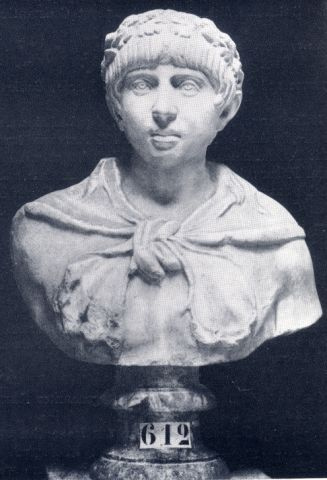
Portrait of prince with corona civica on bust of Hercules. Rome. Earlier fourth century.
Record details
Photographs
Bibliography
- Delbrueck, R., Spätantike Kaiserporträts. Von Constantinus Magnus bis zum Ende des Westreichs , Leipzig 1933, 159-60, fig. 53 (probable son of Constantine)
- Visconti, P.E., Catalogo del Museo Torlonia di sculture antiche, Rome 1880, 231, no. 522
Discussion
DESCRIPTION (Object)
Head mounted on bust. H: 46, H (of head): 17.2 cm. Marble.
The head is attached to a bust for which it was not originally made. It is unclear when the two were brought together.
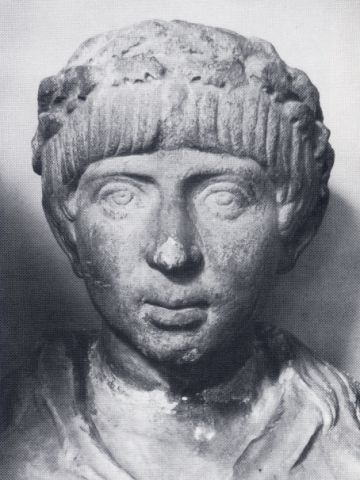
The head has been re-cut from an earlier portrait. Extra lines above the upper eye lids and perhaps even the eye markings have been added.
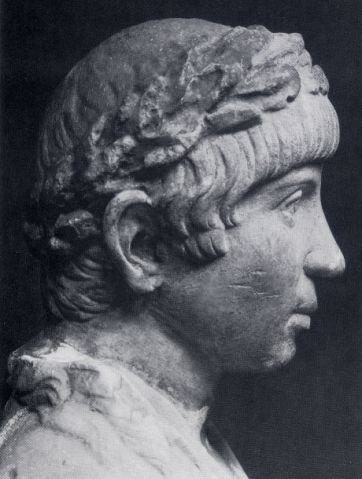
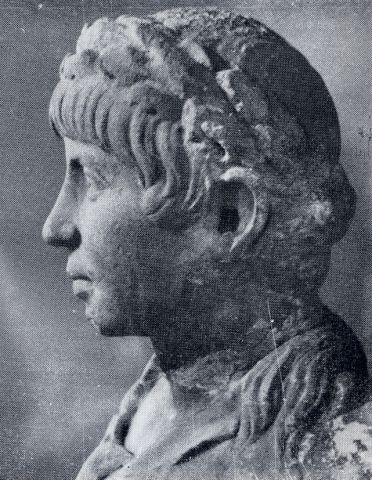
The hair is worked with a flat chisel. The irises are engraved and essentially semi-circular. The pupils are also engraved but cannot be seen clearly in the photographs.
PROVENANCE
Found in 1825 in the Circus of Maxentius on the Via Appia.
DESCRIPTION (Subject)
The head shows a boy wearing an oak wreath. He has medium-length straight hair which falls low onto the brow and has a small part over the inner corner of the left eye. In front of the ears the locks are longer, fall in two tiers, and curl forward.
The face is triangular in shape. The cheekbones are widely spaced, and the lower face is narrow. The mouth has a full projecting lower lip, and the lips are separated by a drill channel so as to appear slightly open. The nose, which may be restoration, is short, and its root is recessed with respect to the lips.
The bust wears only a lion skin, the legs of which are knotted at the sternum. One paw hangs in front of each pectoral. There are traces of hair on the shoulders, possibly belonging to the mane of the animal which was probably draped over the original head of the bust.
DATE AND HONORAND
The oak wreath should indicate a prince. A prince with a bowl hairstyle and re-worked eyes should belong to the fourth century. Delbrueck considered the most plausible candidates to be the sons of Constantine (because of the hairstyle) but did not exclude Romulus, son of Maxentius, or Licinius II, son of Licinius. Coin portraits of Romulus which show him as short-haired and a probable portrait of Licinius II, LSA-334, make the Constantinian connection more tempting, as both Calza and L’Orange have noted.
Discussion references
- Calza, R., Iconografia Romana Imperiale. Da Carausio a Giuliano (287-363 d. C.), Rome 1972, 198, no. 115, 284-5, no. 196, pl. 99,356-7 (Constantinus II)
- L'Orange, H. P., Das spätantike Herrscherbild von Diokletian bis zu den Konstantin-Söhnen, 284-361 n. Chr. Das Römische Herrscherbild. III. Abteilung ; Bd. 4 , Berlin 1984, 137, pl. 60a-b (probably a prince from time of Constantine and sons)
Cite: Last Statues of Antiquity, LSA-566 (J. Lenaghan).