
LSA-567
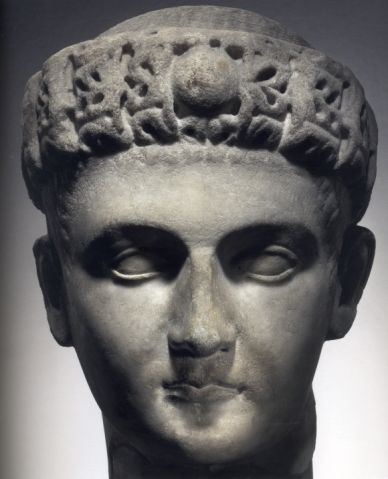
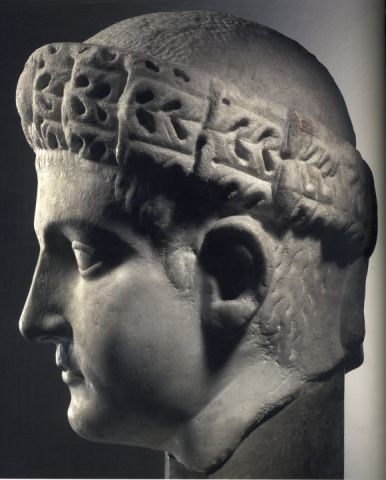
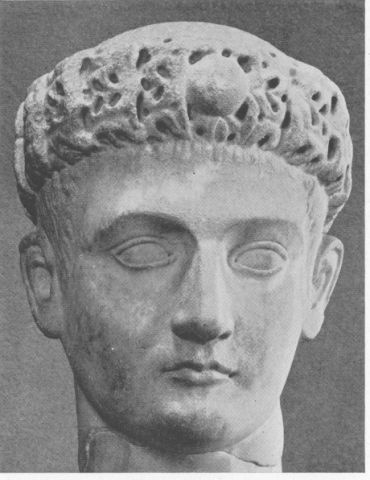
Re-worked portrait head wearing a corona civica. From Italy? Early to mid-fourth century.
Record details
Photographs
Bibliography
- Delbrueck, R., Spätantike Kaiserporträts. Von Constantinus Magnus bis zum Ende des Westreichs , Leipzig 1933, 161-2, fig. 57
Discussion
DESCRIPTION (Object)
Over life-size head. H: 32.5 cm. Marble.
The head is broken unevenly around the top of the neck; more of the left side of the neck is preserved. There seems to be a trace of gilding in the upper edge of the wreath above the left ear.
The head has been re-worked from an earlier head. Above the wreath the hair has been cut down to a domed shape on which claw-chisel marks are visible. The hair behind the ears has been engraved with wavy lines in a vertical direction. Below the wreath the hair is badly worn and in low relief; mainly here original hair has been removed. On the brow there seem to be traces of rasp work. The eyeballs are unmarked.
PROVENANCE
Purchased in 1913 in Rome.
DESCRIPTION (Subject)
The head represents a clean-shaven young Emperor with short hair and an unusual crown. The crown sits almost directly on the brow and passes just above the ears. It appears to have ties that fall down the back of the head.
The crown has a central circular jewel, a lower edge, a central area which may portray leaves, and an upper edge. Moreover it has been divided into four vertical sections between the ear and the jewel. The lower edge features a series of drill holes around which loop small bits of material which look like curled female hair. The upper sections also feature significant drilling. It is neither a traditional corona civica nor a laurel wreath.
The face features a broad brow and a narrower lower face. The eyes are small with fine lids; the nose is long with a dip at the bridge and a pointed tip; and the mouth is small with finely formed lips. The upper lip has central dip and the lower lip is fuller. The chin is small but projecting. The ears have a rounded upper rim that makes them seem abruptly short.
DATE
Because of the royal diadem without pearls and the unmarked eyes, all scholars are agreed that this head is a re-used portrait that represents an Augustus of the Constantinian period. Although the arrangement of the hair does not follow the same layout as the portrait inscribed Constantine II, LSA-559, both have a similar aspect and are re-worked from earlier portraits which causes some alteration from the imperial model.
COMMENT ON RE-CARVING.
The crown of this head was not part of the first portrait. It is too low on the brow, too close to the head, and has a composition that does not belong to the high imperial period. On close observation, the lower border of the crown seems to consist of the locks of hair of the original portrait. These locks correspond to the Type 3 or Type 4 portrait of Agrippina the Younger; compare, for example, LSA-1597. A re-cutting from such a portrait would explain the lack of height of the ears and the lack of a fringe. It also fits well with the rendering of the eyes and the physiognomy (small mouth and chin) of the lower face.
Discussion references
- Konstanin in Berlin, Milan 2006, 34-5, 44, no. 9 (A. Effenberger: Constantine II?)
- Calza, R., Iconografia Romana Imperiale. Da Carausio a Giuliano (287-363 d. C.), Rome 1972, 293-4, no. 203, pl. 102, 368 (Constantinian prince)
- L'Orange, H. P., Das spätantike Herrscherbild von Diokletian bis zu den Konstantin-Söhnen, 284-361 n. Chr. Das Römische Herrscherbild. III. Abteilung ; Bd. 4 , Berlin 1984, 129, pl. 45a (Constantinian prince)
Cite: Last Statues of Antiquity, LSA-567 (J. Lenaghan).