
LSA-57
Base for statue of Phosphorius, governor of Achaea. From Megara (Achaea). Late fourth century
Record details
Photographs
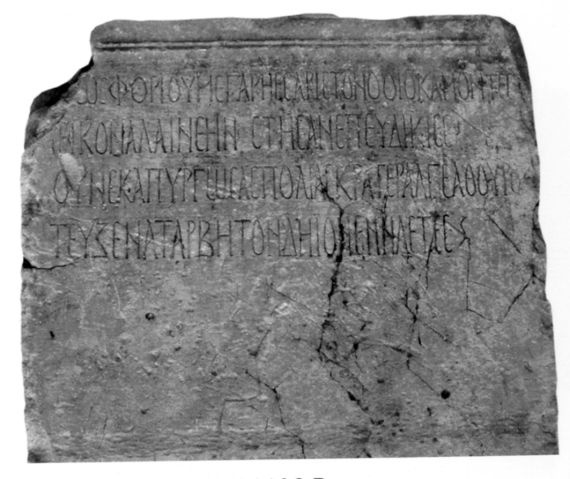
Inscription
[Φ]οσφορίου Μεγαρῆες ἀριστονόοιο καμόντες
εἰκόνα λαϊνέην στῆσαν ἐπ’ εὐδικίες,
οὕνεκα πυργώσας πόλιας κρατεραλγέα θοῦρο[ν]
τεῦξεν ἀτάρβητον δήϊον ἐνναέτες.
Inscription translation
The Megarans set up a marble statue of the noble-minded Phosphorius for his righteousness, because, having fenced the cities with towers, for the inhabitants he rendered the cruel and violent one (= Ares, god of war) an enemy which they do not have to fear.
Bibliography
- Inscriptiones Graecae, IV (2) 1129 B
Discussion
INSCRIPTION
In four lines of verse:
[Φ]οσφορίου Μεγαρῆες ἀριστονόοιο καμόντες /
εἰκόνα λαϊνέην στῆσαν ἐπ’ εὐδικίες, /
οὕνεκα πυργώσας πόλιας κρατεραλγέα θοῦρο[ν] /
τεῦξεν ἀτάρβητον δήϊον ἐνναέτες.
'The Megarans set up a marble statue of the noble-minded Phosphorius for his righteousness, because, having fenced the cities with towers, for the inhabitants he rendered the cruel and violent one (= Ares, god of war) an enemy which they do not have to fear.'
The epigram praises in two elegiac distichs Phosphorius' justice, and, above all, his activity in building city walls.
DESCRIPTION (from IG IV (2) and the published photo)
Rectangular base of grey marble with thin shallow mouldings at top and bottom. The epigraphic field is smoothly finished with a claw, and the inscription extends across the whole width of the base. According to IG, on the top surface there are 'two smaller holes and two bigger ones with cast channels'. There is a break at the top left corner, and slight damage along both sides. The surface is crossed by several thin cracks. The base was earlier used for a statue to the governor Plutarchus (LSA-56), whose inscription is carved on the opposite face to that to Phosphorius.
PROVENANCE AND LOCATION
In 1828 the base was recorded built into a wall of the Venetian castle of Nisaia, the port of Megara, by the Corpus Inscriptionum Graecarum ('Nisaeae in pariete Castelli'). According to IG VII, it was 'later brought to Aegina (postea translata Aeginam)'. Transfers of antiquities to Aegina took place after the city became the first capital of an independent Greece in 1828, and here Greece's first archaeological museum was set up and opened in 1829. The base for Phosphorius (earlier used for Plutarchus, LSA-56) is one of those today standing in front of the old Archaeological Museum in Aegina (and inacessible to the public).
HONORAND AND DATE
Although the present inscription gives no explicit title to the honorand, the praise of his righteousness and his building activities make it certain that he was a high-ranking state official. The same Phosphorius was awarded an honorific statue at Argos (LSA-595), where his office, governor (anthupatos) of Achaea, is explicit.
The identity of the honorand requires some discussion. That he was to be identified with Aurelius Valerius Tullianus Symmachus, in whose family the signum Phosphorius occurs (PLRE I, 871 Symmachus 6), consul in 330 and governor of Achaea in 319, was first proposed by Reinach in 1900, supported by Premerstein in 1913, rejected by Groag in 1946, then again supported by Polara in 1974, and adopted by Frantz 1988 and by IG IV (2) in 2002. Without being able to give a full critical account of the discussion here, we would like to point out that none of the arguments advanced so far have taken into account, or even mentioned, the first-use inscription on the base (LSA-56). The honorand of this first use, Plutarchus, was proconsul after 326, with a terminus ante quem of around 360. This first-use date of 326/60 definitively excludes Aurelius Valerius Tullianus Symmachus as the honorand for the second use of the base.
Groag (1946) proposed a date between 379 and 382 for the proconsulship of our Phosphorius, while PLRE I favoured a more generic later 4th-century date. As we have seen, the date of the previous use of this base (AD 326/60) lends new support to a later 4th-century date.
However we should note that, while it is always assumed that the Phosphorius inscription is later than that to Plutarchus, the two are on opposite sides of the base, and their relative chronology could perhaps be reversed. If so, Aurelius Valerius Tullianus Symmachus, signo Phosphorius, would again become a candidate for our honorand! A close inspection of the base itself, might shed some light on the two inscriptions' relative chronology.
FURTHER DISCUSSION
This is an interesting example of a base that has been used twice within a comparatively short period of time.
Discussion references
- Inscriptiones Graecae; , IV 1608
- Inscriptiones Graecae; , VII 94, 95
- Frantz, A., Late Antiquity A. D. 267 - 700: The Athenian Agora XXIV, Princeton 1988, 49-51
- Groag, E., Die Reichsbeamten von Achaia in spätrömischer Zeit, Budapest 1946, 54-5
- Paribeni, R., "Iscrizioni dei Fori Imperiali", Notizie degli Scavi di Antichità, 1933
- Premerstein, A. v., Zu den Inschriften der Ostgermanen, Zeitschrift für deutsches Altertum und deutsche Litteratur 60, 1923, 71-80
- Reinach, T., Un nouveau proconsul d'Achaie, Bulletin de Correspondance hellénique 24, 1900, 324-8
Cite: Last Statues of Antiquity, LSA-57 (Ulrich Gehn).