
LSA-571
Lost base for statue of Constantine I, emperor. Tegea (Achaea). 310-337
Record details
Photographs
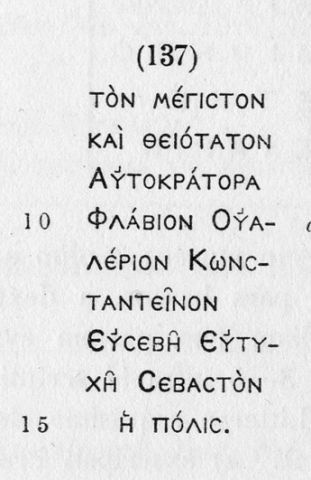
Inscription
Τὸν μέγιστον / καὶ θειότατον / αὐτοκράτορα, / Φλάβιον Οὐα/λέριον Κωνσ/ταντεῖνον, / εὐσεβῆ εὐτυ/χῆ σεβαστὸν, / ἡ πόλις.
Inscription translation
To the greatest and most divine emperor, Flavius Valerius Constantinus, the pious and fortunate Augustus. The city [set him up].
Bibliography
- Inscriptiones Graecae, V, 2, 137
- Feissel, D. & Philippidis-Braat, A., Inventaires en vue d’un recueil des inscriptions historiques de Byzance, 3. Inscriptions du Péloponnèse, (à l’exception de Mistra)., Travaux et mémoires, 9, Paris 1985, 267-395, 270 no. 1
Discussion
INSCRIPTION
In nine lines:
Τὸν μέγιστον / καὶ θειότατον / αὐτοκράτορα, /(4) Φλάβιον Οὐα/λέριον Κωνσ/ταντεῖνον, / εὐσεβῆ εὐτυ/χῆ σεβαστὸν, / ἡ πόλις.
'To the greatest and most divine emperor, Flavius Valerius Constantinus, the pious and fortunate Augustus. The city [set him up].'
DESCRIPTION (from Inscriptiones Graecae (IG) V, 2)
The inscription was one of two recorded on the same base, the other one being an honorific inscription to Constantius I (LSA-570). Hiller von Gaertringen (IG V, 2) reports that a drawing of this inscription appears on p. 168 of the manuscript notes of Fourmont ('ex schedis Fourmonti'), which were one source for the editors of Corpus Inscriptionum Graecarum; but this has not been available to us, and no other illustration of the base is known.
According to Hiller von Gaertringen there were imprints of the feet of two statues on the top of the base, which makes it certain that the statues in question were of bronze. Possibly these two sets of imprints were, respectively, for Constantius I and Constantine; however the bases from Tegea that we have been able to examine (LSA-355, LSA-356) both bear clear traces of having been used for statuary before Late Antiquity, so it is likely that one of the two statues that left imprints on our base was from an earlier century.
Boeckh in the Corpus inscriptionum Graecarum reports that the two inscriptions were on the same side of the base (in eodem monumenti latere duo tituli). It is therefore very possible that a statue of Constantius I was rededicated to Constantine I without replacing it.
PROVENANCE AND LOCATION
Boeckh in the Corpus Inscriptionum Graecarum of 1828 lists the base under the monuments from Tegea. However, it was not recorded by V. Bérard in 1893. Likewise Hiller von Gaertringen, in 1913 (for IG V, 2, 136) did not see it, and recorded it only as 'once in Tegea (olim Tegeae)'.
HONORAND AND DATE
The honorand, Constantine, was elevated to the rank of Augustus in 306, but achieved full recognition in the East only in 310 (Kienast 1996, 298-9). He died in 337.
FURTHER DISCUSSION
It is remarkable that a dedication to Constantius I (the father of Constantine) should have been replaced so soon after its erection with one to his son, who remained, throughout his life, dedicated to the memory of his father. This is a well documented and interesting case of a rapid turn-over of statue dedications.
Discussion references
- Corpus Inscriptionum Graecarum; , Vol. I no. 1522
- Bérard, E., Tégée et la Tégéatide, Bulletin de correspondance hellénique XVII, 1-24, Paris 1893, 1-24, esp. 10-11
- Kienast, D., Römische Kaisertabelle. Grundzüge einer römischen Kaiserchronologie, Darmstadt (2)1996, 298-9
Cite: Last Statues of Antiquity, LSA-571 (Ulrich Gehn).