
LSA-575
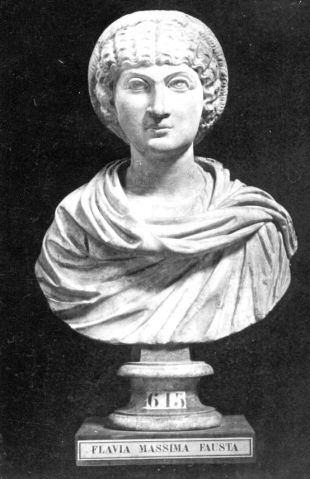
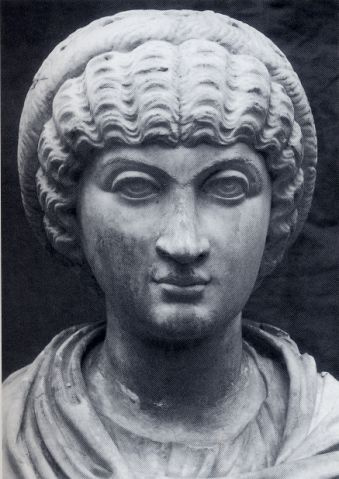
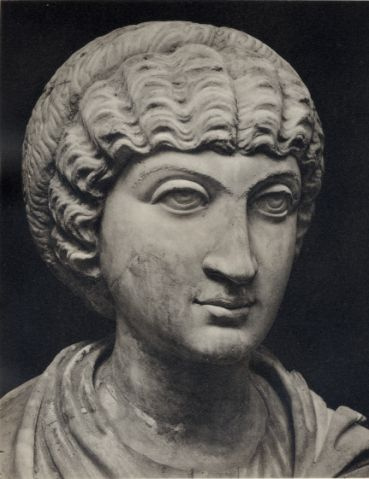
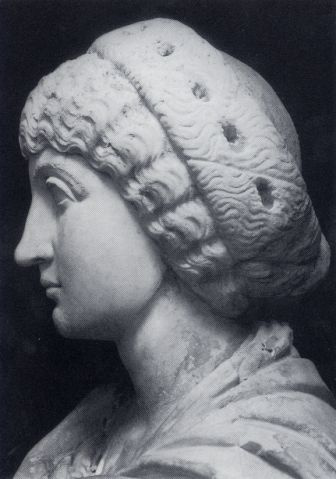
Portrait head of woman (Empress?) with cuttings for headgear, set on bust. Rome. Fourth century.
Record details
Photographs
Bibliography
- Delbrueck, R., Spätantike Kaiserporträts. Von Constantinus Magnus bis zum Ende des Westreichs , Leipzig 1933, 172-3, pl. 71, fig. 59
- Visconti, P.E., Catalogo del Museo Torlonia di sculture antiche, Rome 1880, 232, no. 525
Discussion
DESCRIPTION (Object)
Head, mounted on bust. Fine-grained white marble. The height is variably listed as 73 and 14.5 cm; the one may be presumed to represent the entire bust but the other is difficult to interpret.
The neck, lower right cheek, the lower part of the back of the head, and nostrils are restoration. The head is mounted on a bust which appears to be ancient but to which it probably did not originally belong. There are holes in the braid that wraps around the head for the addition of a separately-worked element.
The hair at the top of the head has not been given full representational detail. All other hair has been mainly indicated with a flat chisel. The pupils of the eyes appear lightly drilled. The irises, which do not touch the lower lids, are defined by a sharply engraved line.
PROVENANCE
Found in 1856 on the ancient Via Labicana (modern Via Casilina) at Tor Pignattara. This is an area of considerable interest in the fourth century; it was the property of Helena known as Ad duas lauros which at her death passed to the church. Located here is the mausoleum of Helena, and the basilica and catacombs of Marcellinus and Peter.
DESCRIPTION (Subject)
The head shows a woman without indication of age who wears a large ‘encircling braid’ hairstyle. The hair around the face is crimped and parted at the centre. It is pulled to both sides, covering the ears, and at the back the hair divided into two sections which begin each behind an ear and cross over each other above the centre of the nape. They are then wrapped around the head and form a thick band behind the ears. In this thick band are holes for elements of a separately-worked headgear.
The face is broad across the cheekbones and tapers to the chin. The eyes are large and framed above by semi-circular eyebrows which meet at the middle of the bridge of the nose. The mouth is short from side to side and has upturned corners and bow-shaped lips. A round chin is defined below the lower lip by a curving indentation.
DATE AND HONORAND
The crimped hairstyle with the encircling braid recalls that of the mature empress represented in LSA-406. The shape of the face and disposition of the features recall the empress represented by LSA-574. Schade notes a stylistic similarity between this head and that of a prince, also from Rome, LSA-598; eyebrows, eyes, and mouth are all worked similarly. None of the cited examples are securely dated; all are generally placed in the Theodosian period for stylistic reasons.
Delbrueck in contrast to more recent scholars (Schade and von Sydow) placed this head around AD 350 and compared it to LSA-561, probably a portrait of a son of Constantine.
The date is thus best given as AD 340-400.
Discussion references
- L'Orange, H. P., Das spätantike Herrscherbild von Diokletian bis zu den Konstantin-Söhnen, 284-361 n. Chr. Das Römische Herrscherbild. III. Abteilung ; Bd. 4 , Berlin 1984, 154
- Meischner, J., 'Das Porträt der valentianischen Epoche,', Jahrbuch des Deutschen Archäologischen Instituts, 107 (1992), 217-34, pl. 87-91, pl.88.3
- Schade, K., Frauen in der Spätantike--Status und Repräsentation, Mainz 2003, 188, no. I 28, pl. 41.1-2 (early Theodosian)
- von Heintze, H. ‘Ein spätantikes Mädchenportät in Bonn. Zur stilitischen Entwicklung des Frauenbildnisses im 4. und 5. Jahrhundert’, Jahrbuch für Antike und Christentum 14, Münster 1971, 74, no. III 10, pl. 10d (mid fourth century)
Cite: Last Statues of Antiquity, LSA-575 (J. Lenaghan).