
LSA-576
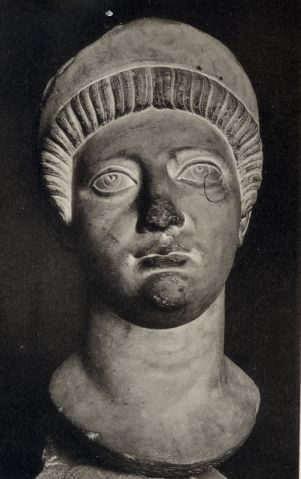
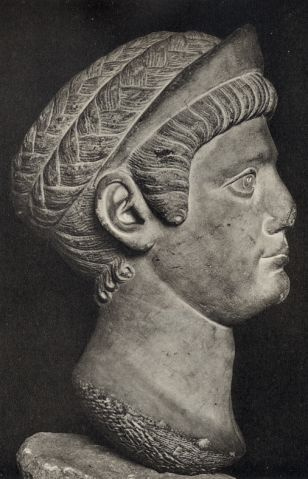
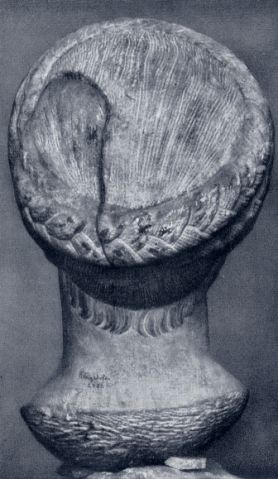
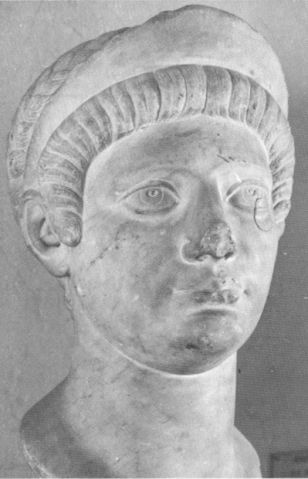
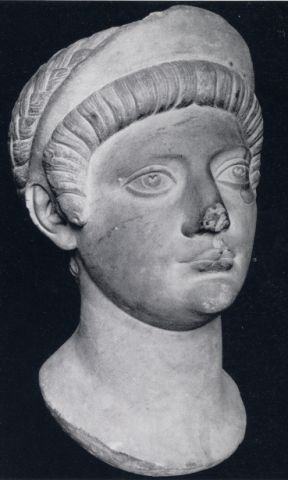
Portrait head of woman wearing stephane. Argentoratum. Second quarter of second or fourth century?
Record details
Photographs
Bibliography
- Delbrueck, R., Spätantike Kaiserporträts. Von Constantinus Magnus bis zum Ende des Westreichs , Leipzig 1933, 173-4, pl. 73, fig. 60 (after 350)
- Hart, J.-J., Sculptures antiques régionales : Strasbourg, Musée archéologique, Paris 1964, no. 10 (early second century)
Discussion
DESCRIPTION (Object)
Over life-size head, separately worked. H: 42, H (of face): 17, W: 19 cm. Fine-grained white marble.
The head is worked with the neck and small area of chest and shoulder. The tip of the nose is missing and there is damage under the left eyes.
The hair at the top of the head is rendered with engraved lines of varying widths, all made by flat chisels. The iris is also engraved. The pupils are heart-shaped
PROVENANCE
Found in 1867 in a necropolis at Königshofen which is immediately outside the modern city of Strasbourg and is the site of many Roman finds.
DESCRIPTION (Subject)
The head shows a woman with a full face, a stephane, and an ‘encircling braid’ hairstyle. The hair around the face is combed downwards and has a small central part. It has a sideburn in front of the ear. Above the smooth and undecorated stephane are two braids which wrap around the head. The hair at the top of the head is rendered in long straight strands. On the nape of the neck small locks escape the braids.
The face is oval and classically-structured. The brow is smooth; the eyes large; the mouth small and full-lipped. It has slightly upturned corners. The chin is small and its upper edge is defined by a groove beneath the lower lip.
DATE AND HONORAND
Delbrueck considered the head to date after AD 350 and hypothesized Constantia (Gratian’s first wife, daughter of Constantius II) as the potential honorand. Felletti-Maj identified it as Eusebia, the second wife of Constantius II.
The stephane is however unlike the jewelled royal diadems of the fourth century; and the hairstyle seems to have much in common with Hadrianic or early Antonine styles. Hart in 1964 in the Strasbourg museum catalogue placed it in the early second century, and Von Sydow in 1969 discussed it at length and assigned it an early Antonine date. In 1972, Calza supported Delbrueck’s date but thought that it probably represented a non-imperial subject. In 1983, it was included in a late-antique exhibition where it was considered however early Antonine. In 1985 L’Orange presented the entire argument under the heading Eusebia. Most recently, Schade omits the head from discussion, tacitly accepting the second-century dating.
The second-century dating seems likely to me also. The head, however, does have an inorganic treatment of the face and unusually linear handling of the hair. Thus, without first-hand inspection of the head and better knowledge of the find location, I do not entirely exclude the later possibility.
Discussion references
- Calza, R., Iconografia Romana Imperiale. Da Carausio a Giuliano (287-363 d. C.), Rome 1972, no. 230, pl.111.403-404 (4th c., private)
- L'Orange, H. P., Das spätantike Herrscherbild von Diokletian bis zu den Konstantin-Söhnen, 284-361 n. Chr. Das Römische Herrscherbild. III. Abteilung ; Bd. 4 , Berlin 1984, 157 (under Eusebia, summary of arguments)
- Stutzinger, D. (ed.), Spätantike und frühes Christentum. Ausstellung im Liebieghaus, Museum alter Plastik, Frankfurt am Main. 16. Dezember bis 11. März 1984, Frankfurt a.M. (1983), 445-6, no. 55 (early Antonine)
- Sydow, W. von, Zur Kunstgeschichte des spätantike Porträts im 4. Jahrhundert. n. Chr, Bonn 1969, 151-2 (early Antonine)
Cite: Last Statues of Antiquity, LSA-576 (J. Lenaghan).