
LSA-579
Lost base for statue of Bassus, local notable and benefactor. From Epidaurus (Achaea), sanctuary of Asclepius. Later fourth century
Record details
Photographs
Inscription
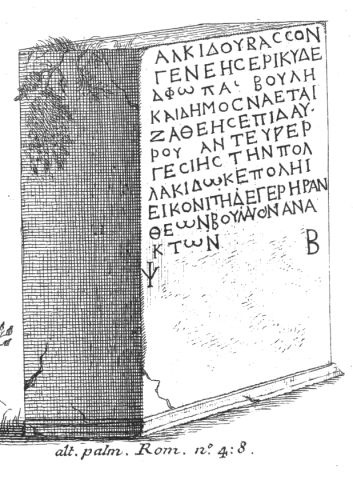
Ἀλκίδου Βάσσον / γενεῆς ἐρικυδέ/α φῶ[τ]α
βουλὴ / καὶ δῆμος, ναέται /(5) ζαθεὴς Ἐπιδαύ/ρου,
ἀντ’ εὐερ/γεσίης, τὴν πολ/λάκι δῶκε πόληϊ, /
εἰκόνι τῇδε γέρηραν, /(10) θεῶν βουλαῖσ̣[ι]ν ἀνά/κτων.
Ψ(ηφίσματι) β(ουλῆς).
Inscription translation
The council and the people, the inhabitants of the sacred Epidaurus honoured Bassus, he the very famous light of Alcidean descent, with this statue for the benefactions which he often gave to the city, by order of the divine emperors. By decree of the council.
Bibliography
- Inscriptiones Graecae, IV, 1475
- Paciaudi, P., Monumenta Peloponnesia, Roma 1761, Vol. II pp. 6-19
Discussion
INSCRIPTION
Verse inscription of two elegiac distichs, laid out in eleven lines, and a dedicatory formula, 12 lines in all:
Ἀλκίδου Βάσσον / γενεῆς ἐρικυδέ/α φῶ[τ]α
βουλὴ / καὶ δῆμος, ναέται /(5) ζαθεὴς Ἐπιδαύ/ρου,
ἀντ’ εὐερ/γεσίης, τὴν πολ/λάκι δῶκε πόληϊ, /
εἰκόνι τῇδε γέρηραν, /(10) θεῶν βουλαῖσ̣[ι]ν ἀνά/κτων.
Ψ(ηφίσματι) β(ουλῆς).
'The council and the people, the inhabitants of the sacred Epidaurus honoured Bassus, the very famous light of Alcidean descent, with this statue for the benefactions which he often gave to the city, by order of the divine emperors. By decree of the council’.
We reproduce the inscription in the reading proposed by Feissel 1984, 550. Inscriptiones Graecae (IG) has an alternative reading in line 4 of βουλαῖο̣ν̣, which would lead to a translation 'Bassus, ... the counseller of the divine emperors’.
DESCRIPTION (from the engraving by Paciaudi)
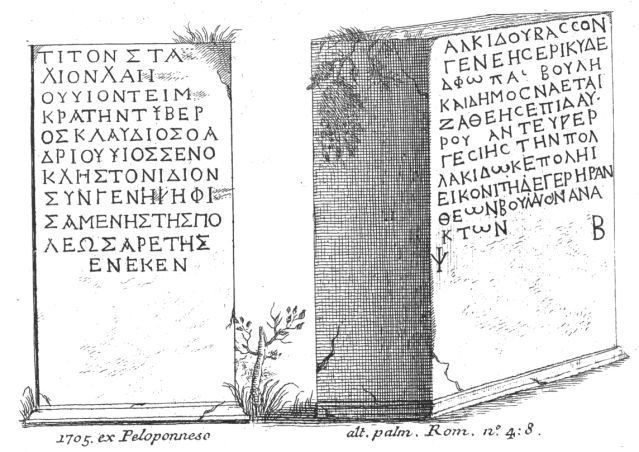
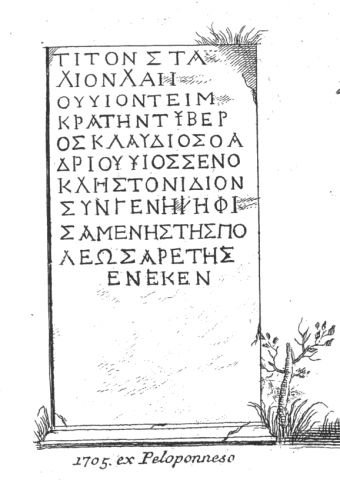
The only known record of this lost base's appearance is the engraving published by Paciaudi in 1761 and re-used by Driuzzo in 1815. The base is rectangular, with on its back side another inscription, from the 2nd century (IG IV, 1451 for Titus Statilius Timocrates). In Feissel's reading of the inscription, which we are following here, imperial permission is mentioned in the text, which suggests that Bassus was honoured with a bronze statue (Feissel 1984; Premerstein 1912). Paciaudi's drawing shows a flat top, with no trace of the imprints for a bronze statue, but is unlikely to have been bothered with such a detail.
PROVENANCE AND CURRENT LOCATION
The base comes from the sanctuary of Asclepius in Epidaurus but was brought to Venice, to the Museo Naniano, in 1705. This collection was dispersed in the early 19th century and the base has not been recorded since.
HONORAND AND DATE
The honorand is said to be 'of Alcidean descent'. This could simply mean that his father's name was Alceus, but may well be a claim to descent from the family of Hercules who was the grandson of Alceus, a mythological allusion that fits perfectly with the habits of late antique honorific verse-inscriptions. Bassus, moreover, is an old Greek name, and the honorand with all probability a local man (cf. IG IV, 1475). The absence of any allusion to his justice, or to other virtues characteristic of magistrates, makes it certain that the honorand was a private benefactor, not a state official.
Feissel 1984 was, as far as we are aware, the first scholar to attribute a fourth century date to this inscription. His arguments are conclusive: it belongs to a group of late-antique inscriptions with explicit reference to imperial permission to erect the statue (Feissel 1984; Premerstein 1912); the plurality of the 'divine emperors' refers to the imperial college of this period; in form and motifs the epigram belongs to the group of late-antique honorific epigrams studied by L. Robert (Robert 1948). We fully accept Feissel's proposed date in the fourth century, while the reference to imperial permission points to a date in the 2nd half of the century (Premerstein 1912).
Discussion references
- Driuzzo, F. , Collezione di tutte le antichità che si conservano nel Museo Naniano di Venezia, divisa per classi in due parti. aggiuntevi le classi di tutte le medaglie, Venezia 1815, no. 55 fig. 55
- Feissel, D. 'Notes d' Épigraphie chrétienne', Bulletin de Correspondance Hellénique 108, 545-579, Paris 1984, 545-58, esp. 550-1
- Premerstein, A. v., 'Griechisch-Römisches aus Arkadien', Jahreshefte des Österreichischen Archäologischen Instituts 15, 197 - 218, Wien 1912, 216-18
- Robert, L., Epigrammes du Bas-Empire (Hellenica IV), Paris 1948
Cite: Last Statues of Antiquity, LSA-579 (Ulrich Gehn).