
LSA-58
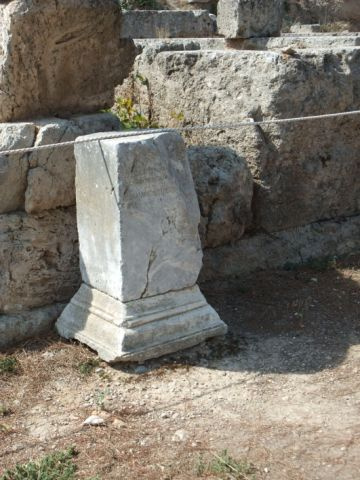
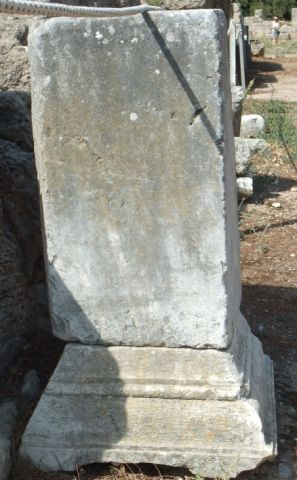
Base for statue of unknown governor, presumably of Achaea. Corinth (Achaea). Fourth century
Record details
Photographs
Inscription
[--------------]
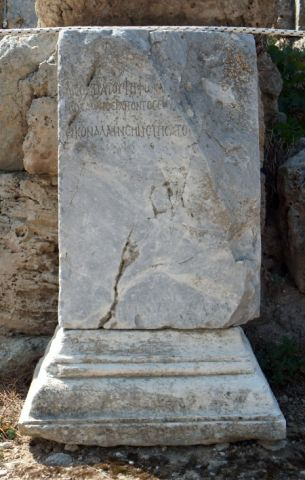
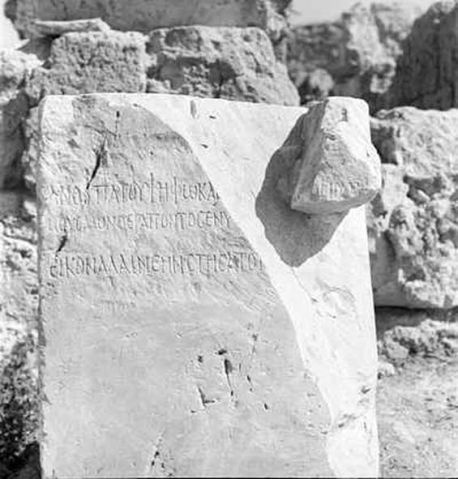
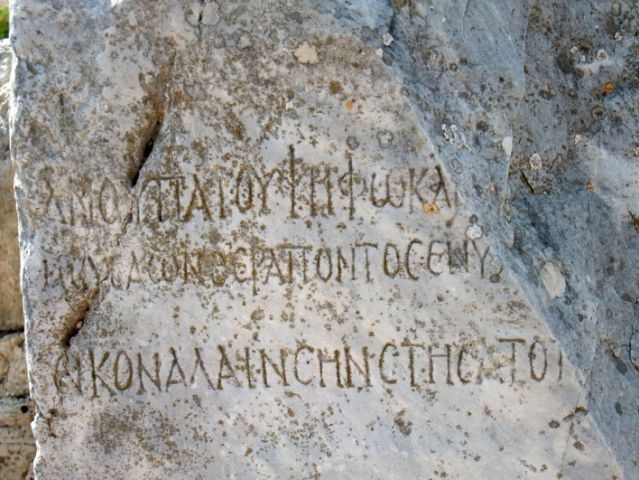
ἀνθυπάτου ψήφῳ καὶ [----]σιουν
Μουσάων θεράποντος ἐν Ὑμ[------]
εἰκόνα λαϊνέην στήσατο π[---]
Inscription translation
'... set up the marble statue of the governor (anthupatos), the companion of the Muses in Hy(...) ... by vote ... and...
Bibliography
- Kent, J. H., The inscriptions, 1926-1950: Corinth VIII, 3, Princeton 1966, no. 129
Discussion
INSCRIPTION
In four lines:
[--------------]
ἀνθυπάτου ψήφῳ καὶ [----]σιουν
Μουσάων θεράποντος ἐν Ὑμ[------]
εἰκόνα λαϊνέην στήσατο π̣[---]
' ... set up the marble statue of the governor (anthupatos), the companion of the Muses in Hy(...) ... by vote ... and... '
Letter height 2-2.5 cm.
The epigram celebrates in at least two elegiac distichs a governor of Achaea for his intimacy with the Muses, and refers to the marble statue he was awarded.
Kent 1950 (the authoritative publication) published the inscription with extensions and a different translation. He believed that ἀνθυπάτου (in line 2) and Μουσαῶν θεράποντος (in line 3) referred to two different persons, and argued that this was a 2nd-century honorific inscription set up to Herodes Atticus (styled Μουσαῶν θεράποντος ἐν Ὑμ[ηττῳ μελιηδεῖ ), with the consent of the governor:
[---] / ἀνθυπάτου, θήφῳ καὶ ---σιουν / Μουσαῶν θεράποντος ἐν Ὑμ[ηττῳ μελιηδεῖ] / εἰκόνα λαϊνέην στήσατο π[ρὸς τεμένι] - '[The Council (?) ---] with the consent of the governor and [---]set up in front of [the sanctuary] a marble statue of the servant of the Muses on [honeyed] Hym[ettus]'.
We give only the legible text and do not find Kent's extensions convincing. Alternative readings are possible: in line 3, Ὑμ[ηττῷ] ('on Hymettus'), could, for instance, be ὕμ[νοις] ('in hymns'), as proposed by Robert 1966, 742; and in line 4, π[ρὸς τεμένι] ('by the sanctuary'), could be π[ᾶσα πόλις] ('the whole city'). In its verse form, with the motif of intimacy with the Muses, and with its explicit reference to a statue in marble, the inscription displays key elements of honorific inscriptions to late-antique governors as studied by Robert 1948 (on the Muses, Robert 1948, 29-34; for reference to the material of the statue in these inscriptions cf. Bauer 2003, 88).
DESCRIPTION
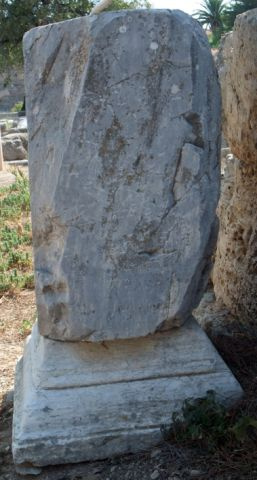
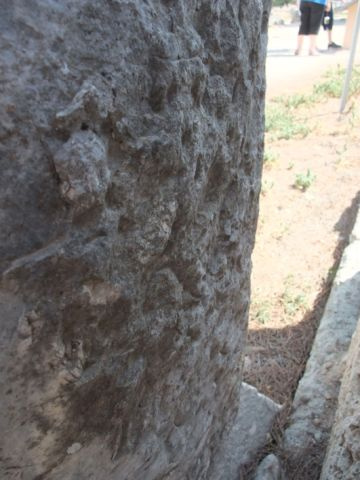
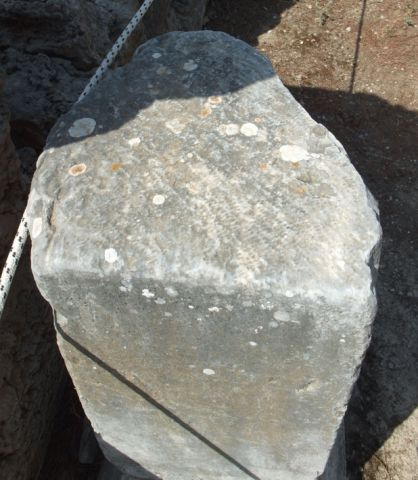
Rectangular block of grey-blue marble set on an upside-down pillar capital of white marble (we are uncertain whether these two elements originally went together): H 70, W 48, D 39 cm. The front, left and right sides of the block are smoothly finished, its top finished with a claw, and its back roughly finished with a point. The inscription is carved directly into the front surface and extends across the whole base. The top right corner is broken and lost, and there is also damage to the right side. A conjoining fragment of the missing top-right corner (with part of the inscription, '---σιουν' in line 2) was stolen in 1999 (http://ascsa.net/id/corinth/object/i%201752). The top of the front face is badly chipped, destroying the first line of the inscription.
PROVENANCE/ LOCATION
The base was found in 1936 in the central area of the South Stoa of the Agora. Today it is standing in that same area, in front of the inner wall of the Stoa at the west end of the Bouleuterion.
HONORAND AND DATE
The verse form and motifs identify the base as a late-antique honorific monument. Of the honorand nothing more is known than that he was a governor (proconsul, anthupatos) of Achaea. The terminus post quem is therefore the re-elevation of the province to proconsular rank in 324 (Groag 1946).
FURTHER DISCUSSION
Kent 1966 speculated that this inscription was the late-antique copy of a dedication to Herodes Atticus, and was followed in this by Rizakis 2001. There is absolutely no reason for this assumption, cf. Robert 1966. The dedication is to a proconsul (anthupatos) of Achaea, a role that Herodes Atticus never held.
ACKNOWLEDGEMENTS
We are very grateful to Denis Feissel for discussing this inscription with us.
Discussion references
- Bauer, F. A., Virtuelle Statuensammlungen, Statuen in der Spätantike, ed. F. A. Bauer & C. Witschel, Wiesbaden 2007
- Groag, E., Die Reichsbeamten von Achaia in spätrömischer Zeit, Budapest 1946, 22
- Rizakis, A. D., Roman Peloponnese 1. Roman personal names in their social context (Achaia, Arcadia, Argolis, Korinthia and Eleia), Athens and Paris 2001, 290-1 no. 174.3
- Robert, L., Epigrammes du Bas-Empire (Hellenica IV), Paris 1948
- Robert, L., Inscriptions de l'Antiquité et du Bas-Empire a Corinthe, Revue des Études grecques 79, 1966, 733-770, 742-3
Cite: Last Statues of Antiquity, LSA-58 (Ulrich Gehn).