
LSA-580
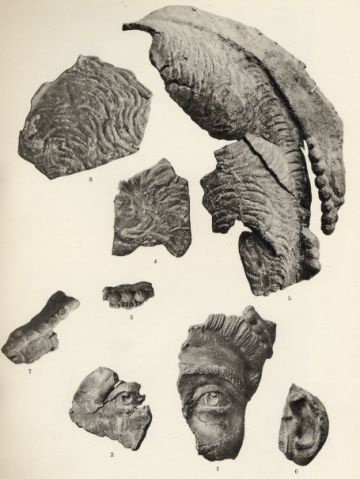
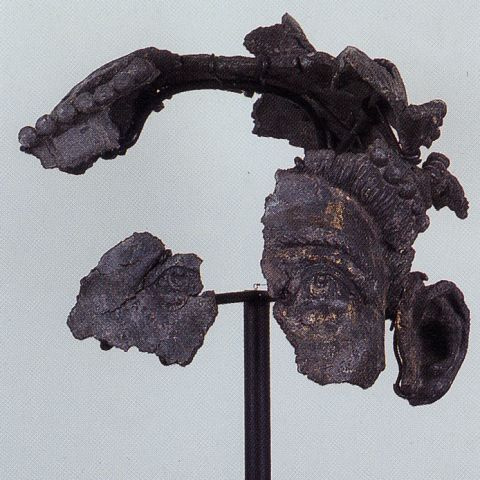
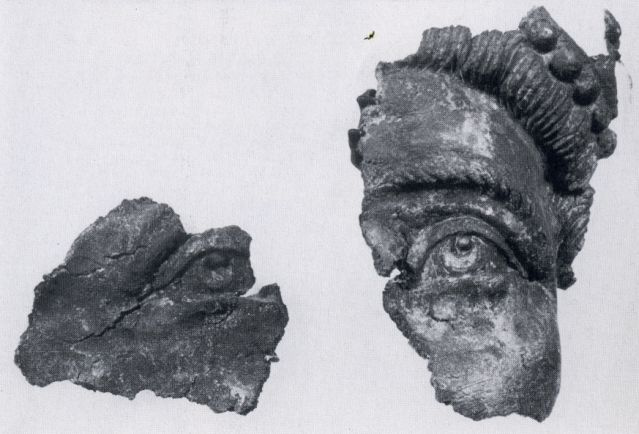
Bronze portrait head of Valens (or Valentinian). From Rome. 366-367.
Record details
Photographs
Bibliography
- Delbrueck, R., Spätantike Kaiserporträts. Von Constantinus Magnus bis zum Ende des Westreichs , Leipzig 1933, 182-3, pl. 80
- Giuliano, A. (ed.), Museo Nazionale Romano. Le Sculture I,9. Magazzini. I Ritratti. Parte II, Rome 1988, 416-420, no. R319
Discussion
DESCRIPTION (Object)
Eight fragments of an over life-size head. H: 22.5 m. Gilded bronze
The eight fragments belong to the upper part of an over life-size head. They preserve an area of the upper cranium, the diadem, the right eye, and an area of the left side that includes hair, the brow, eye, and ear.
The head was cast in one piece, following the principal of the lost wax technique. The wax model however went through various stages and techniques; see E. Formigli, in A. Giuliano (ed.) Museo Nazionale Romano. Le sculture.
PROVENANCE
Found on the banks of the Tiber near the Ponte Sisto in 1878.
DESCRIPTION (Subject)
The head wears a diadem which has an upper and lower pearl-edged border. The fringe arches across the brow in full short locks. The brow is unmarked. The eyes have a high-arching upper lid which is surmounted by a broad blank (but modelled) space and then the eyebrow.
The individual locks of hair and eyebrows are rendered by engraved lines as is the outer, almost circular demarcation of the iris. The pupil has been scooped out and has a crescent shape.
IDENTIFICATION
The diadem identifies the portrait as an Emperor. The hairstyle belongs to the mid-fourth to early fifth century. This particular portrait has been associated with the Conservatori-Copenhagen-Uffizi type (see LSA-597, LSA-578, andLSA-582).
Most importantly, the head was found with an inscription on a base for Valens (LSA-1820) set by the Senate and People of Rome in thanks for the bridge of Valentinian, Valens' brother. The inscription dates to before 367 when Gratian also held the title of Emperor and after 365 when the overseer, L. Aurelius Avianius Symmachus signo Phosphorius was prefect of the City. In addition, a gilded bronze togate statue (LSA-1072), fragments of a Victory (LSA-2586), two bases for Victories (LSA-2584,LSA-2585),and several ex-votos (CIL VI 31405-31408) were also found.
CONTEXT
See discussion under LSA-1820.
Discussion references
- Dehn, G. 'Die Bronzefunde bei Ponte Sisto', Mitteilungen des Deutschen Archäologischen Instituts, Römische Abteilung 26, Rome 1911, 238-46, pls. 12-13
- Di Mino, M.R. and M. Bertinetti, Archeologia a Roma. La materia e la tecnica nell'arte antica, Rome 1990, 109, no. 96
- Ensoli, S. and E. La Rocca (eds.), Aurea Roma: dalla città pagana alla città cristiana, Roma 2000, 461, no. 62
- Stichel, R. H. W., Die römische Kaiserstatue am Ende der Antike, Roma 1982, 41, pl. 1
Cite: Last Statues of Antiquity, LSA-580 (J. Lenaghan).