
LSA-581
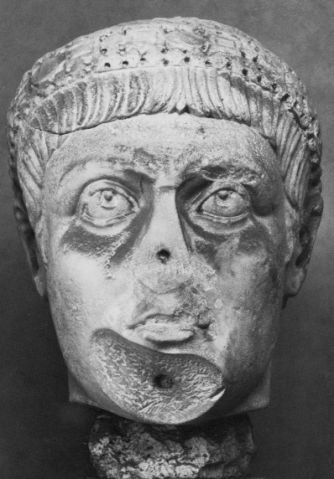
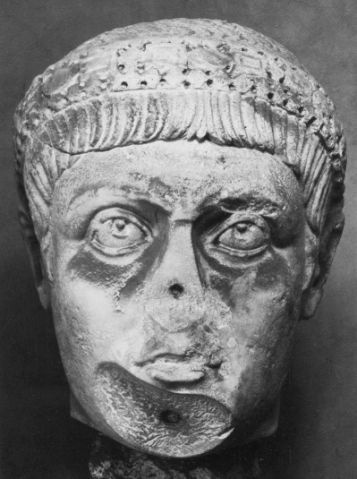
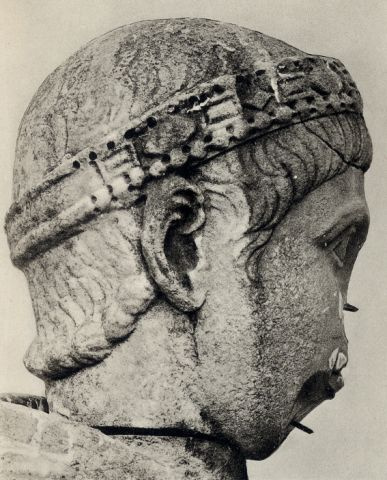
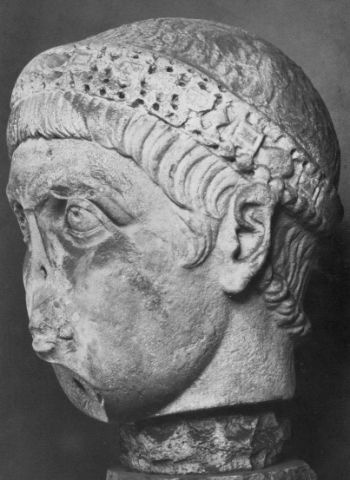
Portrait head of emperor. Rome. Mid to later fourth century.
Record details
Photographs
Bibliography
- Delbrueck, R., Spätantike Kaiserporträts. Von Constantinus Magnus bis zum Ende des Westreichs , Leipzig 1933, 183, pl. 81 (Valens)
- Heintze, H. von. 'Der spätantike Kaiserkopf in Tivoli, Villa d’Este', Mitteilungen des Deutschen Archäologischen Instituts. Römische Abteilung 91, Rome 1984, 399-415, pls. 126-33
Discussion
DESCRIPTION (Object)
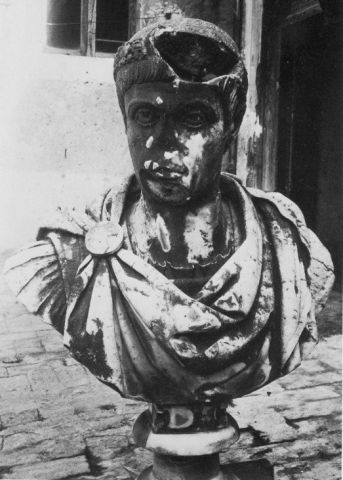
Over life-size head on modern bust. H (head): 35, H (chin to hairline): 23.5, H (bust) 71 cm. White fine-grained marble.
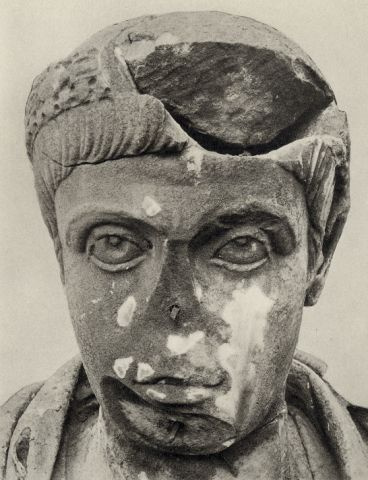
The head was removed from its bust in 1960 (and a plaster cast was made to replace it on display above the fountain). The nose and the chin were once restored, but the restorations, which were attached by metal pins, have been removed. A large section of the middle and left side of the brow was broken and missing. It has been repaired in the 20th c. in plaster. There is damage on the upper lip, on the lids of the eyes, and on the left eyebrow. The left ear is chipped.
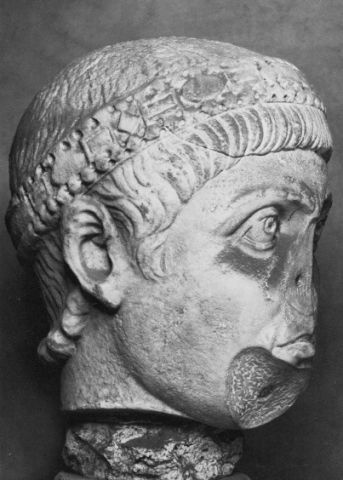
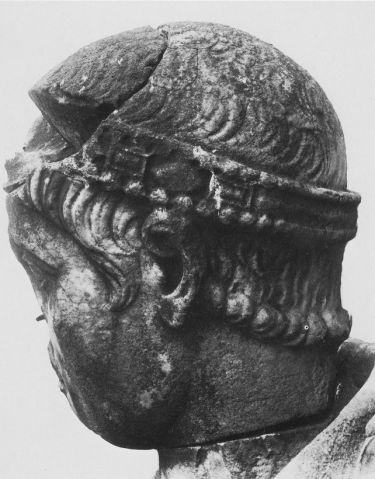
The head probably originally belonged on a statue of c. 2.60 m and was not meant to be seen from the back; the back of the diadem is not fully articulated. The individual locks of hair and eyebrows are rendered by engraved lines. The iris has been scooped out in a large crescent shape. The pupil is the raised circular area within it. There is drill work between the gems of the crown. Below both eyes is a depression which seems to correspond to a band of large flat chisel. This, designed to give the eyes greater emphasis, is possibly evidence that the head has been re-worked from an earlier head.
PROVENANCE
The head can be traced to the collection of Ippolito d’Este in Rome where it was once in his Villa of Monte Cavallo on the Quirinal. It was probably therefore found in Rome. It was brought to Tivoli almost certainly between 1568 and 1572 where it was displayed above a fountain that was finished in 1569. It is first securely attested in Tivoli in 1611.
DESCRIPTION (Subject)
The head shows an emperor with a youthful face, combed-forward hair, and a diadem. The diadem has an upper and lower pearl-edged border. Between the pearl borders the main area features alternating rectangular, vertical diamond, and oval shapes which represented a variety of gems. Over the proper left eyes much of these are however restoration. At the back of the head, only the pearl edges of the diadem are represented; the area between them is smooth.
The fringe crosses the brow evenly with a small part over the centre. In front of each ear is a sideburn that curls forward. At the back of the head, the locks terminate in a regular curl which has greater volume than the hair above it.
The face lacks any marked signs of age. The brow has one horizontal crease under which the lower half swells. The cheeks are full and round. The mouth is short from side to side with thick lips. The eyes are the most prominent element of the physiognomy. They are deep-set and large. Both the upper and lower lids follow arching paths. The upper lids overlap the lower lids at the outer corners.
IDENTIFICATION
The diadem identifies the portrait as an Emperor. The face shows that he is a young man. The hairstyle and diadem make a date between the mid-fourth and late-fourth century possible. Thus, scholars have identified him as Valens (Delbrueck), most often as Gratian (L’Orange, Wrede, Fittschen), and as Valentinian II (von Heintze who wished to associate the head with a statue group of Valentinian II and Arcadius erected in the Roman Forum by C. Rufus Albinus = LSA-1356, LSA-1357, LSA-1374). The curls in front of the ear and nape would seem to make the earlier dates preferable.
The portrait justifiably is associated by scholars with the Conservatori-Copenhagen-Uffizi type (see LSA-597, LSA-578, andLSA-582) which is universally accepted to represent Valentinian or Valens The Tivoli head is technically similar and wears a similar hairstyle and diadem. The fragmentary bronze head from the Ponte Sisto that certainly represents Valens or Valentinian (LSA-582) is also similar.
Discussion references
- Fittschen, K. and P. Zanker, Katalog der Porträts in den Capitolischen Museen und den anderen kommunalen Sammlungen der Stadt Rom, Band I, Mainz 1985, (2)1994, 159 (Gratian)
- L'Orange, H. P., Studien zur Geschichte des spätantiken Porträts, Oslo 1933, 75, 142, no. 100, figs. 190-191 (Gratian)
- Stichel, R. H. W., Die römische Kaiserstatue am Ende der Antike, Roma 1982, 42-3, pl. 5 (associates with Valens and Valentinian)
- Wrede, H., Die spätantike Hermengalerie von Welschbillig : Untersuchung zur Kunsttradition im 4. Jahrhundert n. Chr. und zur allgemeinen Bedeutung des antiken Hermenmals , Berlin 1972, 92, 94 (Gratian)
Cite: Last Statues of Antiquity, LSA-581 (J. Lenaghan).