
LSA-583
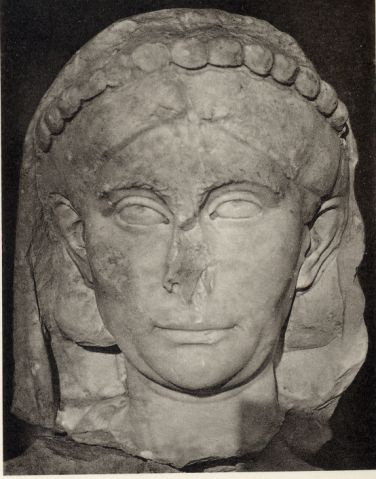
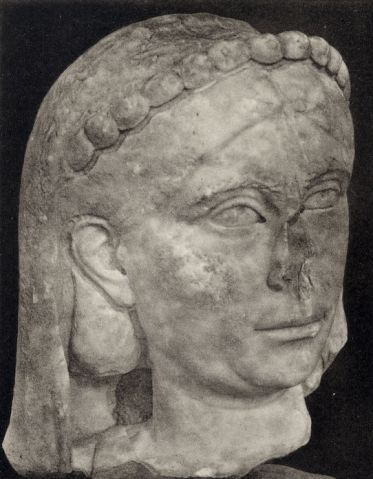
Veiled portrait head of woman wearing a diadem (?) Thamugadi (Numidia). Fourth century?
Record details
Photographs
Bibliography
- Ballu, A. and R.L. Cagnat, Musée de Timgad, Paris 1903, 17-18, pl. 4.5 (Severan)
- Delbrueck, R., Spätantike Kaiserporträts. Von Constantinus Magnus bis zum Ende des Westreichs , Leipzig 1933, 192-3, pl. 89 (c. 370)
Discussion
DESCRIPTION (Object)
Over life-size head. H: 32 cm. Marble.
The head is broken around the base of the neck and through the veil. Some of the right shoulder is preserved. The nose and drapery folds on the right side of the head are broken.
The hair beneath the head band has volume but its surface has not been articulated. In contrast the hair of the eyebrows has been marked with heavy parallel diagonal lines made with a flat chisel. Both the lower border of the head band and the right ear are separated from the contiguous unarticulated hair surface by drill channels. A drill channel also marks the central part. Behind the head band there seems to be little representational detail and only a vague sense of the edge of the drapery. The irises are not indicated, and the pupils are drilled. The inner canthi also feature drill holes.
PROVENANCE
Thamugadi.
DESCRIPTION (Subject)
The head shows a woman wearing an inner (visible at the right shoulder) and outer (visible over the head) garment. The inner garment seems to be sleeveless and have a strap. The outer garment covers the back of the head. The portrait also wears a hair band consisting of round objects, possibly stones.
The hair is parted in the centre and then pulled back around both ears. Behind the ears, it hangs in broad sections which were pulled upwards.
The face has a distinctive physiognomy. The eyebrows are rope-like and continue down the root of the nose. The eyes are close-set and long with heavily marked inner canthi. The mouth is broad and slightly smiling. The chin projects in front of loose hanging skin (a double chin). The neck has vertical creases (Venus lines).
DATE AND HONORAND
Delbrueck identified this portrait has an empress of the period of Valentinian. Von Sydow supported this dating and compared especially the mouth area to the Conservatori-Copenhagen-Uffizi type emperor usually identified as Valentinian (see LSA-582). Von Heintze placed it earlier in the fourth century, and Schade considered it third century.
The shape outline of the hairstyle (centrally parted and tucked behind the ears) is similar to the low bun styles of the late Severan woman (see the portraits of Julia Mammaea). It however continues even in fourth-century hairstyles which have ‘crown’ or encircling braids (see for example LSA-256 LSA-395, LSA-574). The head band also leaves itself open to interpretation; it might relate to a high-imperial priesthood or it might be an imperial pearl-diadem. Interestingly, J. Rumscheid, Kranz und Krone : zu Insignien, Siegespreisen und Ehrenzeichen der römischen Kaiserzeit (Tübingen 2000) does not discuss this head and presents no similar crowns. The re-cut head for an imperial woman of Late Antiquity, LSA-1597, however, has a series of cuttings for a series of inset stones which might once have looked like this. The lack of surface detail in the hair of the Thamugadi head, the emphatic eyebrows, and the punctuated inner canthi equally suggest a re-working. Thus, though I do not exclude the possibility of a third-century date, I favour one in the fourth century after the introduction of the jewelled diadem by Constantine.
It is interesting to note that a statue of Concordia LSA-2272 was set up in the period of Valentinian and Valens was set up in a sacellum devoted to the imperial cult.
Discussion references
- Schade, K., Frauen in der Spä̈tantike: Status und Repräsentation , Mainz 2004, 89, pl. 7.1 (third century)
- Sydow, W. von, Zur Kunstgeschichte des spätantike Porträts im 4. Jahrhundert. n. Chr, Bonn 1969, 74, 78 (Valentinian period)
- von Heintze, H. ‘Ein spätantikes Mädchenportät in Bonn. Zur stilitischen Entwicklung des Frauenbildnisses im 4. und 5. Jahrhundert’, Jahrbuch für Antike und Christentum 14, Münster 1971, 65, no. II 8 (first third of fourth century)
Cite: Last Statues of Antiquity, LSA-583 (J. Lenaghan).