
LSA-590
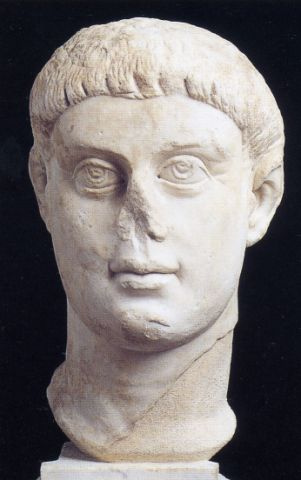
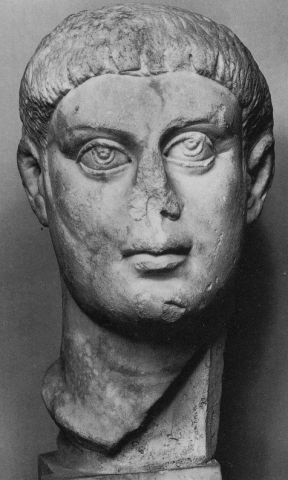
Twice (?) re-worked portrait head of prince (?) From Rome. Late third to early fourth century.
Record details
Photographs
Bibliography
- Delbrueck, R., Spätantike Kaiserporträts. Von Constantinus Magnus bis zum Ende des Westreichs , Leipzig 1933
- Fittschen, K. and P. Zanker, Katalog der Porträts in den Capitolischen Museen und den anderen kommunalen Sammlungen der Stadt Rom, Band I, Mainz 1985, 143-4, no. 119, pl. 148
Discussion
DESCRIPTION (Object)
Over life-size head, worked separately. H: 35 cm. H (chin to crown): 26 cm. Marble.
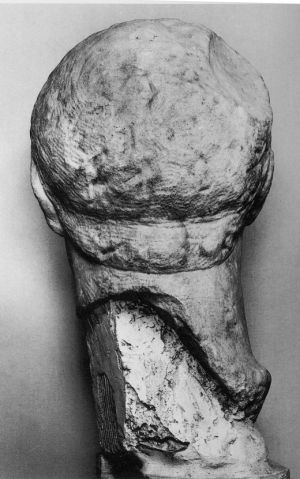
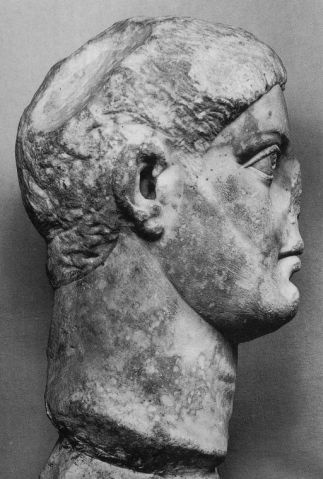
The head was worked separately from its body. The left side of the neck and most of the nose are missing. On the back right side of the head, is a scooped-out area. It may represent an area of marble flaw that was removed during manufacture or a repair made when the portrait head was re-worked. It probably was filled with stucco. Parisi Presicce suggests that the head might actually have been part of an important high relief.
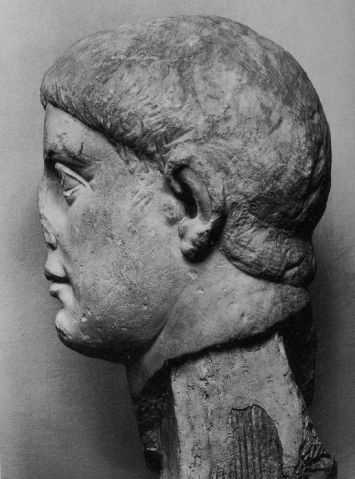
The head has been used possibly three times. The neck is too thick for the present portrait. The hair of the original head has been mainly removed to create the round shape of the back and top of the head. The current surface has been worked over with a claw chisel. Traces of the original locks remain at the top of the head and above and behind the right ear. The rims of the ears have been trimmed. The hair over the brow has also been cut back to an even line which comes forward slightly at the centre. The seven schematic slashes of the drill in this hair over the brow have been interpreted by Zanker as evidence for a third use. They might, however, relate to deep drill channels in the original portrait.
The eyebrows have been undercut, and the eyes emphatically marked. Each eye has two concentric engraved half-circles. The outer of these does not touch the lower lid, and within the inner of these is a slash of a drill or chisel to indicate the pupil. The inner corners have been given drill points. Technically these eyes resemble those of LSA-381 (which should date to the earlier fourth century).
A beard has been removed (for Zanker, part of third use). This explains the raised surface on the right side of the cheek, the presence of sideburns, the odd area immediately in front of the left ear which seems to be a curl, the heavy rasp finish on the face around the jawline, and even the lack of a defining upper border of the upper lip. The corners of the mouth have also been engraved in a non-original use.
PROVENANCE
Previously in the Antiquario Communale of Rome which is located on the Caelian. Presumably the head was found in Rome.
DESCRIPTION (Subject)
The head represents a clean-shaven young man who turns to the right. It has been re-cut awkwardly.
The face is full. The brow is unmarked and flat. The eyes are large and close-set with crow's feet wrinkles at the outer corners. The nose is short and seems to have been hooked. The small mouth has emphasized creases at the outer corner and a full lower lip. The chin is small and round.
The hair is a uniform mass which comes slightly forward at the centre of the brow and which indents at the juncture of the skull and neck. Engraved strands all come forward. Over the brow, seven parallel drill channels divide the uniform mass.
DATE AND IDENTIFICATION
The fashion details of the head, straight combed forward hair, no beard, and small sideburns, seem most likely to belong in the early fourth century: see, for example, the portraits of Constantine and a son LSA-555 and LSA-559. Stylistically, the head has the cubic aspect and the manner of the rendering of the re-cut hair of the tetrarchic period; see, for example, the portrait type usually ascribed to Maxentius, LSA-896 and LSA-897. The form of the eyes appears on both tetrarchic period and Constantinian works; see, for example, LSA-1043 and LSA-381.
Zanker places one re-use of the head assuredly in the tetrarchic period. He postulates, however, a possible third re-use to explain the removal of the beard as well as for the appearance of drill work in the brow hair (the drill is ohterwised used only in the corners of the eyes). Because of the clean-shaven face and the full oval face, he imagines that the third re-use was probably Constantinian. This would accord well with the need for large, short, parallel locks across the brow. Thus, he concludes tentatively that perhaps an imperial tetrarchic period portrait was changed to a Constantinian prince. He neglects to mention in support of his argument the added up-turned corners of the mouth which also appear on the portraits of the sons of Constantine (see LSA-559<k).
Discussion references
- Delbrueck, R., Spätantike Kaiserporträts. Von Constantinus Magnus bis zum Ende des Westreichs , Leipzig 1933, 210-11, pl. 109-10 (Constantius III)
- Donati, A. and G. Gentili, Costantino il Grande. La civiltà antica al bivio tra Occidente e Oriente, Milan 2005, 290, no. 134 (C. Parisi Presicce: from relief?)
- Ensoli, S. and E. La Rocca (eds.), Aurea Roma: dalla città pagana alla città cristiana, Roma 2000, 544, no. 192
Cite: Last Statues of Antiquity, LSA-590 (J. Lenaghan).