
LSA-592
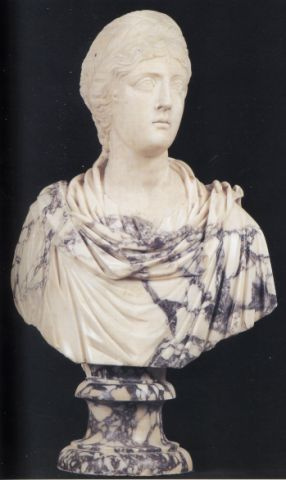
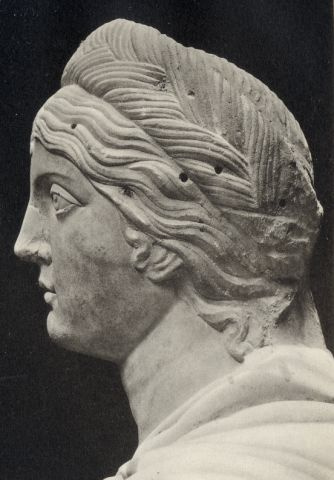
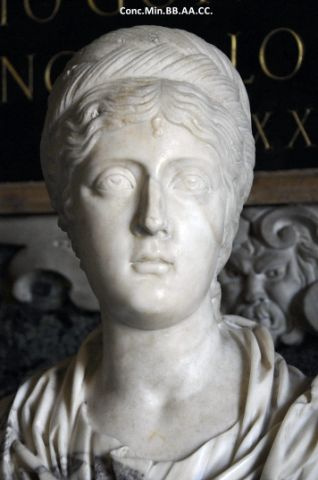
Portrait bust of woman in Phrygian marble and with holes for headgear. From Rome or its environs. Late fourth century
Record details
Photographs
Bibliography
- Delbrueck, R., Spätantike Kaiserporträts. Von Constantinus Magnus bis zum Ende des Westreichs , Leipzig 1933, 234-6, pls. 124-6, fig. 78
- Fittschen, Klaus and P. Zanker, Katalog der Porträts in den Capitolischen Museen und den anderen kommunalen Sammlungen der Stadt Rom, Band III , Mainz 1983, 118-19, no. 180, pls. 209-10 (c. 400)
Discussion
DESCRIPTION (Object)
Over life-size bust. H: 65cm. Head: 25 cm. Head: White marble, Bust: Phrygian purple and white marble (Pavanozetto).
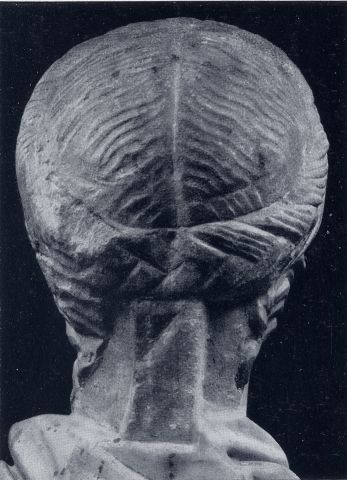
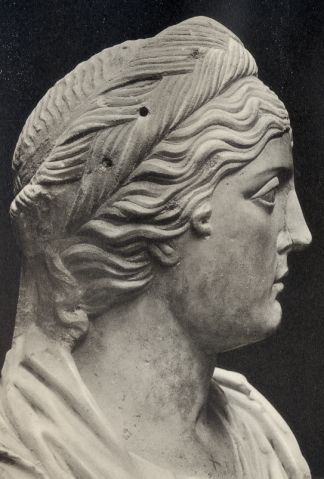
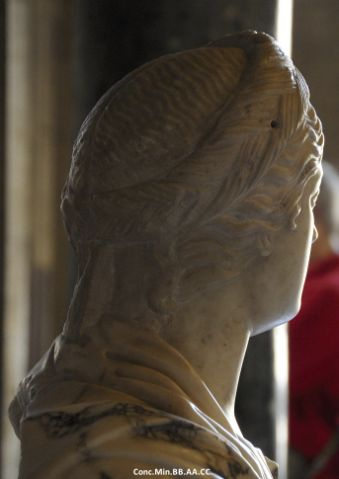
According to Bergmann, the head is worked separately from the bust. According to Fittschen and Zanker, the head and bust are made of one piece of marble. The bust and foot area are worked from separate pieces of marble. The entire ensemble was probably put together in Late Antiquity. The nose is broken. There is a vertical band of unworked stone at the back of the neck. There are holes (c. 10) for the insertion of some additional head gear in the hair over the brow.
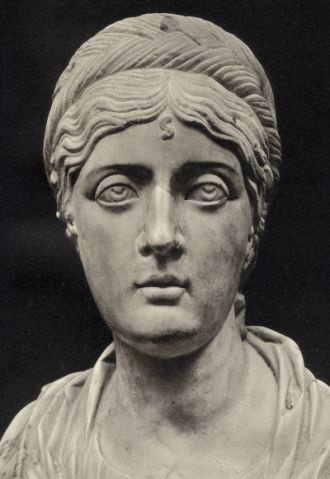
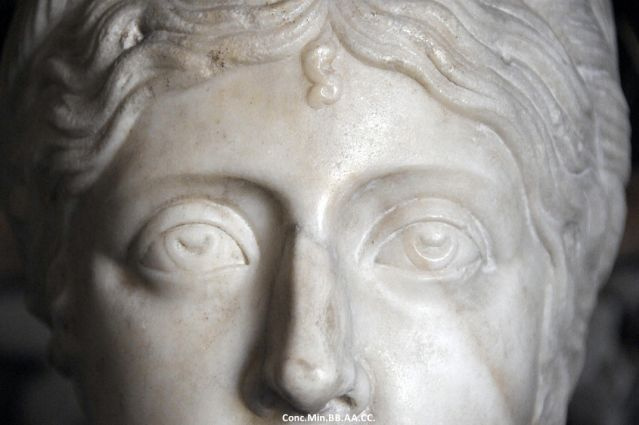
The irises are finely engraved and are three-quarter circles. The pupils are set low within the iris and are carefully-shaped crescents. The hair is rendered with flat chisel work. According to Bergmann the bust has been worked over in Late Antiquity.
PROVENANCE
Formerly in the Villa Albani collection. Presumably from Rome or the area around it.
DESCRIPTION (Subject)
The beautifully coloured and carved bust is over life-size and shows a woman with an encircling braid hairstyle who looks to her left. She wears a heavy outer garment (himation) which is draped over the left side of her body and pulled across her body. Its upper edge hangs in a series or roll of thick folds. Beneath this roll is an inner garment which hangs loosely around the neck.
The hair is parted in the centre and pulled back in long wavy strands which cover all but the lobes of the ears. The hair is collected in two braids which are wrapped around the head and form a tall stephane of hair. A single small S-shaped lock hangs below the central part and marks the centre of the brow.
The face is smooth oval that remains unbroken by the chin and is marred by no creases or folds. The brow is smooth; the eyes are large and elegantly-shaped with finely pointed inner corners; the mouth is small with slightly open bow-shaped lips.
DATE
The handling of the eyes (crescent-shaped pupils and raised irises) and the hairstyle of encircling braids place the head in the fourth century. All scholars have place it in the Theodosian period. Bergmann believes that the folds of the drapery also show stylistic similarities to Theodosian works.
HONORAND
The portrait had some additional head gear. In addition, the portrait seems to follow the same model as that used for a portrait statue in the Pamphili collection (LSA-2122). This is a little discussed detail. Calza, who notes it, suggests that the two might both have represented a Theodosian empress.
Discussion references
- Calza, R. et al. (eds.), Antichità di Villa Doria Pamphilj, Rome 1977, 306-307 (Theodosian)
- Ensoli, S. and E. La Rocca (eds.), Aurea Roma: dalla città pagana alla città cristiana, Roma 2000, 576-7, no. 260 (M. Bergmann: 370-400)
- von Heintze, H. ‘Ein spätantikes Mädchenportät in Bonn. Zur stilitischen Entwicklung des Frauenbildnisses im 4. und 5. Jahrhundert’, Jahrbuch für Antike und Christentum 14, Münster 1971, 83, no. VI 1 (late fourth to fifth century)
Cite: Last Statues of Antiquity, LSA-592 (J. Lenaghan).