
LSA-595
Base for statue of Phosphorius, governor of Achaea. Argos (Achaea). Mid to late fourth century
Record details
Photographs
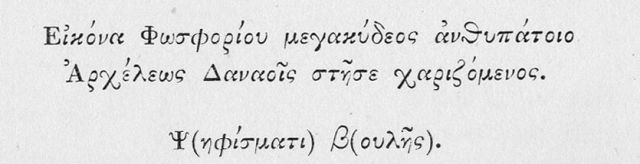
Inscription
Εἰκόνα Φωσφορίου μεγακύδεος ἀνθυπάτοιο
Ἀρχέλεως Δαναοῖς στῆσε χαριζόμενος.
Ψ(ηφίσματι) Β(ουλῆς).
Inscription translation
Archelaus set up this statue of Phosphorius, the much renowned governor (proconsul), giving it cheerfully to the Danaens (= people of Argos). By decree of the council.
Bibliography
- Inscriptiones Graecae, IV 1608
- Feissel, D. & Philippidis-Braat, A., Inventaires en vue d’un recueil des inscriptions historiques de Byzance, 3. Inscriptions du Péloponnèse, (à l’exception de Mistra)., Travaux et mémoires, 9, Paris 1985, 267-395, no. 27
Discussion
INSCRIPTION
Verse inscription in one elegiac distich, followed by a dedicatory formula:
Εἰκόνα Φωσφορίου μεγακύδεος ἀνθυπάτοιο
Ἀρχέλεως Δαναοῖς στῆσε χαριζόμενος.
Ψ(ηφίσματι) Β(ουλῆς).
'Archelaus set up this statue of Phosphorius, the much renowned governor (proconsul), giving it cheerfully to the Danaens (= people of Argos). By decree of the council'.
DESCRIPTION (from the published records)
No published photo of this base exists. According to IG IV, the inscription is on a plaque (tabula), a description followed by Rizakis 2001. Reinach 1900, on the contrary, calls it a marble base ('une base de marbre'), but with no indication that he had seen it.
PROVENANCE AND CURRENT LOCATION
The monument was found in 1900 in a modern house in the forum area of Argos (Vollgraff 1945, 5). It is not in situ, and there is no published record of its present location.
HONORAND, AWARDER AND DATE
The name of the honorand reappears on a statue base from Megara (now in Aegina), where his justice and his care for the fortification of the city are praised (LSA-57). Although the proconsular title is not given in that inscription from Megara, it clearly identifies him as a governor (cf. Robert 1948), and therefore almost certainly the same Phosphorius as the man commemorated here at Argos (PLRE I, 700 Phosphorius 2).
The identity of the honorand requires some discussion. That he was to be identified with Aurelius Valerius Tullianus Symmachus, in whose family the signum Phosphorius occurs (PLRE I, 871 Aurelius Valerius Tullianus Symmachus 6), consul in 330 and governor (proconsul) af Achaea in 319, was first proposed by Reinach in 1900, supported by Premerstein 1913, rejected by Groag 1946, then again supported by Polara 1974, again rejected by Feissel 1985, again adopted by Frantz 1988 and by IG IV, 2 in 2002. Without being able to give a full critical account of the discussion here, we would like to point out that none of the arguments so far have taken into account the first-use inscription of the base from Megara (LSA-56 (first use), LSA-57 (second use)). The honorand of the first-use inscription of that base, Plutarchus (LSA-56) was proconsul after 326, with a terminus ante quem around 360 and a high probability for a date in the 2nd quarter of the 4th century. This excludes Aurelius Valerius Tullianus Symmachus as candidate for the second use of that base.
Groag (1946) proposed a date between 379 and 382 for the proconsulship of our Phosphorius, followed by Feissel 1985, while PLRE I favoured a more generic later 4th-century date. The date of the first use of the base in Megara (AD 326/60) lends new support to a later 4th-century date.
A late 4th-century date is supported by the person of the awarder. Archelaus is widely assumed to be the same Archelaus as introduced into Athens the taurobolium (a cult practice in the worship of the Magna Mater) in the middle of the 4th century (IG II/III 4841; on the introduction of the taurobolium, Frantz 1988, 19; on the family of Archelaus idem, 50-1). He held priestly functions in Lerna and in Eleusis (cf. LSA-424). Unsurprisingly Archelaus, a man strongly involved in mystery religions, features here as the dedicator of a statue to a proconsul whose name likewise indicates participation in mystery cults (Phosphorius is a rank in the mysteries of Mithras, Wytzes 1977).
Discussion references
- Frantz, A., Late Antiquity A. D. 267 - 700: The Athenian Agora XXIV, Princeton 1988
- Groag, E., Die Reichsbeamten von Achaia in spätrömischer Zeit, Budapest 1946, 54-5
- Reinach, T., Un nouveau proconsul d'Achaie, Bulletin de Correspondance hellénique 24, 1900, 324-8
- Rizakis, A. D., Roman Peloponnese 1. Roman personal names in their social context (Achaia, Arcadia, Argolis, Korinthia and Eleia), Athens and Paris 2001, 217 nr. 204
- Robert, L., Epigrammes du Bas-Empire (Hellenica IV), Paris 1948, 23 with note 5
- Vollgraff, W., Argos dans la dépendance de Corinthe au IVe siècle, L'Antiquité Classique 14, 5-28, Bruxelles 1945, p. 5-6
- Wytzes, J., Der letzte Kampf des Heidentums um Rom, Leiden 1977, 122-4
Cite: Last Statues of Antiquity, LSA-595 (Ulrich Gehn).