
LSA-596
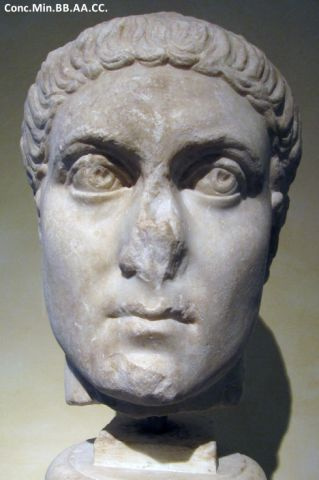
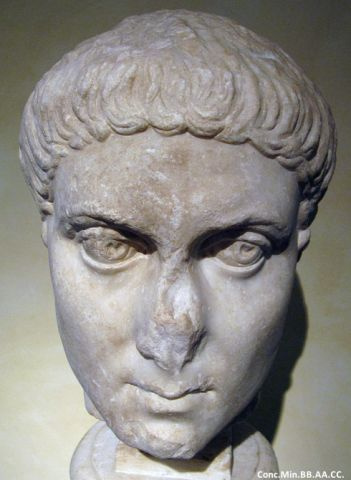
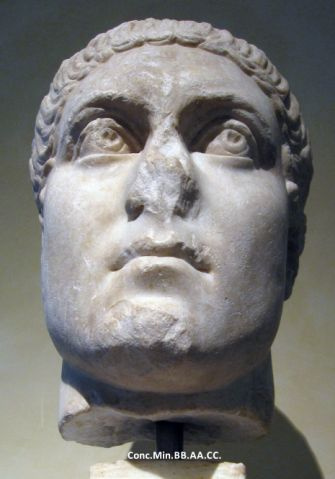
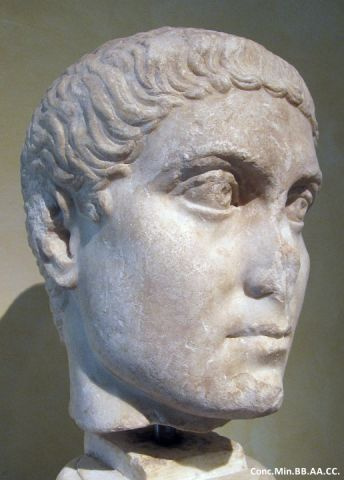
Portrait head of son of Constantine (Crispus or Constantine II?). From Rome. Early fourth century.
Record details
Photographs
Bibliography
- Fittschen, K. and P. Zanker, Katalog der Porträts in den Capitolischen Museen und den anderen kommunalen Sammlungen der Stadt Rom, Band I, Mainz 1985, 155-6, no. 124, pl. 155
Discussion
DESCRIPTION (Object)
Over life-size head. H: 33, W: 26, D: 28 cm. H (chin to crown): 32 cm. Marble.
The head is broken through the upper neck. The neck and adjacent area were at one point restored but the restoration has at present been removed. Most of the nose is missing. The ears are chipped.
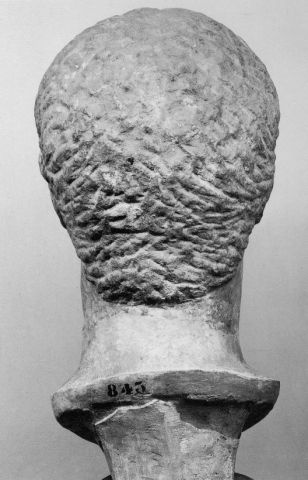
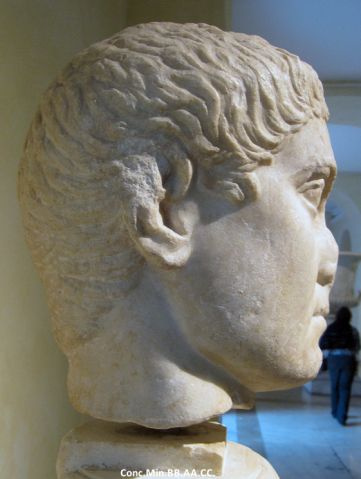
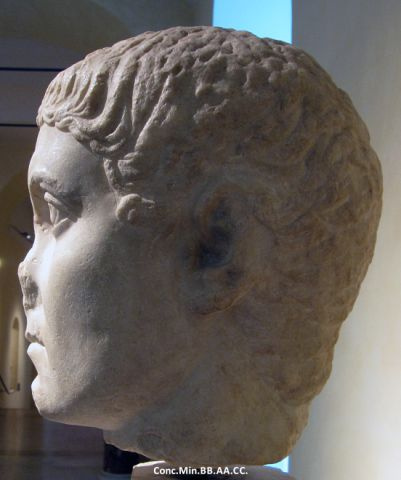
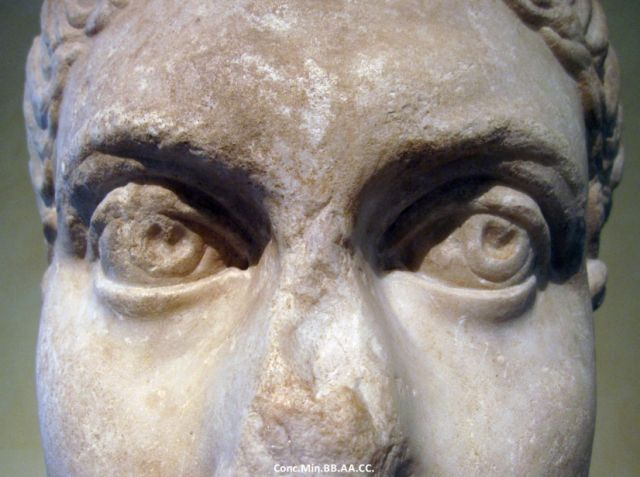
The head has been re-cut from an earlier portrait. The back has been taken down with a point chisel and left in that state. The longer hair of the original portrait curled into the ears. This is especially visible on the right ear. The area directly beneath the eyebrows has had marble removed with a flat chisel. This creates a bulge of skin between the upper eyelid and the eyebrow and makes the eyebrow appear in relief. The hair over the brow is recessed in comparison to the hair above it.
The irises are finely engraved and larger than semi-circular; the line of the inner canthi is also engraved. The pupils are drilled out in a U-shape, and a drill point marks each inner corner. The current hair is rendered entirely with a flat chisel.
PROVENANCE
Found in 1877 on the Esquiline. No further detail is given in the Bullettino Communale of that year (page 269, no. 12).
DESCRIPTION (Subject)
The large head shows a clean-shaven young man with an oval face and short hair combed forward on to the brow. The physiognomy is that of Constantine or one of his sons.
The brow is tall and unmarked. The cheekbones are wide-set and project; the cheeks are long and flat. The eyes are large. The nose dips at the bridge and is short. The chin projects below a shapely mouth with a pouting lower lip.
The hair falls forward flatly in broad locks which form a regular arch over the brow. The ends of the locks curve inwards on the brow, and two ends converge neatly in a point over the proper lefts side of the nose. The short sideburns in front of the ears also curve forward.
DATE AND IDENTIFICATION
The physiognomy of the portrait recalls that of Constantine, and even though the head is re-cut from an earlier portrait, the hair is carefully rendered. The contiguous curving brow locks lie flat and converge in a point; this differs from the well-known Constantine type (see LSA-558 and LSA-554). This combined with a lack of any indication of age suggest that the portrait represents a son of Constantine (Zanker, L’Orange, Calza, von Sydow, Bergmann, Parisi Presicce). The preferred candidates are Crispus or Constantine II because the head has short hair on the neck and long nape hair does not appear on coin portraits until late in the reign of Constantine. A comparison to the statue in Rome identified by its plinth as Constantine II (LSA-559) in inconclusive. The portraits are similar but not clearly based on the same type, and both are re-cut from earlier works.
Zanker points out that that a similar motif of converging locks appears over the brow of a fragmentary head, now in Agrigento LSA-752 and in a private collection in Germany LSA-753.
Discussion references
- Calza, R., Iconografia Romana Imperiale. Da Carausio a Giuliano (287-363 d. C.), Rome 1972, 217-18, no. 130, pl. 72,250-251 (Constantine)
- Delbrueck, R., Spätantike Kaiserporträts. Von Constantinus Magnus bis zum Ende des Westreichs , Leipzig 1933, 20, pl. 61 (private portrait, c. 330)
- Demandt, A. and J. Engemann, (eds.), Konstantin der Grosse, Mainz 2007
, no. I.8.9 (C. Parisi Presicce: Crispus?) - Donati, A. and G. Gentili, Costantino il Grande. La civiltà antica al bivio tra Occidente e Oriente, Milan 2005, 213, no. 12 (S. Guglielmi: Crispus or Constantine II)
- L'Orange, H. P., Das spätantike Herrscherbild von Diokletian bis zu den Konstantin-Söhnen, 284-361 n. Chr. Das Römische Herrscherbild. III. Abteilung ; Bd. 4 , Berlin 1984, 135 (Crispus or Constantinus II)
Cite: Last Statues of Antiquity, LSA-596 (J. Lenaghan).