
LSA-597
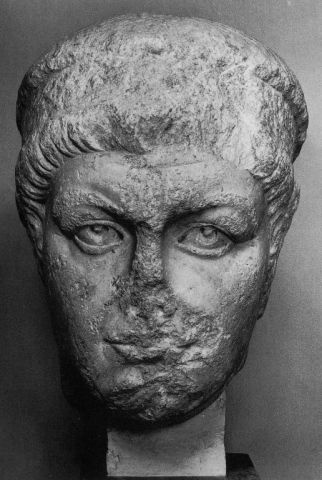
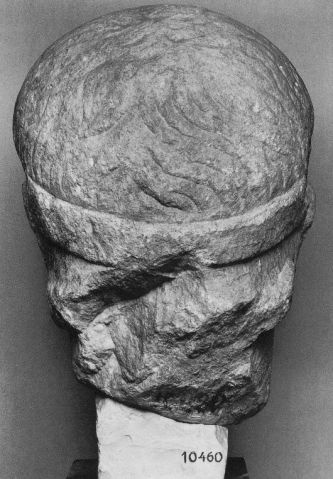
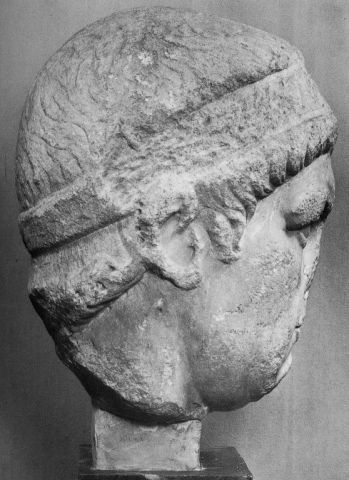
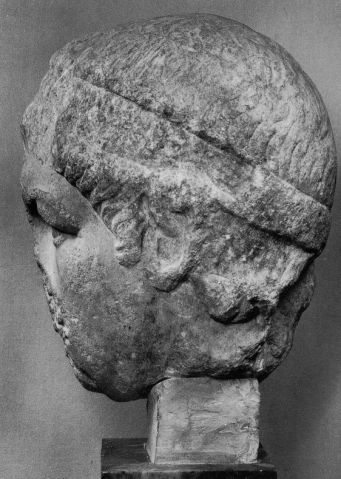
Portrait head of Emperor (Valentinian or Valens?) in Conservatori-Copenhagen-Uffizi type. From Rome. Mid to later fourth century.
Record details
Photographs
Bibliography
- Fittschen, K. and P. Zanker, Katalog der Porträts in den Capitolischen Museen und den anderen kommunalen Sammlungen der Stadt Rom, Band I, Mainz 1985, 158-9, no. 126, pl. 157
Discussion
DESCRIPTION (Object)
Over life-size head. H: 33.5 cm. H (chin to crown): 33 cm. Marble.
The head is broken through the top and back of the head. The nose is missing. The fringe, lips, chin, and ears are damaged. The diadem was worked separately. Between the ears the area of the diadem has been worked down to receive this element.
The hair is worked with a flat chisel. The pupils are thick and deeply drilled U-shapes.
PROVENANCE
Found in 1939 in the Forum Boarium.
DESCRIPTION (Subject)
The head shows a long-haired, clean-shaven mature Emperor who wears a diadem. The hair is long at the back, has a twisting sideburn, and falls over the brow in a thick arching fringe of locks which turn inwards.
The distinctive elements of the face are the eyebrows which create lines of contraction at the centre of the brow and which rise sharply above the outer half of the eyes; a large shapely mouth; and a broad chin, the upper edge of which is delineated beneath the lower lip and below which hangs loose skin. The double chin and a horizontal crease in the brow indicate a mature age.
HONORAND
The diadem indicates that this is the portrait of an Emperor. Two other portraits from Rome are clearly based on the same model, LSA-578 and LSA-582. Another portrait now in Tivoli LSA-581shows stylistic similarities but seems to represent a different (younger?) man.
DATE
The contraction of the brow does not appear on portraits identified with the Constantinian dynasty nor to those assigned to the Theodosian dynasty. The hairstyle also seems to belong between that of the Constantinian dynasty and the Theodosian one. The portrait is therefore traditionally ascribed to the Valentinian family. It is generally thought to represent either Valentinian or Valens.
Discussion references
- Ensoli, S. and E. La Rocca (eds.), Aurea Roma: dalla città pagana alla città cristiana, Roma 2000, 545-6, no. 195
- Stichel, R. H. W., Die römische Kaiserstatue am Ende der Antike, Roma 1982, 41-2, pls. 2-3
- Stutzinger, D. (ed.), Spätantike und frühes Christentum. Ausstellung im Liebieghaus, Museum alter Plastik, Frankfurt am Main. 16. Dezember bis 11. März 1984, Frankfurt a.M. (1983), no. 52
Cite: Last Statues of Antiquity, LSA-597 (J. Lenaghan).