
LSA-598
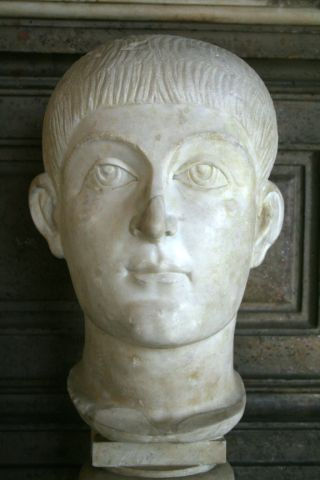
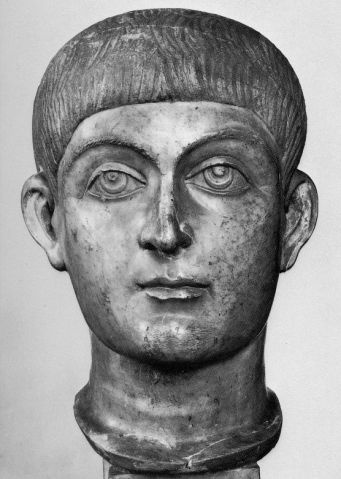
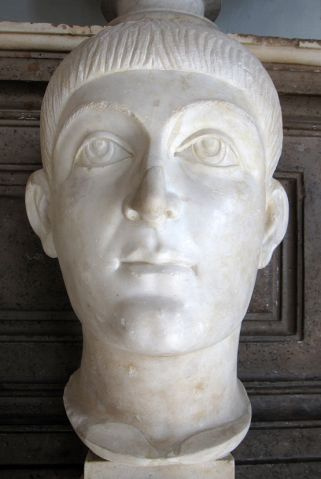
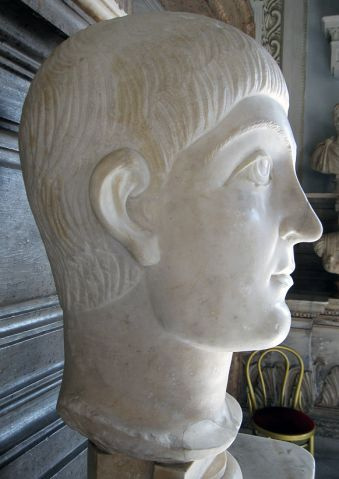
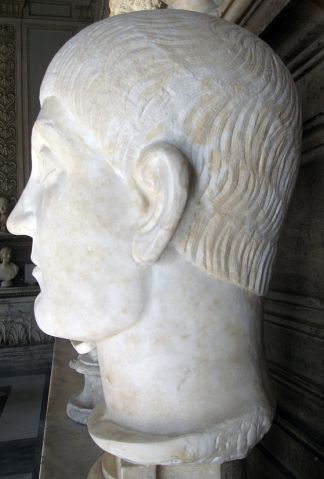
Colossal head of youthful Emperor ('Honorius'). From Rome or its environs. Late fourth to early fifth century.
Record details
Photographs
Bibliography
- Fittschen, K. and P. Zanker, Katalog der Porträts in den Capitolischen Museen und den anderen kommunalen Sammlungen der Stadt Rom, Band I, Mainz 1985, 159-61, no. 127, pl. 158
Discussion
DESCRIPTION (Object)
Colossal head. H: 47.5 cm. H (chin to crown): 38 cm. Marble.
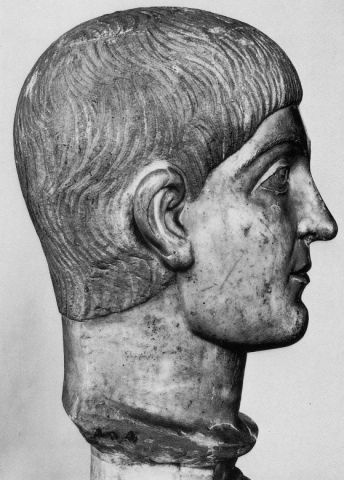
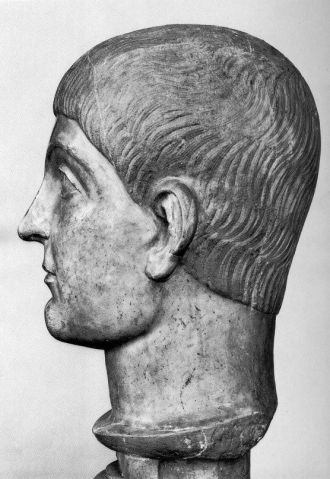
The head was worked separately with its neck and a small area around the base of the neck for insertion into another element. The tip of the nose, two chips in the rim around the front of the neck, and small sections in the rims of the ears have been restored.
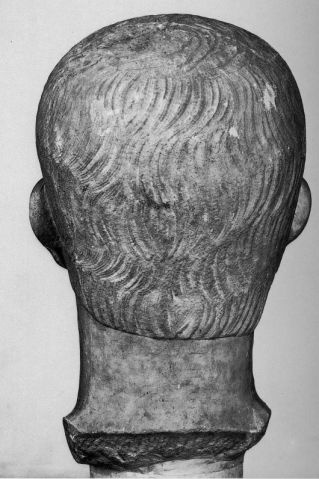
The hair is worked with a broad flat chisel. A fine chisel has been used to make the short hairs of the eyebrows and the perimeter of the irises. The pupils are defined by thick U-shapes (made with bull-nosed chisel). The underside of the socket has been roughly scored with a point chisel.
The portrait has been worked out of an earlier head. The uniformity and relative proportion to the head of the hair cap, the separation of the hair cap from the neck and forehead, the thicker locks at the top of the head which seem to originate in a starfish pattern, the flatness of the back of the head and nape, and the roughly worked patch behind the right ear all demonstrate that the head was not carved ex novo.
PROVENANCE
In 1630 in the Galleria Giustiniani.
DESCRIPTION (Subject)
The head shows a clean-shaven male with immobile features. His hair is fine and straight and cut in layers. It falls low on the brow, and the locks make a small part at the centre.
The eyes are large and emphasized by inorganic, almost semi-circular eyebrows. The nose is short, and the mouth is small with full bow-shaped lips. The jaw line is square and features a projecting rounded chin. This is the most specific element of the portrait.
DATE
The youthful physiognomy, the high arch of the eyebrows, and the fineness and cut of the hair are comparable to a portrait of an emperor in Istanbul, LSA-337, which is usually dated c. 400. The well-preserved and dated portrait (AD 388-392) of a Theodosian Emperor from Aphrodisias, LSA-163, is generally similar in physiognomy and hairstyle, although its slightly longer hair and diadem have been regularly noted by scholars.
HONORAND
The size indicates that this is the portrait of an Emperor. No trace remains of a diadem, which may have been made of another material. Because the portrait seems to belong to c. 400, it is often ascribed to Honorius who was born in 384 at that point and who may have been honoured as a prince without a diadem before 393.
Discussion references
- Ensoli, S. and E. La Rocca (eds.), Aurea Roma: dalla città pagana alla città cristiana, Roma 2000, 548, no. 200 (end of fourth century)
- L'Orange, H. P., Das spätantike Herrscherbild von Diokletian bis zu den Konstantin-Söhnen, 284-361 n. Chr. Das Römische Herrscherbild. III. Abteilung ; Bd. 4 , Berlin 1984, 135 (tradition of Constantinian family )
Cite: Last Statues of Antiquity, LSA-598 (J. Lenaghan).