
LSA-599
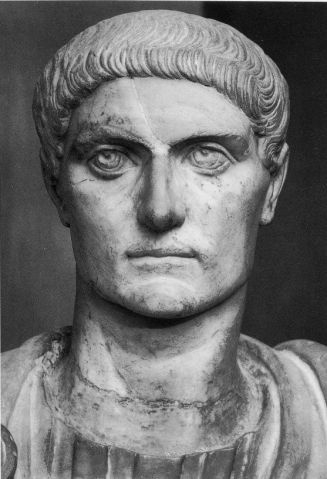
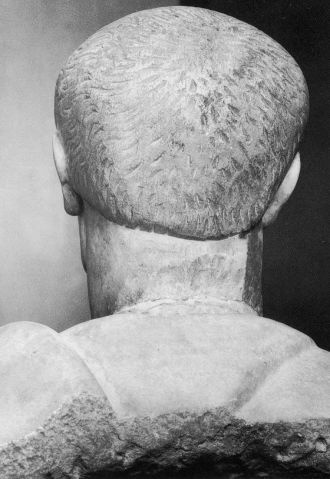
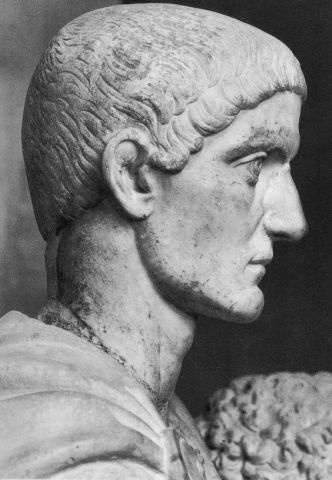
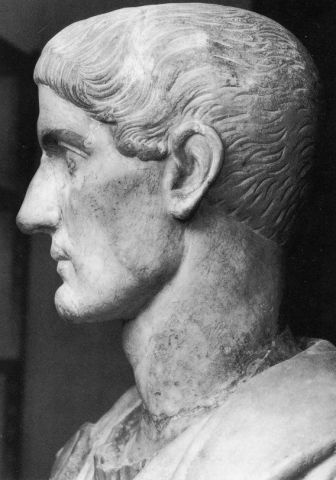
Head of Constantine. Unknown Provenance. Early fourth century.
Record details
Photographs
Bibliography
- Schröder, S., Museo del Prado. Catálogo de la escultura clásica. I: Los Retratos, Madrid 1993, 288-90, no. 89
Discussion
DESCRIPTION (Object)
Over life-size head on modern bust. H (head and neck): 33 cm. H (chin to crown): 26 cm. Fine-grained white marble.
The central and left part of the brow with a section of hair and part of the left eye, the nose, parts of the upper lip, the chin, the rims of the ears, and the bust are modern restorations. The right eyebrow is chipped, and the back of the neck seems to have been taken down near the break.
The hair is worked with a flat chisel. The irises are defined by engraved lines which are about three-quarters of a circle. The pupils are large drilled-out U-shapes.
PROVENANCE
The provenance is unknown. It probably comes from Rome given the history of the Prado collection and the restorations.
DESCRIPTION (Subject)
The head turns to its right and probably came from a statue. It shows a clean-shaven mature man with hair that is combed forward. They fall in two tiers, one of which ends a few centimeters above the other and falls toward the side of the head. The other falls onto the brow, and its locks over the right eye turn inwards toward the centre of the brow (the locks over the left eye are modern). Only the locks immediately in front of the ears curl in a different direction.
The face is broad across the brow which has slight horizontal furrow. The eyes are large. The cheekbones are broad, and the jaw is square. The cheeks indent between this strong frame.
DATE
The physiognomy and fundamental arrangement of the brow hair correspond to those of Constantine’s main, Quinquennalia, type which was created in 311and is known in c. 15 versions and. For other similar examples from the area of Rome, see LSA-558, LSA-834, or LSA-899. The head is without any crown and may therefore be placed before 325.
Discussion references
- Demandt, A. and J. Engemann, (eds.), Konstantin der Grosse, Mainz 2007
, no. I.8.7 (S. Schröder) - Fittschen, K. and P. Zanker, Katalog der Porträts in den Capitolischen Museen und den anderen kommunalen Sammlungen der Stadt Rom, Band I, Mainz 1985, 149-50, no. A 3, Beilage 94 (Zanker: essential example of main type)
- L'Orange, H. P., Das spätantike Herrscherbild von Diokletian bis zu den Konstantin-Söhnen, 284-361 n. Chr. Das Römische Herrscherbild. III. Abteilung ; Bd. 4 , Berlin 1984, 122-3, pl. 38c-d (young Constantine)
- L'Orange, H. P., Studien zur Geschichte des spätantiken Porträts, Oslo 1933, 64, 138, no. 89
Cite: Last Statues of Antiquity, LSA-599.