
LSA-6
Base for statue of Publilius Optatianus, governor of Achaea. Sparta (Achaea). 325-329
Record details
Photographs
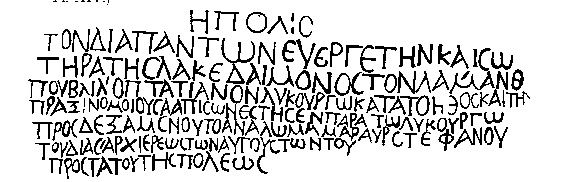
Inscription
Ἡ πόλις / τὸν διὰ πάντων εὐεργέτην καὶ σω/τῆρα τῆς Λακεδαίμονος, τὸν λαμ(πρότατον) ἀνθ(ύπατον) / Πουβλίλ(ιον) Ὀπτατιανόν, Λυκούργῳ κατὰ τὸ ἦθος καὶ τὴν / πρᾶξιν ὁμοιοῦσα ἀπ’ ἴσων, ἔστησεν παρὰ τῷ Λυκούργῳ, / προσδεξαμένου τὸ ἀνάλωμα Μάρ(κου) Αὐρ(ηλίου) Στεφάνου, / τοῦ δια(σημοτάτου) ἀρχιερέως τῶν Αὐγούστων, τοῦ / προστάτου τῆς πόλεως
Inscription translation
The city [honours] the benefactor in all things and saviour of Lacedaimon, the governor (proconsul) of clarissimus rank Publilius Optatianus, [who is] similar, almost equal, to Lycurgus in his character and his deeds, in the vicinity of [the statue of] Lycurgus. Marcus Aurelius Stephanus, priest of the imperial cult, of perfectissimus rank, the leader (prostates) of the city, took charge.
Bibliography
- Feissel, D. & Philippidis-Braat, A., Inventaires en vue d’un recueil des inscriptions historiques de Byzance, 3. Inscriptions du Péloponnèse, (à l’exception de Mistra)., Travaux et mémoires, 9, Paris 1985, 267-395, 284-5 no. 22
Discussion
INSCRIPTION
In eight lines:
Ἡ πόλις / τὸν διὰ πάντων εὐεργέτην καὶ σω/τῆρα τῆς Λακεδαίμονος, τὸν λαμ(πρότατον) ἀνθ(ύπατον), / Πουβλίλ(ιον) Ὀπτατιανόν, Λυκούργῳ κατὰ τὸ ἦθος καὶ τὴν / (5) πρᾶξιν ὁμοιοῦσα ἀπ’ ἴσων, ἔστησεν παρὰ τῷ Λυκούργῳ, / προσδεξαμένου τὸ ἀνάλωμα Μάρ(κου) Αὐρ(ηλίου) Στεφάνου, / τοῦ δια(σημοτάτου) ἀρχιερέως τῶν Αὐγούστων, τοῦ / προστάτου τῆς πόλεως.
'The city [honours] the benefactor in all things and saviour of Lacedaimon, the governor (proconsul) of clarissimus rank Publilius Optatianus, [who is] similar, almost equal, to Lycurgus in his character and his deeds, in the vicinity of [the statue of] Lycurgus. Marcus Aurelius Stephanus, priest of the imperial cult, of perfectissimus rank, the leader (prostates) of the city, took charge.'
DESCRIPTION (from Woodward)
Woodward 1927-1928, 35, describes it as 'a plain base of greyish marble, of irregular shape'. The only published image known to us is the cast of the letters printed by Woodward and reproduced by Feissel & Philippidis-Braat.
PROVENANCE AND CURRENT LOCATION
Excavated by Woodward in the orchestra of the theatre in Sparta, in front of the front seats, near the foot of staircase VII (for a map of the theatre see The Annual of the British School at Athens XXVI pl. XIV). The present location of the base is not recorded.
The formula 'παρὰ τῷ Λυκούργῳ' - 'in the vicinity of Lycurgus' - reoccurs in another honorific inscription from the theatre, set up for the proconsul Anatolius (LSA-357), and presumably refers to a statue here of Lycurgus, the mythologized first law-giver of the Spartans. This provides explicit evidence of an awareness of older statues in the vicinity when setting up a new honour in Late Antiquity (cf. Deligiannakis 2010, 24).
HONORAND AND DATE
The honorand, Optatianus, governor (proconsul) of Achaea, was a poet and high-ranking senator of the Constantinian period, and twice urban prefect in Rome (in 329 and 333: PLRE I, 649 Optatianus 3; Chastagnol 1962, 80-2 no. 33). The first prefecture gives a secure terminus ante quem for his proconsulship in Achaea, since, as Chastagnol (1960, 409-11) has shown, provincial governorships in a senatorial cursus honorum always precede the supreme rank of the urban prefecture. Publilius Optatianus was exiled, but recalled from exile in 325, which gives a possible terminus post quem. This dating is perhaps supported by the possibility that the governorship of Achaea was only restored to proconsular rank (as in this inscription) after the defeat of Licinius in 324 (Groag 1946, 22).
The statue was awarded by Marcus Aurelius Stephanus on behalf of the city. Stephanus was priest of the imperial cult at Sparta, an office that was held by members of the local aristocracy.
Discussion references
- Chastagnol, A., La préfecture urbaine a Rome sous le Bas-Empire, Paris 1960
- Chastagnol, A., Les fastes de la Préfecture de Rome au Bas-Empire, Paris 1962
- Deligiannakis, G., Late Antique Honorific Statuary from the province of Achaia, A.D. 300-600: A contribution to the topography and public culture of late antique Greece, Psaroudakes, K. & E. Sioumpara (eds.), Festschrift for Professor P.G. Themelis, Athens, 2010, 24
- Groag, E., Die Reichsbeamten von Achaia in spätrömischer Zeit, Budapest 1946, 22, 25-6
- Jones, A. H. M. et al., The Prosopography of the Later Roman Empire. Vol. I 260-395, Cambridge et al. 1971 (1975), 649 Publilius Optatianus signo Porphyrius 3
- Woodward, A. M., Excavations at Sparta, 1924-1928, The Annual of the British School at Athens XXIX, London 1927-1928, 35-7 no. 58
Cite: Last Statues of Antiquity, LSA-6 (Ulrich Gehn).