
LSA-60
Base for statue, probably of Claudius Illyrius, governor of Achaea. Corinth (Achaea). Late third century
Record details
Photographs
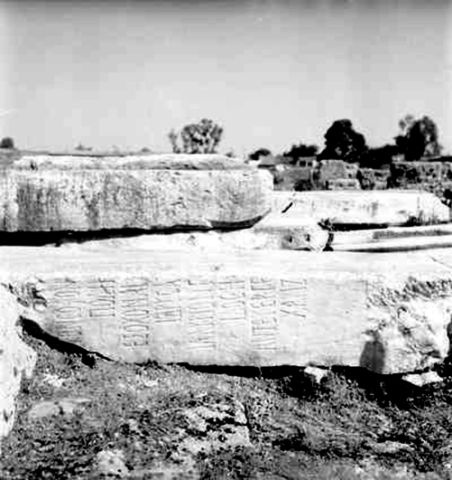
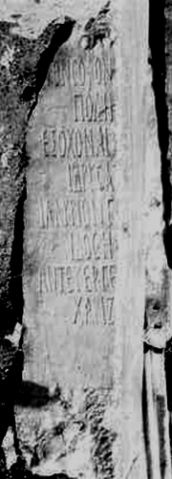
Inscription
τὸν σοφὸν [- - -] / πολιῆ[ται] / ἔξοχον αι[- - - ] / ἱδρύσατ̣[ο - - -] / (5) Ἰλλύριον γα̣[ιης - - - Ἀχα-?] / ιδος ἡγ̣[εμονῆα - - -] / ἀντ’ εὐεργε[σιῶν - - -] / [στῆσε] χαριζ[όμενος.
Inscription translation
The citizens [of Corinth] rejoicingly [set this up to] the wise and outstanding ... Illyrius, governor of the la[nd of Achaea?] ... he supported ... for his benefactions.
Bibliography
- Kent, J. H., The inscriptions, 1926-1950: Corinth VIII, 3, Princeton 1966, nr. 118
Discussion
INSCRIPTION
Verse inscription in eight lines, of which only the first parts survive:
τὸν σοφὸν [- - -]
πολιῆ[ται]
ἔξοχον αι[- - - ]
ἱδρύσατ̣[ο - - -]
(5) Ἰλλύριον γα̣[ιης - - - Ἀχα-?]
ιδος ἡγ̣[εμονῆα - - -]
ἀντ’ εὐεργε[σιῶν - - -]
[στῆσε] χαριζ[όμενος.
'The citizens [of Corinth] rejoicingly [set this up to] the wise and outstanding ... Illyrius, governor of the la[nd of Achaea?] ... he supported ... for his benefactions.'
It is impossible to tell from what survives how many syllables are missing from the text: it was either two distichs, or, as Kent 1966 proposed, four hexameter verses. Kent's assumption that the inscription celebrated 'one of the emperors who waged a campaign in Illyria' (Kent 1966) is certainly wrong, since the verse form and the wording identify it as one of a characteristic group of late-antique honorific epigrams (Robert 1948; see also Robert 1966). Our extensions, and our interpretation, follow the critical re-reading done by Robert 1966. Hence in line 5 we read 'Ἰλλύριον' as the name of the honorand, Illyrius, and in line 6 interpret 'ἡγ..' as the beginning of the name of the office of governor of Achaea (hegemon).
DESCRIPTION (from Kent and the published photo)
Left half of a tall rectangular base in grey marble, with mouldings at top and bottom. The original back, left top and bottom, and front surfaces are partially preserved, all smoothly finished. The base has been sawn vertically, with the loss of the right half, and re-used as a door sill (itself later re-used as a wall block). The mouldings at top and bottom were roughly cut back at the time of the first re-use, though portions of the base moulding survive.
PROVENANCE AND LOCATION
Found in 1934, in a late wall at the east end of the Central Shops. Now in the Corinth museum, inv. no. 1354.
HONORAND AND DATE
In line 5, the epigram preserves the name of the honorand, Illyrius, and in line 6 almost certainly tells us that he was a governor (hegemon). He was therefore probably Claudius Leonticus Illyrius, governor of Achaea and an Athenian by birth, who was honoured with two statues in Athens (LSA-93 and LSA-94). From another Athenian inscription (IG II/III 5199; Sironen 1994 no. 4), Illyrius is known to have rebuilt the Athenian walls after the Herulian incursion. This building activity has long led to a mid-3rd-century date for his governorship (PIR(2) p. 207 no. 892; Groag 1939, 94). However recent research now dates the wall "firmly ... in the reign of Probus (276-282) or slightly later" (Frantz 1988).
In the Athenian inscriptions Illyrius is described as anthupatos (proconsul) of Achaea, which provides a date in the late 270s or the 280s for his governorship, before the provincial reforms which lowered the governor of Achaea to the rank of hegemon (Latin praeses), sometime in the 290s. Our Corinthian inscription, by contrast, appears to describe him as hegemon. This is probably a generic use of that word for provincial governors, rather than an indicator that his office had been transformed into that of praeses Achaeae. A date in the late 3rd century for our inscription seems widely accepted (Millar 1969; Christol 1986; Sironen 1994).
Discussion references
- Inscriptiones Graecae; , II/III (5) no. 13263 (comment)
- Inscriptiones Graecae; , II/III 5199
- Christol, M., Essai sur l'évolution des carrières sénatoriales dans la 2e moitié du IIIe siècle ap. J. C., Paris 1986, 177-182
- Frantz, A., Late Antiquity A. D. 267 - 700: The Athenian Agora XXIV, Princeton 1988, 9-11
- Groag, E., Die Römischen Reichsbeamten von Achaia bis auf Diokletian (Schriften der Balkankommision, Antiquarische Abteilung IX), Wien & Leipzig 1939, 94
- Groag, E. & A. Stein, Prosopographia Imperii Romani Saec. I. II. III Pars II, Berlin & Leipzig 1936, vol. 2 p. 207 no. 892
- Millar, F., P. Herennius Dexippus: The Greek World and the Third-Century Invasions, Journal of Roman Studies 59, 12-29, London 1969, 17
- Robert, L., Epigrammes du Bas-Empire (Hellenica IV), Paris 1948
- Robert, L., Inscriptions de l'Antiquité et du Bas-Empire a Corinthe, Revue des Études grecques 79, 1966, 733-770, 740-2
- Sironen, E. , 'Life and administration of late Roman Attica in the light of public inscriptions'
P. Castrén, Post-Herulian Athens : aspects of life and culture in Athens, A.D. 267-529 , Helsiniki 1994, 15-62, 20 no. 2, 21-2 no. 4
Cite: Last Statues of Antiquity, LSA-60 (Ulrich Gehn).