
LSA-605
Base for statue of governor of Phrygia et Caria. Hierapolis (Caria). Later third to very early fourth century.
Record details
Photographs
Inscription
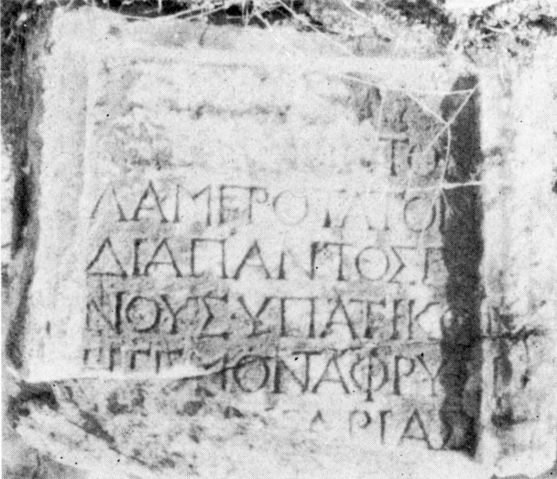
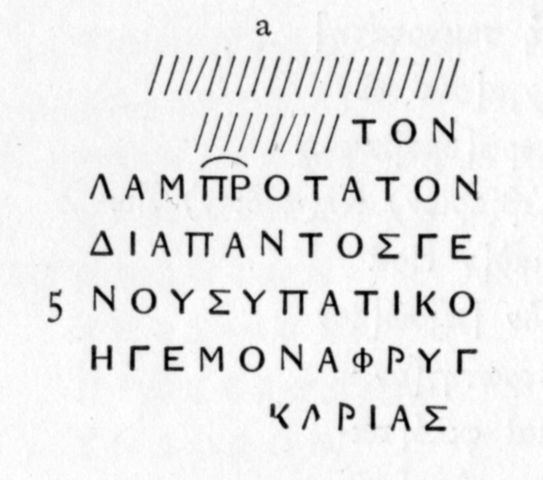
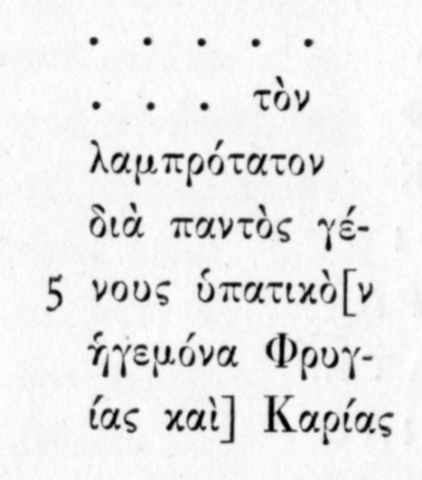
[[[— — —]]] / [[[— — —]]] τὸν / λαμπρότατον /(4) διὰ παντὸς γέ/νους ὑπατικὸ[ν] / ἡγεμόνα Φρυγ/[ίας καὶ Κ]αρίας / [---]
Inscription translation
... (erased name) ..., of clarissimus rank throughout his ancestry, consular governor of Phrygia and Caria ... .
Bibliography
- Cagnat, R. (ed.), Inscriptiones Graecae ad res Romanas pertinentes, Paris 1906-, vol. IV no. 814
Discussion
INSCRIPTION
In seven preserved lines:
[[[— — —]]] / [[[— — —]]] τὸν / λαμπρότατον /(4) διὰ παντὸς γέ/νους ὑπατικὸ[ν] / ἡγεμόνα Φρυγ/[ίας καὶ Κ]αρίας / [---]
' ... (erased name) ..., of clarissimus rank throughout his ancestry, consular governor of Phrygia and Caria ... .'
Letter height 4 cm.
The honorand’s name in lines 1-2 has been deliberately erased; his titles appear, as is usual in Greek statue inscriptions, in the accusative. The awarder’s name presumably appeared in the portion of the base now lost (see below, 'Description').
DESCRIPTION (from Judeich 1898 and the published photo)
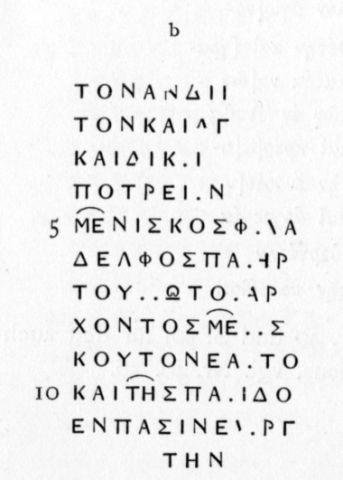
Upper portion of a rectangular block of white marble, broken and lost at the bottom: H 48, W 52, D 58 cm. The inscription is framed within a moulding. On one of the other sides of the base (presumably the back, though this is not specified in the description), there is an earlier inscription, set up by Publius Trebonius Meniscus Philadelphus, father of the archon Meniscus, to an anonymous benefactor of the city (Judeich 1898 no. 43; Cagnat no. 814).
PROVENANCE AND CURRENT LOCATION
The inscription was recorded by Judeich 1898 in the environs of the theatre at Hierapolis ('Bei der 'Halle' in der Nähe des Theaters'). There is no recent record of its location; it is possibly still in situ.
HONORAND AND DATE
The honorand, whose name has been deliberately erased (lines 1-2), was a governor of the joint province of Phrygia et Caria (lines 5-7). The term ὑπατικός (Latin consularis), as in our inscription, is, from the 2nd century onwards, often used for governors of imperial provinces instead of their official title legatus Augusti pro praetore, or, in Greek, πρεσβευτὴς καὶ ἀντιστράτηγος τοῦ Σεβαστοῦ (for this usage see Eck 1992, and our LSA-524 and LSA-606). Our honorand is proudly described as, not a new man, but from an established senatorial family (lines 4-5). Another statue base to a governor of Phrygia et Caria, at Laodicea ad Lycum (LSA-606), has been similarly defaced; it may have honoured the same man.
The province of Phrygia et Caria was cut out of the province of Asia in the mid third century; it was further divided into the smaller provinces of Phrygia I, Phrygia II, and Caria in the wake of the tetrarchic reforms, probably in 303 (Roueché 1981, 111). Our base therefore dates from the period between the mid third century and 303; Roueché 1981, 109-10 ascribed it to the mid 3rd century on the basis of its letter forms.
Discussion references
- Eck, W., C. Iulius Octavius Volusenna Rogatianus, Statthalter einer kaiserlichen Provinz, Zeitschrift für Papyrologie und Epigraphik 90, 1992, 199-206
- Judeich, W., Inschriften, Humann, C., Cichorius, C., Judeich, W. and F. Winter, Altertümer von Hierapolis (Jahrbuch des Deutschen Archäologischen Instituts, Ergänzungsheft 4), 67-180, Berlin 1898, pp. 87-8 no. 43
- Roueché, C., Rome, Asia and Aphrodisias in the third century, Journal of Roman Studies 71, 1981, 103-120
Cite: Last Statues of Antiquity, LSA-605 (Ulrich Gehn).