
LSA-606
Lost base for statue of governor of Phrygia et Caria. Laodicea ad Lycum (Phrygia Pacatiana). Later third to very early fourth century.
Record details
Photographs
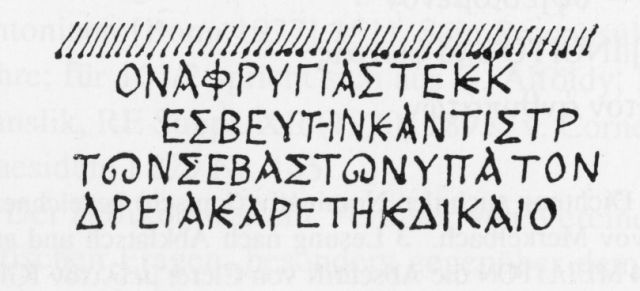
Inscription
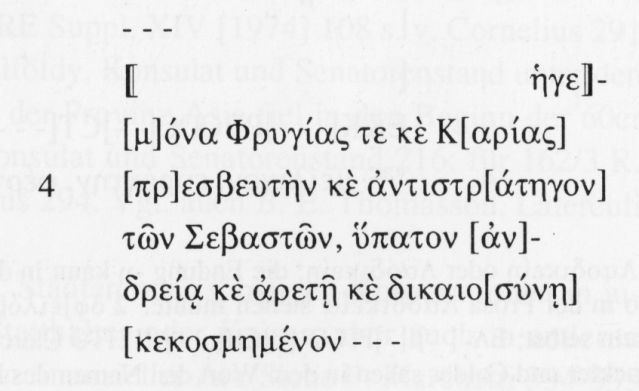
[[[— — ἡγε]]]/ [μ]όνα Φρυγίας τε κὲ Κ[αρίας] / (4) [πρ]εσβευτὴν κὲ ἀντιστρ[άτηγον] /τῶν Σεβαστῶν, ὕπατον [ἀν]/δρείᾳ, κὲ ἀρετῇ, κὲ δικαιο[σύνῃ] / [κεκοσμημένον — —].
Inscription translation
... (erased name) ... governor of Phrygia et Caria, legate on behalf of the praetor (legatus pro praetore) of the Augusti, of consular rank, with bravery, virtue, and righteousness ... [honours him].
Bibliography
- Corsten, T., Die Inschriften von Laodikeia am Lykos. Teil I (Inschriften griechischer Städte aus Kleinasien, Bd. 49) , Bonn 1997, pp. 82-3 no. 39
Discussion
INSCRIPTION
In four recorded legible lines, with one further line erased above:
[[[— — — ἡγε]]]/[μ]όνα Φρυγίας τε κὲ Κ[αρίας], / [πρ]εσβευτὴν κὲ ἀντιστρ[άτηγον] /τῶν Σεβαστῶν, ὕπατον [ἀν]/δρείᾳ κὲ ἀρετῇ κὲ δικαιο[σύνῃ] / [κεκοσμημένον — — —].
' ... (erased name) ... governor of Phrygia et Caria, legate on behalf of the praetor (legatus pro praetore) of the Augusti, of consular rank, with bravery, virtue, and righteousness ... [honours him].'
We reproduce the inscription with the completions proposed by Corsten 1997. The honorand’s name (in line 1) has been deliberately erased. The wording is typical of statue dedications to imperial officials.
Letter height not recorded.
DESCRIPTION
No description and no measurements have been publishd. The only published image is a drawing of the inscription after Ramsay (see below, 'Provenance and Location').
PROVENANCE AND CURRENT LOCATION
The inscription was recorded in Laodicea by Sir William Ramsay in 1926 and published by Anderson 1932. It is now lost.
HONORAND AND DATE
The honorand was a senatorial governor (legatus Augusti pro praetore, πρεσβευτὴν κὲ ἀντιστράτηγον τῶν Σεβαστῶν, lines 4-5) of the province of Phrygia et Caria (line 3). This province was cut out of the larger province of Asia in the mid 3rd century. In the wake of the provincial reforms of the tetrarchy, probably in 303, it was further split into the provinces of Caria, Phrygia I (or Pacatiana) and Phrygia II (Roueché 1981, 111-12), all administered by governors (praesides) of equestrian rank.
Our honorand may have received another statue dedication in Hierapolis (LSA-605) where the name of the honoured governor is likewise erased (Anderson 1932, 24; Roueché 1981, 109-10). The inscription at Hierapolis has been dated to the mid-third century by Roueché on the basis of its letter forms (Roueché 1981, 110 and plate VIII, 2).
The name of the awarder is lost.
FURTHER DISCUSSION
The official title of the governor, πρεσβευτὴς καὶ ἀντιστράτηγος τῶν Σεβαστῶν (lines 4-5) is accompanied by two 'unofficial’ titles, ἡγεμών (line 2-3) and ὕπατος. The former is a general term to denote a provincial governor in the 3rd century, distinct from its official use after the reforms of the tetrarchy specifically for governors of equestrian rank. The latter, likewise unofficially, is a term frequently used by senatorial governors of the 3rd century (as on LSA-524, to a governor of this rank at Laodicea).
Discussion references
- Anderson, J. G. C., The Genesis of Diocletian's Provincial Re-Organization, Journal of Roman Studies 22, 1932, 24-32, p. 24
- Roueché, C., Rome, Asia and Aphrodisias in the Third Century, The Journal of Roman Studies, Vol. 71 (1981)
Cite: Last Statues of Antiquity, LSA-606 (Ulrich Gehn).