
LSA-608
Milestone (or just possibly statue base), with dedication to Constantine and his sons, emperors; later adapted to Honorius. Territory of Hermocapelea (Lydia). 333-337.
Record details
Photographs
Inscription
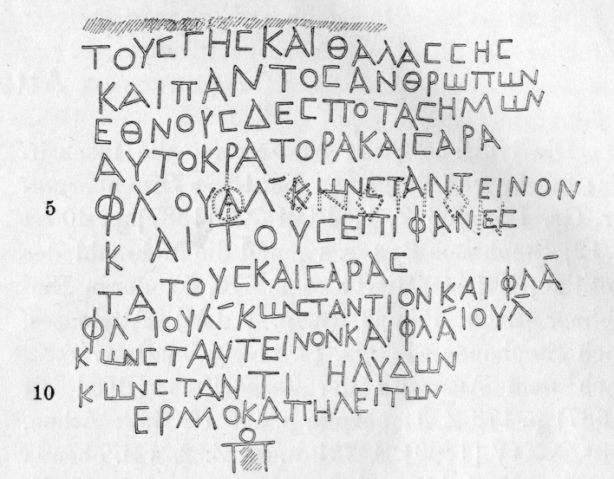
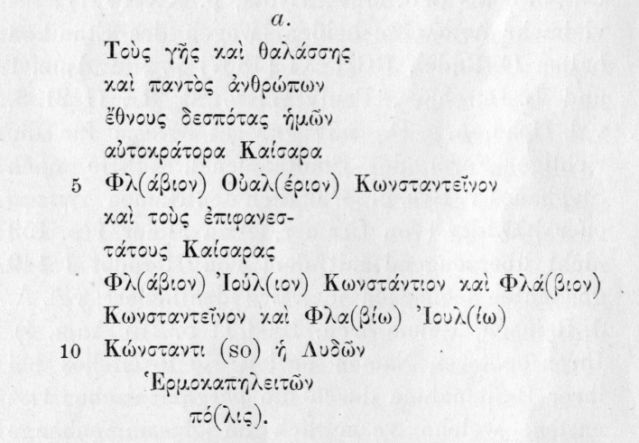
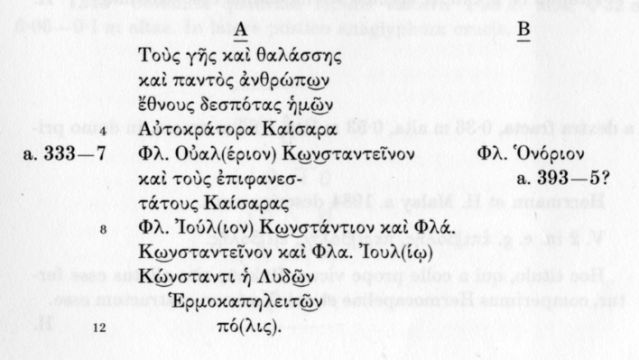
τοὺς γῆς καὶ θαλάσσης / καὶ παντὸς ἀνθρώπων / ἔθνους δεσπότας ἡμῶν, / Αὐτοκράτορα Καίσαρα /(5) Φλ(άουιον) Οὐαλ(έριον) Κωνσταντεῖνον, / καὶ τοὺς ἐπιφανεσ/τάτους Καίσαρας / Φλ(άουιον) Ἰούλ(ιον) Κωνστάντιον, καὶ Φλά(ουιον) / Κωνσταντεῖνον, καὶ Φλα(ουίῳ) Ἰουλ(ίῳ) /(10) Κώνσταντι, ἡ Λυδῶν / Ἑρμοκαπηλειτῶν / πό(λις).
In line 5: ..αλ(έριον) Κωνσταντεῖνον has been overwritten with Φλ(άουιον) Ὁνόριον.
Inscription translation
Our lords of the earth and sea and all races of men, the Emperor Caesar Flavius Valerius Constantinus and the most illustrious Caesars, Flavius Iulius Constantius and Flavius Constantinus, and Flavius Iulius Constans. The city of Lydian Hermokapelites [honours them].
(Much of the first imperial name 'Flavius Valerius Constantinus' has been overwritten with 'Flavius Honorius')
Bibliography
- Herrmann, P. (ed.), Tituli Asiae Minoris, V. Tituli Lydiae, linguis Graeca et Latina conscripti, Vienna 1981 and 1989, 2, no. 1234
Discussion
INSCRIPTION
In twelve lines:
τοὺς γῆς καὶ θαλάσσης / καὶ παντὸς ἀνθρώπων / ἔθνους δεσπότας ἡμῶν, / Αὐτοκράτορα Καίσαρα /(5) Φλ(άουιον) Οὐαλ(έριον) Κωνσταντεῖνον, / καὶ τοὺς ἐπιφανεσ/τάτους Καίσαρας / Φλ(άουιον) Ἰούλ(ιον) Κωνστάντιον, καὶ Φλά(ουιον) / Κωνσταντεῖνον, καὶ Φλα(ουίῳ) Ἰουλ(ίῳ) /(10) Κώνσταντι ἡ Λυδῶν / Ἑρμοκαπηλειτῶν / πό(λις).
'Our lords of the earth and sea and all races of men, the emperor Caesar Flavius Valerius Constantinus and the most illustrious Caesars, Flavius Iulius Constantius, and Flavius Constantinus, and Flavius Iulius Constans. The city of Lydian Hermocapelea [honours them].'
Letter height 2 - 3 cm.
Constans' name (lines 9-10) is in the dative, unlike those of his father and his brothers which are in the accusative. This must simply be an error. In line 5, the latter half of the name of the first honorand (Constantine I), ..αλ(έριον) Κωνσταντεῖνον, has been clumsily overwritten with Φλ(άουιον) Ὁνόριον, a dedication to 'Flavius Honorius', the emperor Honorius.
DESCRIPTION (from Keil & Premerstein 1911)
Columnar shaft of marble (white, streaked with blue and red), broken at the top and with a moulding at the bottom: H 90, diameter 51.5 cm. Keil and Premerstein published a detailed drawing of the inscription, but there is no published image of the whole monument.
PROVENANCE AND CURRENT LOCATION
The inscription was first recorded in 1908 by Keil & Premerstein in the village of Sindelli (northwest of the city of Akhisar) where the block was set up upside down in the lobby of the mosque to support a pillar. There it was recorded again by Herrmann 1989; it is probably still in situ. The village of Sindelli is in the region where the ancient city of Hermocapelea was located (Herrmann 1989, 440; Habicht 1975, 79; Keil & Premerstein 1911, map at end of volume; http://www.trismegistos.org/place/16177).
HONORANDS, AWARDER AND DATE
The dedication is to Constantine I (line 5) and his three sons Constantius II (line 8), Constantine II (lines 8-9) and Constans (lines 9-10). Constantine I was Augustus 306-37; Constantius II was Caesar 324-37; his elder brother Constantine II Caesar 317-37; Constans, Constantine I’s youngest son, was Caesar 333-7. Hence the inscription dates from 333-7. Unusually, the three Caesars are not listed in strict order of seniority, Constantius II, the eldest brother, being listed after Constantine II.
At a later date the inscription was very clumsily dedicated to Honorius, Augustus 393-423.
The inscription was set up by the city of Hermocapelea in Lydia (lines 10-12).
FURTHER DISCUSSION
Keil & Premerstein 1911 argued that this must be a statue base, and indeed its size and the wording of the inscription would suggest this (with the honorands' names in the accusative, and a named awarder in the nominative). However, there are good reasons to think that it was in fact a milestone. A second inscription, with the identical formula, has also been found at Hermocapelea (Herrmann 1989 no. 1235, now preserved in the village of Büknüş). This block was used three times: first in the later tetrarchic period (Herrmann no. 1235 A); then for its Constantinian use (Herrmann 1989 no. 1235 B); finally under Valentinian I (364-75; Herrmann no. 1235 C). Both the two earlier inscriptions, including that which so closely parallels our block, include a mileage, the distinctive indicator of a milestone. All three inscriptions, moreover, name the polis of Hermocapelea as awarder, a feature that appears in the same area on a further 4th-century milestone (Herrmann no. 1236).
Other strong indicators that our block is a milestone, rather than a statue base, are its rural findspot, its exceptionally rough lettering and layout, and the casual addition of a later emperor's name, unparalleled on any certain statue base that we know of, but quite common on milestones. On balance, we are fairly certain that this is a milestone.
Discussion references
- Habicht, C., New Evidence on the Province of Asia, Journal of Roman Studies 65, 1975, 64-91, p. 79 no. 3
- Keil, J. & A. v. Premerstein, Bericht über eine zweite Reise in Lydien. Ausgeführt 1908 im Auftrage des Österreichischen Archäologischen Instituts, Wien 1911, pp. 59-60 no. 124
Cite: Last Statues of Antiquity, LSA-608 (Ulrich Gehn).