
LSA-609
Base for statue of Theodosius I or Theodosius II, emperor. Attalia (Pamphylia). 379-450.
Record details
Photographs
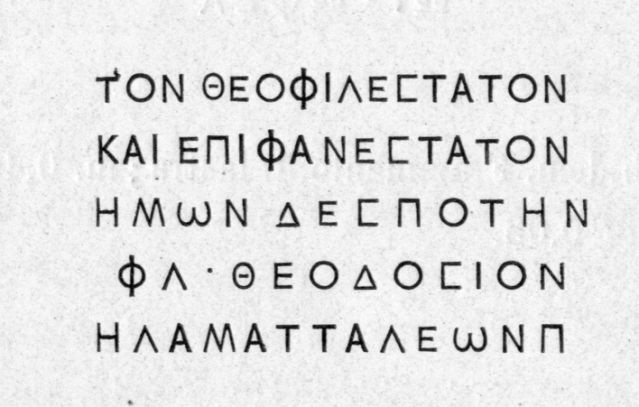
Inscription
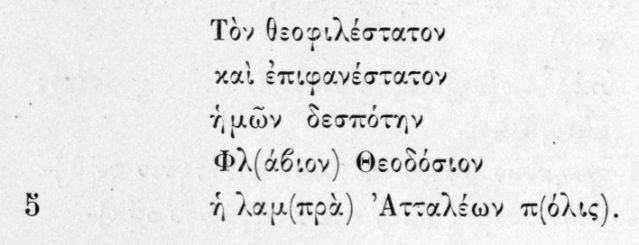
Τὸν θεοφιλέστατον / καὶ ἐπιφανέστατον / ἡμῶν δεσπότην, / Φλ(άβιον) Θεοδόσιον, / ἡ λαμ(πρὰ) Ἀτταλέων π(όλις).
Inscription translation
The most god-beloved and most noble lord of ours, Flavius Theodosius; the shining city of Attalia [honours him].
Bibliography
- Grégoire, H., Recueil des inscriptions grecques chrétiennes d'Asie Mineure. Fasc. I, Paris 1922, p. 107 no. 309 ter
Discussion
INSCRIPTION
In five lines:
Τὸν θεοφιλέστατον / καὶ ἐπιφανέστατον / ἡμῶν δεσπότην / Φλ(άβιον) Θεοδόσιον /(5) ἡ λαμ(πρὰ) Ἀτταλέων π(όλις)
'The most god-beloved and most noble lord of ours, Flavius Theodosius; the shining city of Attalia [honours him].'
Letter height 4 cm.
DESCRIPTION (from Paribeni 1915)
Rectangular marble base: H 122, W 58, D 64 cm. There is no published image.
PROVENANCE AND CURRENT LOCATION
The first western European scholar to publish the inscription was Paribeni 1915 (Paribeni refers to an earlier publication in the Athenian journal 'Xenophanes', that was not accessible to us). He recorded it built into the inner side of the Byzantine city wall of Antalya, close to the breach called Orta-Qapu, in the garden of a private house ('nel giardino di Hagi Grigoraki').
There is no recent record of its location.
HONORAND, AWARDER AND DATE
As Stichel 1982 points out, the imperial name Flavius Theodosius fits both, Theodosius, Augustus 379-9, and his grandson Theodosius II, Augustus 402-50.
The base was set up by the city of Attalia.
Discussion references
- Paribeni, R.& P. Romanelli, Studi e Ricerche Archeologiche nell'Anatolia Meridionale, Monumenti antichi XXIII, 1915, 5-274, p. 22 no. 8
- Stichel, R. H. W., Die römische Kaiserstatue am Ende der Antike, Roma 1982, 99 no. 102
Cite: Last Statues of Antiquity, LSA-609 (Ulrich Gehn).