
LSA-61
Fragmentary base for statue of governor, presumably of Achaea. Corinth (Achaea). Fourth to fifth century.
Record details
Photographs
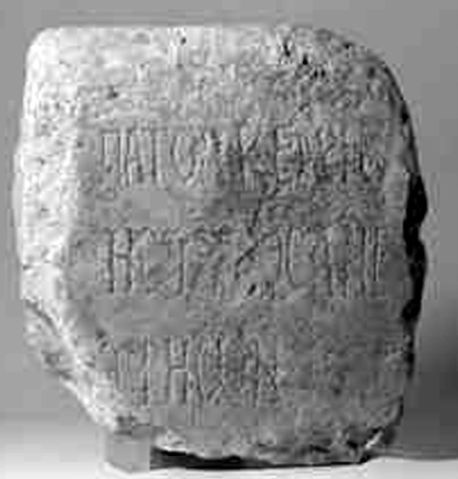
Inscription
--- ἀνθ]ύπατον κὲ ἀρισ/[τοπολείτην,] Ἡσύχιος ἀνέ/[θηκε ὑπὲρ πόλεως Ἐ]φ̣υρηνων.
Inscription translation
Hesychius set [this up to] ... governor (anthupatos) and best [citizen?] on behalf of the city of the Ephyrians (= Corinthians).
Bibliography
- Meritt , B. D., Greek inscriptions, 1896-1927: Corinth VIII. 1, Princeton 1931, no. 92
Discussion
INSCRIPTION
The ends of the first three lines of the inscription survive:
--- ἀνθ]ύπατον κὲ ἀρισ/[τοπολείτην,] Ἡσύχιος ἀνέ/[θηκε ὑπὲρ πόλεως Ἐ]φ̣υρηνων.
'Hesychius set [this up to] ... governor (anthupatos) and best [citizen?] on behalf of the city of the Ephyrians (= Corinthians).'
A fragmentary honorific inscription for a governor (anthupatos, proconsul) set up by a certain Hesychius.
DESCRIPTION (from Meritt 1931)
Fragment of a white marble base broken and lost on left and right side, at bottom, and at back; upper edge preserved: H 30, W 27, D 8 cm. Three lines of the inscription with the original right margin of the epigraphic field are preserved. The surface is badly worn.
PROVENANCE AND LOCATION
Found in 1901 south of the vaulted chamber of the Northwest Shops. Now in the Corinth museum, inv. no. 146.
HONORAND, AWARDER, AND DATE
The reference to an anthupatos (proconsul) dates this inscription to either before the 290s or after 324, since between these dates Achaea was not a proconsular province (Groag 1946). The lettering probably favours a date after 324. In line 1, ἀρισ- can be completed as an adjective ('best') as proposed above, but it could equally be the beginning of the honorand's name. None of the names beginning with 'Aris-' in PLRE I and II were proconsuls, but there is an Aristophanes, citizen of Corinth and probable vicar of Macedonia in 363, who was associated with his fellow citizen Memmius Pontius Ptolemaeus Parnasius (also honoured with a statue at Corinth, LSA-17).
The awarder Hesychius is known only from this base.
Corinth is styled the 'city of the Ephyrians' in a mythological allusion: Ephyra was one of the Oceanids and the first inhabitant of the landscape of Corinth (Realenzyklopädie). The learned mythological allusion suits the habit of late-antique honorific inscriptions. For the use of 'Ephyrian', see also LSA-62.
Discussion references
- Groag, E., Die Reichsbeamten von Achaia in spätrömischer Zeit, Budapest 1946, 22
- Jones, A. H. M. et al., The Prosopography of the Later Roman Empire. Vol. I 260-395, Cambridge et al. 1971 (1975)
- Martindale, J. R., The Prosopography of the Later Roman Empire. Vol. II A.D. 395-527, Cambridge 1980
- Wissowa, G. (ed.), Paulys Realencyclopädie der classischen Altertumswissenschat, Stuttgart, 1894-, VI column 20-1 nos.1, 9
Cite: Last Statues of Antiquity, LSA-61 (Ulrich Gehn).