
LSA-610
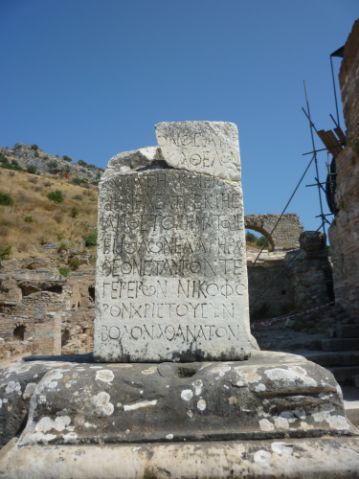
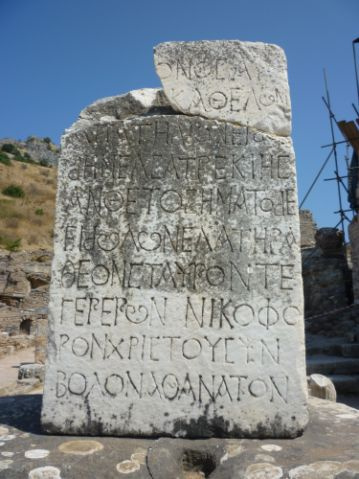
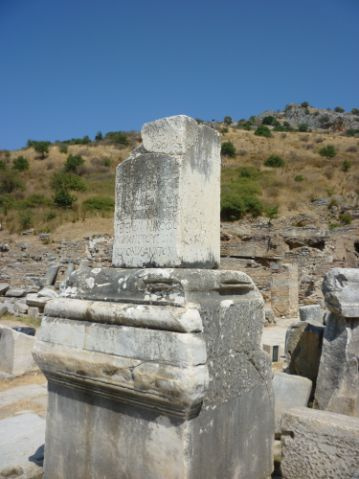
Base for Christian Cross, replacing statue of Artemis. Ephesus (Asia). Late fourth to early fifth century
Record details
Photographs
Inscription
[Δαίμ]ονος Ἀρ/τέμιδος καθελὼν / ἀπατήλιον εἶδος, / Δημέας ἀτρεκίης / ἄνθετο σῆμα τόδε, / εἰδώλων ἐλατῆρα / θεὸν σταυρὸν τε / γερέρων, νικοφό/ρον Χριστοῦ σύν/βολον ἀθάνατον.
Inscription translation
Destroying the guileful statue of the demon Artemis, Demeas dedicated this mark of truth, the divine Cross, the driver away of old idols, immortal victory-bearing sign of Christ.
Bibliography
- Engelmann, H. Knibbe, D. & R. Merkelbach, Die Inschriften von Ephesos Teil IV. Inschriften griechischer Städte aus Kleinasien, vol. 14, Bonn 1980, no. 1351
Discussion
INSCRIPTION
Verse inscription of two elegiac distichs, laid out in ten lines:
[Δαίμ]ονος Ἀρ/τέμιδος καθελὼν / ἀπατήλιον εἶδος /
Δημέας ἀτρεκίης / (5) ἄνθετο σῆμα τόδε, /
εἰδώλων ἐλατῆρα / θεὸν σταυρὸν τε / γερέρων,
νικοφό/ρον Χριστοῦ σύν/βολον ἀθάνατον.
'Destroying the guileful statue of the demon Artemis, Demeas dedicated this mark of truth, the divine Cross, the driver away of old idols, immortal victory-bearing sign of Christ.'
Letter height: 5 - 6 cm.
DESCRIPTION
Rectangular plain block of bluish marble, finished on all sides and without any decoration; H 90, W 54, D 43 cm. Well preserved, except for the upper left segment which is broken and lost. The upper right segment is also broken, but in place. In the middle of the top face, there are one square cutting and two dowel holes. The inscription suggests that this is a re-used block; however, if so, every trace of its previous inscription and use have been totally removed.
PROVENANCE AND CURRENT LOCATION
Found in 1904 by J. Keil, east of the library of Celsus, next to the 'Propylon' (Hadrian's gate). It has been set up on the east side of the marble street, close to its findspot.
HONORAND, AWARDER AND DATE
As the inscription tells us, this base (or one on its site) originally bore a statue of the Ephesian Artemis/Diana, which was removed and replaced by a cross. The material of the cross is unstated, bronze is perhaps most likely.
Demeas, the awarder, is otherwise not known, and the wording of the inscription contains no clues as to his status and its date. A date after the victory of Christianity in the 390s and before the mid 5th century is likely (since it is hard to imagine a statue of the many-breasted goddess surviving in a public place long into the 5th century). Merkelbach (Steinepigramme I, 335) dates the style of the lettering to around 400.
FURTHER DISCUSSION
As far as we are aware, this is the only known record of a statue of a pagan deity being replaced by a Christian symbol.
Discussion references
- Bauer, F. A., Stadt, Platz und Denkmal in der Spätantike, Mainz 1996, 283
- Merkelbach, R. and J. Stauber (eds.), Steinepigramme aus dem griechischen Osten. Bd. 1. Die Westküste Kleinasiens von Knidos bis Ilion , Stuttgart 1998, 334-5
Cite: Last Statues of Antiquity, LSA-610 (A. Sokolicek).