
LSA-613
Base for statue of emperor, probably Julian. Magnesia ad Maeandrum (Asia). 361-363.
Record details
Photographs
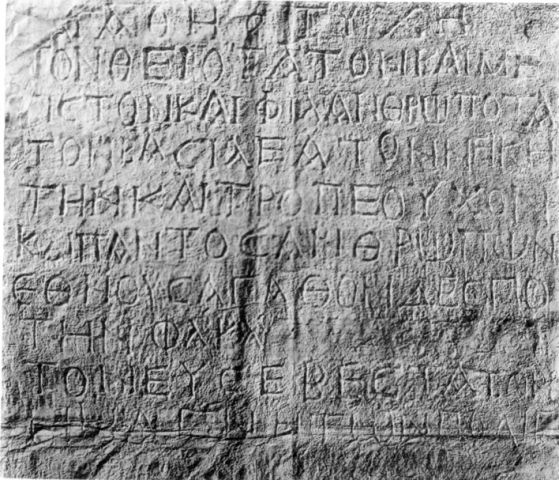
Inscription
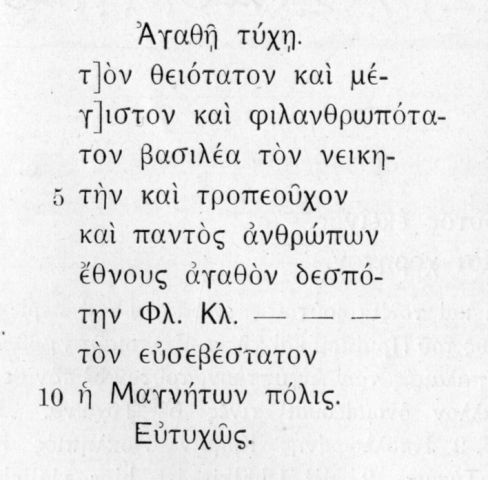
Ἀγαθῇ τύχῃ. / [τ]ὸν θειότατον καὶ μέ/[γ]ιστον καὶ φιλανθρωπότα/τον βασιλέα, τὸν νεικη/τὴν καὶ τροπεοῦχον /(6) καὶ παντὸς ἀνθρώπων / ἔθνους ἀγαθὸν δεσπό/την Φλ(άουιον) Κλ(αύδιον) [[[- - -]]] / τὸν εὐσεβέστατον, / (10) ἡ Μαγνήτων πόλις. / Εὐτυχως.
Inscription translation
To Good Fortune. The most divine and greatest and most benevolent emperor, the victorious and triumphant good lord of all races of men, Flavius Claudius ..., the most pious. The city of Magnesia [honours him]. With good luck.
Bibliography
- Kern. O (ed.), Die Inschriften von Magnesia am Maeander , Berlin 1900, 135, no. 201, pl. 10
Discussion
INSCRIPTION
In eleven lines:
Ἀγαθῇ τύχῃ. / [τ]ὸν θειότατον καὶ μέ/[γ]ιστον καὶ φιλανθρωπότα/τον βασιλέα, τὸν νεικη/τὴν καὶ τροπεοῦχον, /(6) καὶ παντὸς ἀνθρώπων / ἔθνους ἀγαθὸν δεσπό/την, Φλ(άουιον) Κλ(αύδιον) [[[- - -]]] / τὸν εὐσεβέστατον, / ἡ Μαγνήτων πόλις. / Εὐτυχως.
'To Good Fortune. The most divine and greatest and most benevolent emperor, the victorious and triumphant good lord of all races of men, Flavius Claudius ..., the most pious. The city of Magnesia [set this up]. With good luck.'
Letter height 3.5 - 8 cm.
The imperial name in line 8 has been largely erased (see below, 'Honorand, Awarder and Date').
DESCRIPTION (from Kern 1900)
Large marble base: H 144, W 82 m.
PROVENANCE AND LOCATION
The base was first recorded by Kern in 1900 at the south-east corner of the temple of Zeus on the agora in Magnesia ad Maeandrum (http://www.trismegistos.org/place/1289). There is no recent record of its location.
HONORAND, AWARDER AND DATE
The imperial name of the honorand in line 7 is partly erased, only 'Fl(avius) Cl(audius)' remaining; this securely dates our base to the Constantinian dynasty. Of the emperors of the Constantinian emperors 'Flavius Claudius' could fit Constantine’s son Constantine II, or his nephew Constantius Gallus, both of whom suffered damnatio memoriae on their falls from power. However, as Kern 1900 proposed, a third possibility, Julian ('Flavius Claudius Iulianus'), is the most likely honorand. His name fits the erased space best, and, as Kern pointed out, the high-blown phraseology of this inscription is readily paralled on other dedications to him. Julian was Augustus 360-3, but only recognised in the East after the death of Constantius II in 361. He never fell from political grace, but his name was erased on a number of statue bases, presumably by Christians eager to condemn this famous pagan ruler.
The inscription was dedicated by the city of Magnesia (line 10).
Cite: Last Statues of Antiquity, LSA-613 (Ulrich Gehn).