
LSA-614
Base for statue of Eutropius, governor of Asia. Magnesia ad Maeandrum (Asia). Fourth to fifth century, probably 371/2
Record details
Photographs
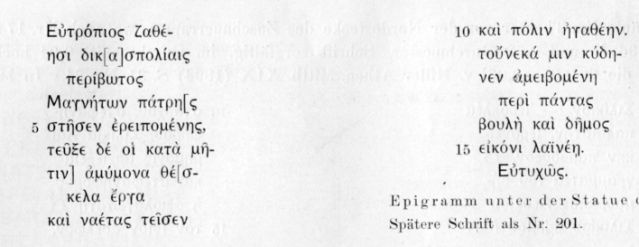
Inscription
Εὐτρόπιος ζαθέ/ησι δικ[α]σπολίαις / περίβωτος, / Μαγνήτων πάτρη[ς] /(5) στῆσεν ἐρειπομένης, / τεῦξε δὲ οῖ κατὰ μῆ/τιν ἀμμύμονα θέ[σ]/κελα ἔργα, / καὶ ναέτας τεῖσεν, /(10) καὶ πόλιν ἠγαθέην. / τοὔνεκά μιν κύδη/νεν ἀμειβομένη / περὶ πάντας / βουλὴ καὶ δῆμος /(15) εἰκόνι λαϊνέῃ. / Εὐτυχῶς.
Inscription translation
Eutropius, much talked of for his divine judgements, when the fatherland of the Magnesians was thrown down, set up and built, according to counsel, excellent and wondrous works for the citizens and most holy city. For this reason, acting in return for all things, the boule and the demos have honoured him with a stone image. With good luck.
Bibliography
- Kern. O (ed.), Die Inschriften von Magnesia am Maeander , Berlin 1900, 135-6, no. 202
- Merkelbach, R. and J. Stauber (eds.), Steinepigramme aus dem griechischen Osten. Bd. 1. Die Westküste Kleinasiens von Knidos bis Ilion , Stuttgart 1998, p. 197 no. 02/01/06
Discussion
INSCRIPTION
Verse inscription laid out over 15 lines, with a closing invocation, making 16 lines in all. The verse consists of three distichs; each hexameter takes up three lines of the inscription; each pentameter two:
Εὐτρόπιος ζαθέ/ησι δικ[α]σπολίαις / περίβωτος, /
Μαγνήτων πάτρη[ς] /(5) στῆσεν ἐρειπομένης, /
τεῦξε δὲ οῖ κατὰ μῆ/τιν ἀμμύμονα θέ[σ]/κελα ἔργα, /
καὶ ναέτας τεῖσεν, /(10) καὶ πόλιν ἠγαθέην. /
τοὔνεκά μιν κύδη/νεν, ἀμειβομένη / περὶ πάντας, /
βουλὴ καὶ δῆμος /(15) εἰκόνι λαϊνέῃ. /
Εὐτυχῶς.
'Eutropius, much talked of for his divine judgements, when the fatherland of the Magnesians was thrown down, set up and built, according to counsel, excellent and wondrous works for the citizens and the most holy city. For this reason, acting in return for all things, the council (boule) and the people (demos) have honoured him with a stone image. With good luck.'
Letter height 3-4 cm.
We reproduce the inscription following the reading and completions of Kern 1900. The reading and completion 'πάτρη[ς] στῆσεν ἐρειπομένης' in lines 4-5 was doubted by Robert 1948 who proposed instead 'πάτρη[ν] στῆσεν ἐρειπομένην, 'he set up his fatherland when it was thrown down', which is probably correct because it allows the verb to relate to the surrounding phrase.
DESCRIPTION (from Kern 1900)
Rectangular base of greyish marble with traces of the imprints for a bronze statue on its top face: H 105, W 57, D 54 cm. The traces of a bronze statue indicate that this was a re-used base, since our inscription explicitly refers to the statue as a 'stone image' (εἰκόνι λαϊνέῃ, line 15). There is no published image of the base.
PROVENANCE AND LOCATION
The inscription was found in 1892 on the southwestern corner of the agora in Magnesia ('an der Südwestecke der Agora beim Brunnenhäuschen', Kern 1900; see also below, 'Further Discussion'), and published by Kern in 1900. There is no recent record of its location.
HONORAND, AWARDER AND DATE
Eutropius, the honorand, is honoured for his justice (lines 1-3) and for his building activity (lines 6-10). Both motifs suggest that he held a high rank in the imperial administration (probably as a provincial governor), rather than a civic office. The poetic term δικασπόλος (judge) reoccurs in a late antique verse epigram to denote the office of a provincial governor (Robert 1948, 55-8). Justice is the most essential virtue of late antique governors; building activity closely follows (Robert 1948, 60 et passim). Our Eutropius is probably the proconsul of Asia of that name in 371/2 (PLRE I, 317, Eutropius 2; Malcus 1967, 111-13).
The inscription was set up by the council and the people of Magnesia.
The verse form of our inscription certainly indicates a late antique date, while Kern 1900, 136 argued that its letter forms were later than those on an inscription to the emperor Julian also in Magnesia ('spätere Schrift als Nr. 201'; our LSA-613). We think this is probably a dedication to the governor of Asia of 371/2, but would not exclude the possibility that it was to another governor of late antiquity of the same name.
FURTHER DISCUSSION
The reference in lines 4-5 of the inscription to the fatherland of the Magnesians being 'thrown down' may well refer to an earthquake, of which there are several documented in the 4th century (Malcus 1967, 113). It is possible that Eutropius' building work related to a late antique restructuring of the southwest corner of the agora of Magnesia, when the southwest entrance, originally a broad street, was built over by a gate, constructed largely of spolia (Humann, Kohte & Watzinger 1904, 110-11, pl. III and figs. 112, 116).
Discussion references
- Humann, C., Kohte, J. & C. Watzinger, Magnesia am Mäander. Bericht über die Ergebnisse der Ausgrabungen der Jahre 1891-1893, Berlin 1904
- Jones, A. H. M. et al., The Prosopography of the Later Roman Empire. Vol. I 260-395, Cambridge et al. 1971 (1975)
- Malcus, B. 'Die Prokonsuln von Asien von Diokletian bis Theodosius II', Opuscula Atheniensa, 7 (1967) 91-154
- Robert, L., Epigrammes du Bas-Empire (Hellenica IV), Paris 1948
Cite: Last Statues of Antiquity, LSA-614 (Ulrich Gehn).