
LSA-615
Base for equestrian statue of Constantine, emperor. Termessus Maior (Pisidia). 324-337
Record details
Photographs
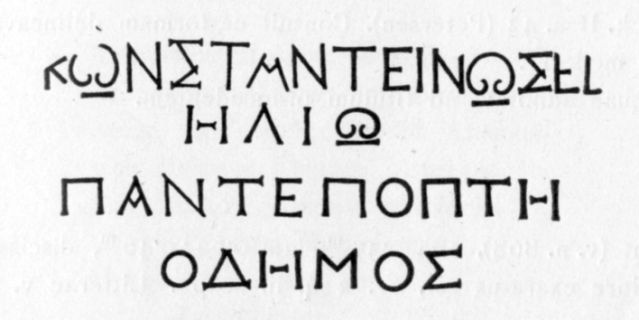
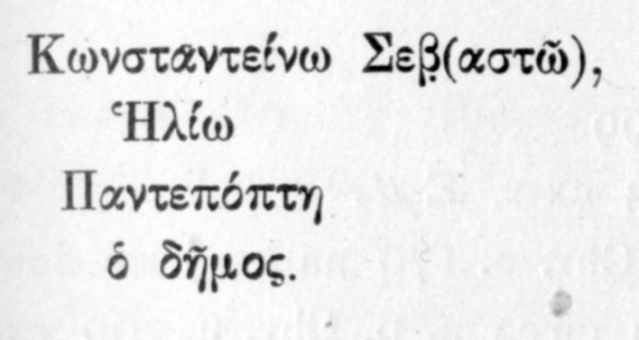
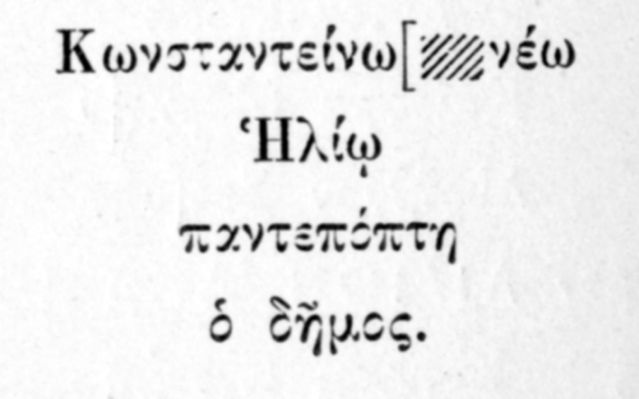
Inscription
Κ̣ωνσταντείνω Σεβ̣(αστῶ),/ Ἡλίω/ Παντεπόπτη, / ὁ δῆμος.
Inscription translation
To Constantine Augustus, to the All-seeing Sun. The demos [set this up].
Bibliography
- Heberdey, R., Tituli Asiae Minoris. Volumen III, Tituli Pisidiae : linguis Graeca et Latina conscripti , Vienna 1941, 39, no. 45
Discussion
INSCRIPTION
In four lines:
Κ̣ωνσταντείνω Σεβ̣(αστῶ),/ Ἡλίω / Παντεπόπτη, / ὁ δῆμος.
'To Constantine Augustus, to the All-seeing Sun; the people (demos) [set this up].'
Letter height 4.5 - 5 cm.
As Tantillo 2003, 165 points out, the inscription is odd in two respects: the honorand is in the dative, and the imperial name is not simply added to the divine (as it was usual, e. g.: Hadrianos Zeus Olympios) but is given with the imperial title. The latter anomaly was interpreted in that the dedication was to two numina, Constantine and Helios (Tantillo 2003, 166 with references). This is, however, excluded by the archaeological features of the base (see below, 'Description').
Constantine’s name is a later addition by a different hand (Tantillo 2003, 166-9). This could explain the dative for the honorand, who is in the same case as the divine addressee of the original religious votive.
DESCRIPTION (from Heberdey 1941, Tantillo 2003, and the published images)
Rectangular base with mouldings at top and bottom, the inscription on one of its short ends: H 104, W 81, D 184 cm. On the top face there are traces of the fixings for an equestrian statue, the horse raising its right front hoof. The back face is only roughly finished. The dedication to Constantine probably made use of an earlier one of the earlier imperial period (Tantillo 2003, 169-77; see also above, 'Inscription').
PROVENANCE AND CURRENT LOCATION
The inscription was first recorded in the ruins of Termessus Maior by Hirschfeld 1874, who noted that it is on an equestrian statue base. Petersen in Lanckoronski 1892 recorded the inscription south of the temple of Zeus Solymeus and east of the big house P 6, the so-called 'house of the ktistes' (see map in Lanckoronski 1892 after p. 20, and pp. 20 (temple), 52, 101 (big house)). Heberdey 1941 recorded it lying on the earth in front of the eastern side of building P 6 ('humi iacet ab aedificio P 6 ad orientem versus'). It was recorded in the same place again by Tantillo 2003; it is presumably still in situ.
HONORAND AND DATE
Constantine I, the honorand, was Augustus 306-37, but fully recognized in the east only from 310. The inscription was dated by Heberdey 1941 to 310-24, the terminus post quem being the year when Constantine chose the Sun god (Sol, Helios) as his personal protector and companion (on this Bowman, Garnsey & Cameron 2005, 91, 560). The terminus ante quem of 324 is defined by Constantine’s sole reign after the defeat of Licinius, and the dropping of Sol from the coinage after this (cf. Bowman, Garnsey & Cameron 2005, 560).
However, it should also be noted that equestrian statues are exceedingly rare in the east, outside Constantinople, which makes it unlikely that the people of Termessus erected one to Constantine while he was only the western companion of the eastern emperor; it seems to us likely that this was set up after Constantine's defeat of Licinius, and conquest of the east, in 324. Moreover, likenesses of Constantine in the guise of Sol/Helios were set up after 324 (LSA-2457 (porphyry column in Constantinople); LSA-2213 (Leptis Magna)), and the comparison of Constantine to the 'all seeing sun' is well present in the literary testimonies after 324 (Tantillo 2003, 179-83). We therefore prefer a date in Constantine's sole reign, 324-37, for our inscription.
ACKNOWLEDGEMENTS
I am deeply indebted to Ignazio Tantillo for help with the interpretation of this inscription.
Discussion references
- Bowman, A. K., Garnsey, P. & A. Cameron, The Crisis of the Empire A. D. 193-337 (The Cambridge Ancient History. Second Edition. Volume XII), Cambridge 2005
- Hirschfeld, G., Vorläufiger Bericht über eine Reise im südwestlichen Kleinasien I, Monatsberichte der Königlichen Akademie der Wissenschaften zu Berlin, November 1874, 710-28, p. 720 n. 2
- Lanckoronski, K., Städte Pamphyliens undPisidiens. II. Band. Pisidien. Unter Mitwirkung von G. Niemann und E. Petersen, Wien 1892, pp. 206-7 no. 82 (Petersen)
- Tantillo, I., Costantino e Helios Pantepoptes: La statua equestre di Termessos, Epigraphica 65, 2003, 159-84
Cite: Last Statues of Antiquity, LSA-615 (Ulrich Gehn).