
LSA-616
Base for statue of Constantius I or Constantius II, emperors. Termessus Maior (Pisidia). 293-305 or 324-337.
Record details
Photographs
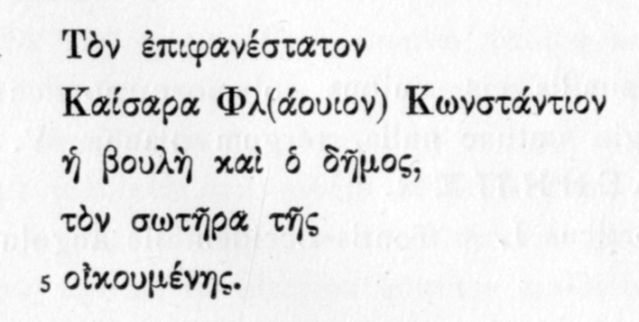
Inscription
τὸν ἐπιφανέστατον / Καίσαρα Φλ(άουιον) Κωνστάντιον / ἡ βουλὴ καὶ ὁ δῆμος,/ τὸν σωτῆρα τῆς /(5) οἰκουμένης.
Inscription translation
The most noble Caesar Flavius Constantius, the saviour of the civilised world; the council (boule) and the people (demos [honour him].
Bibliography
- Heberdey, R., Tituli Asiae Minoris. Volumen III, Tituli Pisidiae : linguis Graeca et Latina conscripti , Vienna 1941, 39, no. 46
Discussion
INSCRIPTION
In five lines:
τὸν ἐπιφανέστατον / Καίσαρα Φλ(άουιον) Κωνστάντιον, / ἡ βουλὴ καὶ ὁ δῆμος,/ τὸν σωτῆρα τῆς / οἰκουμένης.
'The most noble Caesar Flavius Constantius, the saviour of the civilised world; the council (boule) and the people (demos [honour him].'
Letter height 3-5 cm.
DESCRIPTION (from Heberdey 1941)
Tall rectangular marble base with mouldings at top and bottom: H 215, W 74, D 85 cm. The back face is plain and only roughly finished. On the top face there are four dowel holes (Heberdey 1941: 'gomphorum foramina quattuor'). The inscription is carved over an earlier one which has been carefully erased, leaving no legible traces of the earlier letters. No images of the base have been published.
PROVENANCE AND CURRENT LOCATION
The inscription was recorded by Heberdey 1941 standing upside down in front of the 24th column of the western row of columns of the large colonnaded hall L 5 (Lanckoronski 1892, 54-5 and map opposite p. 20). It is probably still in situ.
HONORAND, AWARDER AND DATE
Flavius Constantius, the honorand, is either Constantius I or his grandson Constantius II. Constantius I was Caesar 293-305; Constantius II was Caesar 324-37.
The inscription was set up by the council (boule) and people(demos) of Termessus Maior (line 3).
FURTHER DISCUSSION
If this inscription was to Constantius I, it was almost certainly accompanied by similar dedications to his imperial colleagues Diocletian, Maximian, and Galerius. If it was to Constantius II, similar dedications at least to his father Constantine I, and possibly to his brothers Constans and Constantius II, who were also Caesars, are likely.
Discussion references
- Lanckoronski, K., Städte Pamphyliens undPisidiens. II. Band. Pisidien. Unter Mitwirkung von G. Niemann und E. Petersen, Wien 1892
Cite: Last Statues of Antiquity, LSA-616 (Ulrich Gehn).