
LSA-617
Base for statue of Justinus, praepositus. Termessus Maior (Pisidia). Fourth century.
Record details
Photographs
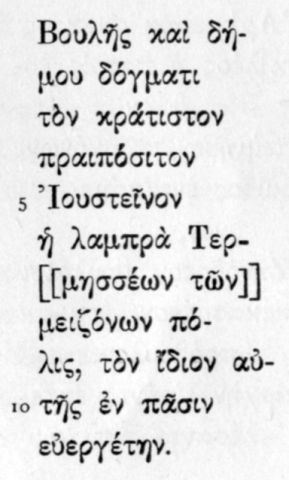
Inscription
βουλῆς καὶ δή/μου δόγματι, / τὸν κράτιστον / πραιπόσιτον / Ἰουστεῖνον, / ἡ λαμπρὰ Τερ/[[μησσέων τῶν]]/ μειζόνων πό/λις, τὸν ἴδιον αὐ/τῆς ἐν πᾶσιν / εὐεργέτην.
Inscription translation
By decree of the council (boule) and the people (demos), the shining city of the greater Termessians [honours] the best praepositus Justinus, its own personal benefactor in every way.
Bibliography
- Heberdey, R., Tituli Asiae Minoris. Volumen III, Tituli Pisidiae : linguis Graeca et Latina conscripti , Vienna 1941, no. 80
Discussion
INSCRIPTON
In eleven lines:
βουλῆς καὶ δή/μου δόγματι, / τὸν κράτιστον / πραιπόσιτον /(5) Ἰουστεῖνον, / ἡ λαμπρὰ Τερ/[[μησσέων τῶν]]/ μειζόνων πό/λις, τὸν ἴδιον αὐ/τῆς ἐν πᾶσιν / εὐεργέτην.
By decree of the council (boule) and the people (demos), the shining city of the greater Termessians [honours] the praepositus Justinus, of egregius (kratistos) rank, its own personal benefactor in every way.
Letter height 3.5 cm.
DESCRIPTION (from Heberdey 1941)
Rectangular base with mouldings at top and bottom on three sides, standing on a rectangular plinth and with a moulded plinth on top: H 195, W 65, D 80 cm. The inscription is set within a frame; above line 1, traces of an earlier inscription, erased to make way for ours, are visible. There is no published image of the base.
PROVENANCE AND CURRENT LOCATION
The inscription was recorded standing in situ in front of column no. 17 of the eastern row of the colonnade L 5 within Termessus Maior (Lanckoronski 1892, 54-5 and map opposite p. 20). It is probably still in situ.
HONORAND, AWARDER AND DATE
Justinus, the honorand, is honoured as a benefactor of Termessus (lines 9-11). He held the office of praepositus (line 4) and was of equestrian rank (Latin egregius, Greek κράτιστος, line 3). The office, again associated with equestrian rank, re-appears in another inscription in Termessus Maior (LSA-618). This is possibly the office of praepositus pagi which was introduced in Egypt in 307/8 (Whitehorne 1988, 613), and is known from Italy under Valentinian I (364-75) (Bowman, Garnsey & Cameron 2005, 297 (Carrié)). The praepositus pagi administered the finances of the rural territory of a city and was usually a member of the local curial class. He was, however, answerable to the imperial authorities in the province (Bowman, Garnsey & Cameron 2005, 291 (Carrié)).
The inscription was set up by decree of the council and people of Termessus Maior (line 1).
Heberdey 1941 dated our inscription to the tetrarchic period (before 305) because of its close resemblance to LSA-618, which he believed could be associated with a tetrarchic milestone. However, if the office of Justinus was, as proposed, that of praepositus pagi, the introduction of this office in Egypt in 307/8 provides a slightly later terminus post quem for our inscription.
Discussion references
- Bowman, A. K., Garnsey, P. & A. Cameron, The Crisis of the Empire A. D. 193-337 (The Cambridge Ancient History. Second Edition. Volume XII), Cambridge 2005
- Lanckoronski, K., Städte Pamphyliens undPisidiens. II. Band. Pisidien. Unter Mitwirkung von G. Niemann und E. Petersen, Wien 1892
- Whitehorne, J., The Strategi of Roman Egypt, Aufstieg und Niedergang der römischen Welt (ANRW), Teil II: Principat, Bd. 10, 1. Halbband, 598-617, Berlin 1988
Cite: Last Statues of Antiquity, LSA-617 (Ulrich Gehn).