
LSA-618
Base for statue of Constantinus, praepositus. Termessus Maior (Pisidia). Fourth century
Record details
Photographs
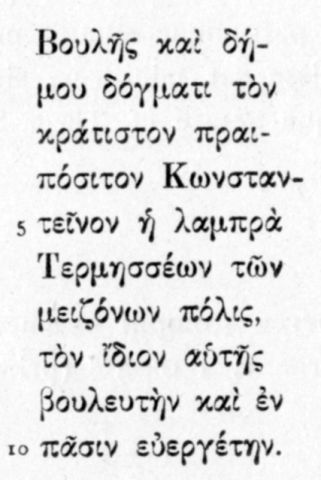
Inscription
βουλῆς καὶ δή/μου δόγματι, τὸν / κράτιστον πραι/πόσιτον Κωνσταν/τεῖνον, ἡ λαμπρὰ /(6) Τερμησσέων τῶν / μειζόνων πόλις,/ τὸν ἴδιον αὑτῆς / βουλευτὴν καὶ ἐν / πᾶσιν εὐεργέτη̣ν.
Inscription translation
By decree of the council (boule) and the people (demos), the shining city of the greater Termessians [honours] the praepositus Constantinus, of egregius rank (kratistos) rank, its own councillor and benefactor in every way.
Bibliography
- Heberdey, R., Tituli Asiae Minoris. Volumen III, Tituli Pisidiae : linguis Graeca et Latina conscripti , Vienna 1941, no. 82
Discussion
INSCRIPTION
In ten lines:
βουλῆς καὶ δή/μου δόγματι, τὸν / κράτιστον πραι/πόσιτον Κωνσταν/τεῖνον, ἡ λαμπρὰ /(6) Τερμησσέων τῶν / μειζόνων πόλις,/ τὸν ἴδιον αὑτῆς / βουλευτὴν καὶ ἐν / πᾶσιν εὐεργέτη̣ν.
'By decree of the council (boule) and the people (demos), the shining city of the greater Termessians [honours] the praepositus Constantinus, of egregius rank (kratistos) rank, its own councillor and benefactor in every way.'
Letter height 3.5 - 4.5 cm.
DESCRIPTION (from Heberdey 1941)
Rectangular base with mouldings at top and bottom on three sides, the upper front corners decorated with cymatia: H 174.5, W 55.5, D 63 cm. The back face is only roughly finished. There is no published image of the base.
PROVENANCE AND CURRENT LOCATION
The inscription was recorded by Heberdey 1941 at the 20th column of the western row of columns of the large colonnaded hall L 5 (Lanckoronski 1892, 54-5, and map opposite p. 20). It is probably still in situ.
HONORAND, AWARDER AND DATE
Constantinus, the honorand, was a citizen and member of the city council of Termessus Maior (lines 8-9); he is honoured as a benefactor of his hometown (lines 9-10). He was of equestrian rank (κράτιστος, in line 3, Latin, egregius), and held the office of praepositus (lines 3-4). This is possibly the office of praepositus pagi which was introduced in Egypt in 307/8 (Whitehorne 1988, 613), and is known from Italy under Valentinian I (364-75) (Bowman, Garnsey & Cameron 2005, 297 (Carrié)). The praepositus pagi administered the finances of the rural territory of a city and was usually a member of the local curial class (explicitly stated in our inscription, lines 8-9). He was, however, answerable to the imperial authorities of the province (Bowman, Garnsey & Cameron 2005, 291 (Carrié)). The office of praepositus, here too associated with the rank of 'kratistos', re-appears on another inscription in Termessus Maior (LSA-617).
Heberdey 1941 dated our inscription to 293/305, arguing that the name and title of our honorand reappears on a heavily mutilated milestone set up under the tetrarchs (Heberdey 1941, 287 no. 943). However, if the office of Constantinus was, as proposed, that of praepositus pagi, the introduction of this office in Egypt in 307/8 provides a slightly later terminus post quem for our inscription.
Discussion references
- Bowman, A. K., Garnsey, P. & A. Cameron, The Crisis of the Empire A. D. 193-337 (The Cambridge Ancient History. Second Edition. Volume XII), Cambridge 2005
- Lanckoronski, K., Städte Pamphyliens undPisidiens. II. Band. Pisidien. Unter Mitwirkung von G. Niemann und E. Petersen, Wien 1892
- Whitehorne, J., The Strategi of Roman Egypt, Aufstieg und Niedergang der römischen Welt (ANRW), Teil II: Principat, Bd. 10, 1. Halbband, 598-617, Berlin 1988
Cite: Last Statues of Antiquity, LSA-618 (Ulrich Gehn).