
LSA-62
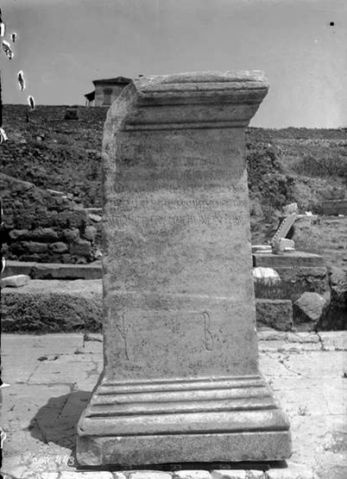
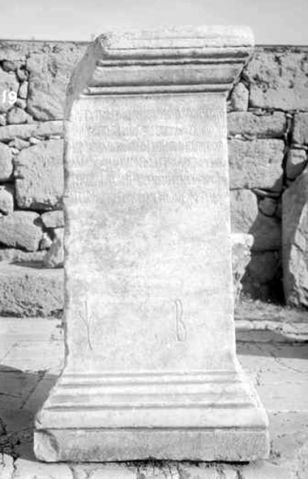
Base for statue of Iunior, governor of Achaea. Corinth. Mid fourth century ?
Record details
Photographs
Inscription
[Τ]ίς τύπον εἱμερόεντα Ἰούνορος ἀνθυπάτοιο / ἥρπασε, τίς μορφὴν τῆ(ι)δ’ ἐνέγλυψε λίθω(ι); / μορφὴν λαοτόμος μὲν ἑῆ(ι) μειμήσατο τέχνη(ι) / Ἑλλάδι κόσμον ὅλον μητρὶ χαριζόμενος. / [σ]τῆσε δ’ ἀγασσάμενός μιν ἀμύμων Εὐτυχιανὸς / [ἀ]ντὶ κασιγνήτου εὖ διέπων Ἐφύρην. / Ψ(ηφίσματος) Β(ουλῆς)
Inscription translation
Who captured the uplifting image of the governor (anthupatos) Iunior, who inscribed [his] shape into this stone? The sculptor emulated his shape in this artwork, making the whole order favourable to mother Greece. The blameless Eutychianus, who manages Corinth well, like a brother, admiring [him] set [this] up to him. By decree of the council.
Bibliography
- Meritt , B. D., Greek inscriptions, 1896-1927: Corinth VIII. 1, Princeton 1931, 66 no. 89
Discussion
INSCRIPTION
In seven lines:
[Τ]ίς τύπον εἱμερόεντα Ἰούνορος ἀνθυπάτοιο
ἥρπασε, τίς μορφὴν τῆ(ι)δ’ ἐνέγλυψε λίθω(ι);
μορφὴν λαοτόμος μὲν ἑῆ(ι) μειμήσατο τέχνη(ι)
Ἑλλάδι κόσμον ὅλον μητρὶ χαριζόμενος.
(5) [σ]τῆσε δ’ ἀγασσάμενός μιν ἀμύμων Εὐτυχιανὸς
[ἀ]ντὶ κασιγνήτου εὖ διέπων Ἐφύρην.
Ψ(ηφίσματος) Β(ουλῆς)
'Who captured the uplifting image of the governor (anthupatos) Iunior, who inscribed [his] shape into this stone? The sculptor emulated his shape in this artwork, making the whole order favourable to mother Greece. The blameless Eutychianus, who manages Corinth well, like a brother, admiring [him] set [this] up to him. By decree of the council.'
The inscription is an honorific epigram in three distichs. In line 6, Corinth VIII.1 incorrectly reads δείπων for διέπων.
DESCRIPTION (partly from ascsa.net/id/corinth/object/i 19)
Tall rectangular statue base of bluish marble with mouldings at top and bottom on three sides: H 134, W 73, D 70 cm. The top moulding is broken on the left side, with slight damage also to the front face of the base. The front face and sides are finished; the back roughly picked with a punch; the top roughly finished with a point. On the front side, the original surface has been cut back for the present inscription, leaving only the final line Ψ(ηφίσματο(ς) Β(ουλῆς)) from the first-use inscription. The inscription runs across the whole width of the base. On top, there is one central dowel hole, and another one close to the right edge.
PROVENANCE AND LOCATION
The base was found at the foot of the stairway leading to the Propylaea (the gate connecting the Lechaeon road with the Agora); today it stands on the east side of the Lechaeon Road.
HONORAND, AWARDER, AND DATE
The name of the honorand in line 1 reads 'Iounor' = Iunior, as Wilhelm 1905 made clear, rectifying Fraenkel's reading 'ἸΘΥΝ(Τ)ΟΡ' (= 'judge') in IG IV. Our Iunior, if late-antique in date, is known only from this inscription. Earlier scholarship identified him with a known proconsul of the 2nd/ 3rd century, Tiberius Claudius Me... Priscus Rufinus Iunior (Groag 1939; Rizakis 2001; CIL X 3723; Prosopographia Imperii Romani).
However, in its motifs and wording, the epigram conforms perfectly to the pattern of late-antique honorific epigrams (Robert 1948), and a date in the 4th century is highly probable. If so, it has a terminus post quem of 324, when the province of Achaea reacquired the proconsular rank that it had lost at the end of the third century.
Kent identified our awarder, Eutychianus, with the man of the same name who dedicated in Corinth, probably in the mid-4th century, an honorific statue to Memmius Pontius Ptolemaeus Parnasius (LSA-17). Groag assumed that our Eutychianus was the brother of the man he was honouring, Iunior, and succeeded him in the governorship (Groag 1939, 98, 111). This interpretation is possible, but not necessary: it depends on how one translates and understands the words [ἀ]ντὶ κασιγνήτου, 'like (or instead of?) a brother' (in line 6 of the inscription). One should also note that our inscription does not style Eutychianus 'governor' (and therefore unequivocally the successor to Iunior), but one who 'manages the city of Corinth'. This wording strongly suggests a role in the municipal administration of the city, rather than in the imperial service, and supports an association of our Eutychianus with the man who dedicated the inscription to Parnasius (LSA-17), since he is described in a similar way. If our man is the Eutychianus of LSA-17, then our inscription too should be of the mid 4th century.
FURTHER DISCUSSION
Corinth is called 'Ephyra', an old name with mythological allusions: Ephyra was one of the Oceanids and the first inhabitant of the landscape of Corinth (Realenzyklopädie). This learned allusion is typical of late-antique honorific inscriptions. For the use of Ephyra, see also LSA-61.
Discussion references
- Corpus Inscriptionum Latinarum; , X 3723
- Inscriptiones Graecae; , IV 1603
- Groag, E., Die Römischen Reichsbeamten von Achaia bis auf Diokletian (Schriften der Balkankommision, Antiquarische Abteilung IX), Wien & Leipzig 1939, 97-8, 111
- Groag, E. & A. Stein, Prosopographia Imperii Romani Saec. I. II. III Editio altera. Pars II, Berlin & Leipzig 1936, 217 no. 935
- Kent, J. H., The inscriptions, 1926-1950: Corinth VIII, 3, Princeton 1966, 164 no. 502
- Rizakis, A. D., Roman Peloponnese 1. Roman personal names in their social context (Achaia, Arcadia, Argolis, Korinthia and Eleia), Athens and Paris 2001, 271-2
- Robert, L., Epigrammes du Bas-Empire (Hellenica IV), Paris 1948
- Wilhelm, A., Zu griechischen Epigrammen, Bulletin de correspondance hellénique 29, 1905, 405-16, 415-6
- Wissowa, G. (ed.), Paulys Realencyclopädie der classischen Altertumswissenschat, Stuttgart, 1894-, VI column 20-1 nos.1, 9
Cite: Last Statues of Antiquity, LSA-62 (Ulrich Gehn and Amelia Brown).