
LSA-621
Base for statue of Honoratus, provincial governor. Termessus Maior (Pisidia). Fourth to fifth century.
Record details
Photographs
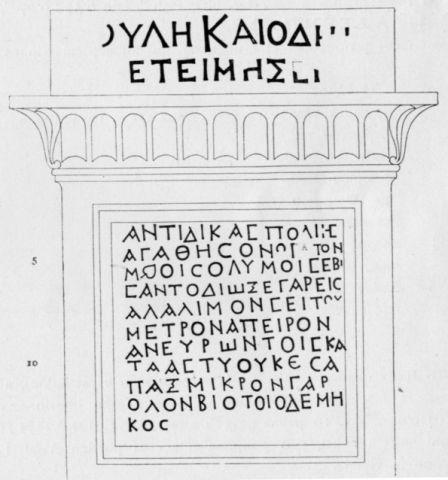
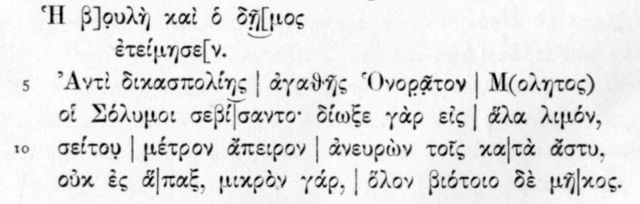
Inscription
[ἡ β]ο̣υλὴ καὶ ὁ δῆ̣[μος] / ἐτείμησε[ν]. / ἀντὶ δικασπολίης / ἀγαθῆς Ὁνορ̣ᾶ̣τον /(5) Μ(ολητος ?) οἱ Σόλυμοι σεβί/σαντο· δίωξε γὰρ εἰς / ἅλα λιμόν, σείτου̣ / μέτρον ἄπειρον /(9) ἀνευρὼν τοῖς κα/τὰ ἄστυ, οὐκ ἐς ἅ/παξ, μικρὸν γάρ, /(12) ὅλον βιότοιο δὲ μῆ/κος.
Inscription translation
The assembly and the people pay honour. Because of his good judgement the Solymi have revered Honoratus, (son of Moles?); for he banished hunger to the sea, discovering a boundless measure of corn for those of the city, not for one time, nor small, but for the whole extension of [his?] life.
Bibliography
- Heberdey, R., Tituli Asiae Minoris. Volumen III, Tituli Pisidiae : linguis Graeca et Latina conscripti , Vienna 1941, no. 103
Discussion
INSCRIPTION
Introductory formula of two lines, and verse inscription in four hexameters, laid out in eleven lines (which do not respect the lines of the verse), altogether 13 lines:
[ἡ β]ο̣υλὴ καὶ ὁ δῆ̣[μος] / ἐτείμησε[ν]. /
ἀντὶ δικασπολίης / ἀγαθῆς Ὁνορ̣ᾶ̣τον /(5) Μ(ολητος ?)
οἱ Σόλυμοι σεβί/σαντο· δίωξε γὰρ εἰς / ἅλα λιμόν,
σείτου̣ / μέτρον ἄπειρον /(9) ἀνευρὼν τοῖς κα/τὰ ἄστυ,
οὐκ ἐς ἅ/παξ, μικρὸν γάρ, / ὅλον βιότοιο δὲ μῆ/κος.
'The council and the people pay honour. Because of his good judgement the Solymoi have revered Honoratus, (son of Moles?); for he banished hunger to the sea, discovering a boundless measure of corn for those of the city, not just once, nor [in] small [quantity], but for the whole extension of [his?] life.'
Letter height: 2.5 (verse) and 3.5 - 6 cm (introductory formula).
The verse inscription is carved over an earlier, erased, inscription. The introductory formula, now partly erased, is carved on the plinth. It probably belonged with the earlier inscription, but was incorporated into ours when the base was re-used.
The completion Μ(ολητος - son of Moles) in line 5, proposed by Heberdey 1941, is entirely hypothetical; it could be any Lycian, Greek or Latin name (indeed, combined with 'Honoratus', Latin is likely).
In line 5 the inhabitants of Termessus are styled 'Solymoi' (line 5). The hero Solymos was considered to be the ancestor of Termessus Maior (Kosmetatou 1997), and Zeus Solymeus was its local deity (Lanckoronski 1892, 2-3, 7-8, 30-1 (cult), 48 (temple)). 'Solymoi' was an accepted, slightly antiquarian, name for the Termessians (Lanckoronski 1892, 1-6).
DESCRIPTION (from Heberdey 1941 and the published image)
Rectangular base with mouldings on three sides at top and bottom, standing on a rectangular plinth, and with a further rectangular plinth above, carved from the same block of stone: H 105, W 53, D 50 cm. The back is only roughly finished. As discussed above ('Inscription') the base is a re-used piece. On the top face there are the imprints for a bronze statue (but there is no way of knowing whether these belong with the first or the second use of the base).
PROVENANCE AND CURRENT LOCATION
The inscription was recorded by Heberdey 1941 in front of column 12 of the western row of the large colonnade L 5 in Termessus Maior (Lanckoronski 1892, 54-5, and map opposite p. 20). It is probably still in situ.
HONORAND, AWARDER AND DATE
Honoratus, the honorand, is otherwise unknown (PLRE I, 440, Honoratus 7). He is honoured for his justice (lines 3-4) and for his successful measures to secure the corn supply of the city (lines 6-12). The poetic term δικασπόλος occurs repeatedly in late antique epigrams to governors, to refer to their justice, a virtue considered essential in a governor (Robert 1948, 58-60; in our inscription in the derivative form δικασπολίης, line 3). The provision of an adequate corn supply is another motif found in late antique inscriptions to governors (Robert 1948, 127-9); Honoratus appears to have made a donation of corn to Termessus that would last as long as he lived (line 12). He was evidently a governor, either of the province of 'Lycia et Pamphylia' which existed until the mid 4th century (Bowman, Garnsey & Cameron 2005, 709), or of Pisidia to which Termessus belonged after the larger province was split up.
The inscription was set up by the council (boule) and people (demos) of Termessus Maior (lines 1-2).
The verse form of the inscription makes a date in the 4th century or later likely.
Discussion references
- Bowman, A. K., Garnsey, P. & A. Cameron, The Crisis of the Empire A. D. 193-337 (The Cambridge Ancient History. Second Edition. Volume XII), Cambridge 2005
- Jones, A. H. M. et al., The Prosopography of the Later Roman Empire. Vol. I 260-395, Cambridge et al. 1971 (1975)
- Kosmetatou, E., The Hero Solymos on the coinage of Termessos Major, Schweizerische Numismatische Rundschau/ Revue Suisse de Numismatique/ Rivista Svizzera di Numismatica 76, 1997, 41-64
- Lanckoronski, K., Städte Pamphyliens und Pisidiens. II. Band. Pisidien. Unter Mitwirkung von G. Niemann und E. Petersen, Wien 1892
- Robert, L., Epigrammes du Bas-Empire (Hellenica IV), Paris 1948
Cite: Last Statues of Antiquity, LSA-621 (Ulrich Gehn).