
LSA-624
Base for statue of Marcus Aurelius Troilus, high priest and benefactor. Termessus Maior (Pisidia). Probably later third to fourth century.
Record details
Photographs
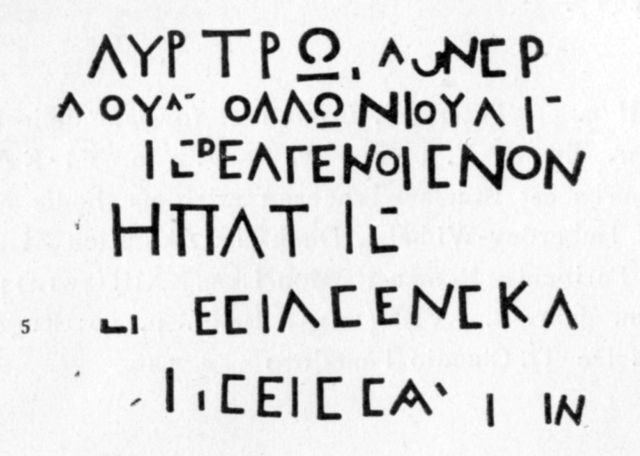
Inscription
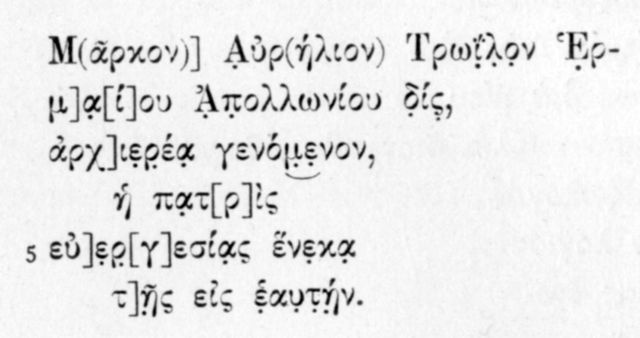
Μ(ᾶρκον)] Α̣ὐρ(ήλιον) Τρωΐ̣λ̣ο̣ν Ἑ̣ρ-/[μ]α̣[ί]ου Ἀ̣π̣ολλωνίου, δ̣ίς,/ [ἀρχ]ιε̣ρ̣έα̣ γενόμ̣ε̣νον,/
ἡ πα̣τ[ρ]ὶς /(5) [εὐ]ε̣ρ̣[γ]εσία̣ς ἕνε̣κα̣ / τ]ῆ̣ς εἰς ἑ̣αυ̣τ̣ή̣ν.
Inscription translation
Marcus Aurelius Troilus, son of Hermaios Apollonius, having become high priest for the second time; the fatherland [honours him] on account of his benefactions towards it.
Bibliography
- Heberdey, R., Tituli Asiae Minoris. Volumen III, Tituli Pisidiae : linguis Graeca et Latina conscripti , Vienna 1941, no. 133
Discussion
INSCRIPTION
In six lines:
Μ(ᾶρκον)] Α̣ὐρ(ήλιον) Τρωΐ̣λ̣ο̣ν Ἑ̣ρ-/[μ]α̣[ί]ου Ἀ̣π̣ολλωνίου, δ̣ίς̣ / [ἀρχ]ιε̣ρ̣έα̣ γενόμ̣ε̣νον,/
ἡ πα̣τ[ρ]ὶς /(5) [εὐ]ε̣ρ̣[γ]εσία̣ς ἕνε̣κα̣ / τ]ῆ̣ς εἰς ἑ̣αυ̣τ̣ή̣ν.
'Marcus Aurelius Troilus, son of Hermaius Apollonius, having become high priest for the second time; the fatherland [honours him] on account of his benefactions towards it.'
Letter height 4 cm.
DESCRIPTION (from Heberdey 1941)
Rectangular base with mouldings at top and bottom, set on a rectangular plinth and with a moulded plinth above: H 150, W 65, D 65 cm. The back is only roughly finished. The inscription, which is not framed, is carved onto the upper part of the shaft, over an erased earlier one of which only illegible traces survive. There is no published image of the whole base.
PROVENANCE AND CURRENT LOCATION
The inscription was recorded by Heberdey 1941 standing in situ at column 4 of the western row of the large colonnaded hall L 5 in Termessus Maior. (Lanckoronski 1892, 54-5 and map opposite p. 20). It is probably still in situ.
HONORAND, AWARDER AND DATE
The honorand, Marcus Aurelius Troilus, son of Hermaius Apollonius, was a citizen of Termessus Maior, since in line 4 of the inscription the city is said to be his fatherland. He is honoured for his benefactions towards Termessus (lines 5-6) in the year when he held the office of high priest for the second time (lines 3-4). His high priesthood could be either local, or provincial.
The statue was set up by the city of Termessus Maior (line 4).
There is no clear indication of this monument's date, though the re-use of an earlier base and the highly irregular lettering of the inscription both suggest a date after the mid 3rd century (Heberdey 1941). A terminus ante quem is provided by the reference to Troilus' priesthood, which must be before the triumph of Christianity towards the end of the 4th century.
Discussion references
- Lanckoronski, K., Städte Pamphyliens und Pisidiens. II. Band. Pisidien. Unter Mitwirkung von G. Niemann und E. Petersen, Wien 1892
Cite: Last Statues of Antiquity, LSA-624 (Ulrich Gehn).