
LSA-625
Base for statue of Florention (or Florentius), wife of chief magistrate. Termessus Maior (Pisidia). Third to fourth century
Record details
Photographs
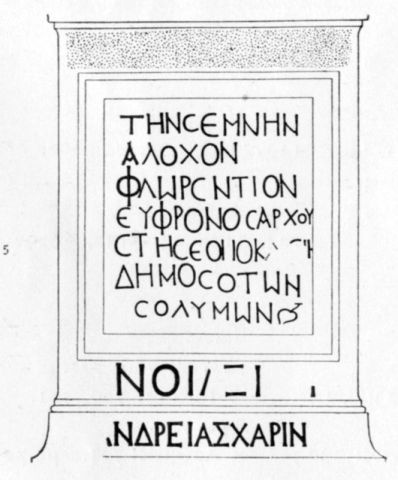
Inscription
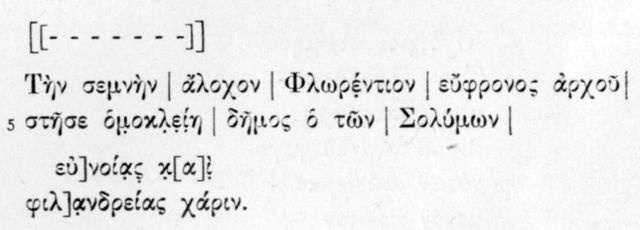
τὴν σεμνὴν / ἄλοχον / Φλωρέ̣ντιον / εὔφρονος ἀρχοῦ /(5) στῆσε ὁμ̣οκλ̣ε̣ί̣ῃ / δῆμος ὁ τῶν / Σολύμων, / [εὐ]νοία̣ς̣ κ̣[α]ὶ̣ / [φιλ]α̣νδρείας χάριν.
Inscription translation
The most honoured wife, Florention, of the cheerful archon (or: the archon Euphron). The people of the Solymoi, by acclamation, set her [statue] up. On account of [her] thoughtfulness and love for her husband.
Bibliography
- Heberdey, R., Tituli Asiae Minoris. Volumen III, Tituli Pisidiae : linguis Graeca et Latina conscripti , Vienna 1941, no. 135
- Merkelbach, R. and J. Stauber (eds.), Steinepigramme aus dem griechischen Osten. Bd. 4. Die Südküste Kleinasiens, Syrien und Palaestina, Munich 2002, p. 88 no 18 / 01 / 08
Discussion
INSCRIPTION
Verse inscription of one distich laid out in seven lines, and a closing formula laid out in two lines, nine lines in all:
τὴν σεμνὴν / ἄλοχον / Φλωρέ̣ντιον / εὔφρονος ἀρχοῦ /(5) στῆσε ὁμ̣οκλ̣ε̣ί̣ῃ / δῆμος ὁ τῶν / Σολύμων, / [εὐ]νοία̣ς̣ κ̣[α]ὶ̣ / [φιλ]α̣νδρείας χάριν.
'The most honoured wife, Florention, of the cheerful archon (or: the archon Euphron). The people of the Solymoi, by acclamation, set her [statue] up. On account of [her] thoughtfulness and love for her husband.'
We reproduce the inscription with the completions suggested by Heberdey 1941. In line 4, εὔφρονος can be read either as the name of the honorand’s husband, or as an adjective (see below, 'Honorand, Awarder, and Date').
Letter height 3.5 - 5 cm.
DESCRIPTION (from Heberdey 1941 and the published image)
Rectangular base with mouldings at top and bottom, put on a rectangular plinth and with a moulded round plinth on top; H 116, W 55, D 53 cm. The back face is plain. The verse inscription is carved into a framed epigraphic field over an erased earlier one. The closing formula (lines 8-9) is carved on the frame below the verse inscription (line 8) and onto the lower moulding (line 9); the two lines originally belonged to the earlier inscription and were adapted to our later one. Above the epigraphic field, the frame appears roughly finished, possibly from the erasure of another line of the earlier inscription.
PROVENANCE AND CURRENT LOCATION
The inscription was recorded by Heberdey 1941 standing in situ at column 13 of the western row of the large colonnade L 5 in Termessus Maior. (Lanckoronski 1892, 54-5 and map, opposite p. 20). There it is possibly still in situ.
HONORAND, AWARDER, AND DATE
Florention, the honorand, is only named by her signum; it is unclear whether this is in the feminine form 'Florention' (as proposed by Merkelbach 2002 and adopted in our translation), or in the masculine form 'Florentios' (Merkelbach 2002). She was the wife of the leading magistrate of Termessus Maior, the proboulos or archiproboulos, styled 'archon' in our inscription probably for metrical reasons. In line 4, euphronos may be the name of Florention’s husband (Euphron), but might be an adjective ('of the cheerful ...), again chosen for metrical reasons and referring to a man so well known in the community that he did not need to be named.
Florention is honoured for her wifely virtues (lines 1-2, 8-9); benefactions towards the city are not mentioned.
The inscription was set up by the people (demos) of Termessus Maior (lines 6-7). The Termessians style themselves 'Solymoi' after their founder hero (as on LSA-621).
Merkelbach 2002 correctly argues that the inscription must date from after the constitutio Antoniniana of 212, because signa appear only after that date.
Discussion references
- Lanckoronski, K., Städte Pamphyliens und Pisidiens. II. Band. Pisidien. Unter Mitwirkung von G. Niemann und E. Petersen, Wien 1892
Cite: Last Statues of Antiquity, LSA-625 (Ulrich Gehn).