
LSA-626
Base, probably for statue, with dedication to Constantius I, emperor. Araxa (Lycia). 293-305
Record details
Photographs
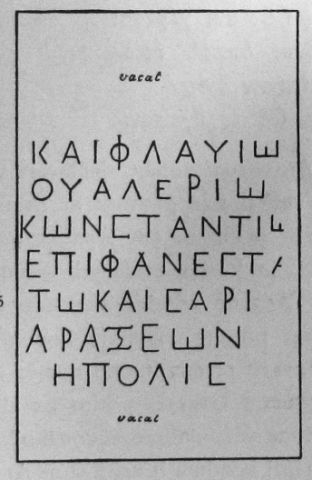
Inscription
--- ] καὶ Φλαυίῳ / Οὐαλερίῳ / Κωνσταντίῳ /(4) ἐπιφανεστά/τῳ Καίσαρι, / Ἀραξέων / ἡ πόλις.
Inscription translation
... and to Flavius Valerius Constantius, the most noble Caesar; the city of Araxa [honours them].
Bibliography
- Kalinka, E., Tituli Asiae Minoris. Volumen II, 1-2. Tituli Lyciae : linguis Graeca et Latina conscripti , Vienna 1920, no. 703
Discussion
INSCRIPTION
In seven surviving lines:
--- ] καὶ Φλαυίῳ / Οὐαλερίῳ / Κωνσταντίῳ, /(4) ἐπιφανεστά/τῳ Καίσαρι, / Ἀραξέων / ἡ πόλις.
'... and to Flavius Valerius Constantius, the most noble Caesar; the city of the Araxa [honours them].'
Letter height 3 cm.
On the right face, the letters OA are written vertically.
The epigraphic formula with the honorand in the dative is not the usual formula of Greek honorific inscriptions (see below, 'Further Discussion').
DESCRIPTION (from Bérard 1891 and Kalinka 1920)
Rectangular block of granite, broken at top; H 57, W 29, D 26 cm.
PROVENANCE AND CURRENT LOCATION
The inscription was first recorded by Bérard 1891 in the village of Ören, on the site of the ancient city of Araxa. Kalinka 1920 recorded it in the village 'behind the house of a certain Begir-oglu Jussuf' ('post domum Turci cuiusdam cui nomen erat Begir-oglu Jussuf'). There is no recent record of its location.
HONORAND, AWARDER AND DATE
Constantius I, the honorand (full name Flavius Valerius Constantius, as in our inscription), was Caesar 293-305.
The inscription was set up by the city of Araxa (lines 6-7; for Araxa, see Stillwell 1976, 84 and Zgusta 1984, 88 § 85-159).
FURTHER DISCUSSION
This dedication is puzzling, and its purpose uncertain. The inscription is clearly only the final part of a longer dedication, presumably to all the tetrarchs, but the drawing published by Kalinka 1920 shows blank space above line 1, with no sign that it was ever filled (Kalinka marks it 'vacat, empty'). The opening of our inscription must therefore have been carved on other blocks, set above or to the left of our segment. Benndorf (in a comment in Kalinka 1920) suggested that our inscription belonged to a monument carrying the statues of all the tetrarchs (perhaps each with his name beneath him). The epigraphic formula does name both an honorand and an awarder (as is usual on statue bases); but the honorand is named in the dative (which is highly unusual in Greek-language statue dedications). Bérard 1891 published it as a milestone, which we think is unlikely.
Discussion references
- Bérard, V., Inscriptions d’Asie mineure
, Bulletin de Correspondance Hellénique 15, 1891, 538-62, p. 552 no. 25. - Stillwell, R. (ed.), The Princeton Encyclopedia of Classical Sites, Princeton 1976, p. 84 (Bean)
- Zgusta, L., Kleinasiatische Ortsnamen, Heidelberg 1984, p. 88 § 85-15
Cite: Last Statues of Antiquity, LSA-626 (Ulrich Gehn).