
LSA-627
Base for bronze statue of emperor. Phaselis (Lycia). Late third to fourth century
Record details
Photographs
Inscription
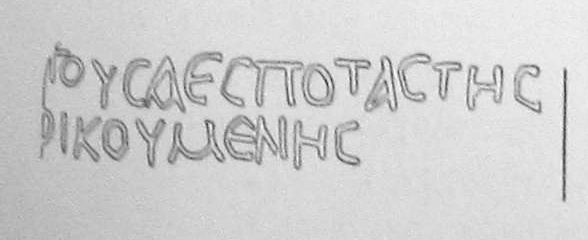
τ̣οὺς δεσπότας τῆς / οἰκουμένης [— — —] / [[— — — — — — — —]] /
Inscription translation
To the rulers of the inhabited world....
Bibliography
- Kalinka, E. , Tituli Asiae Minoris. Volumen II, 3. Tituli Lyciae, linguis Graeca et Latina conscripti, Vienna 1944, p. 421 no. 1199
Discussion
INSCRIPTION
In two preserved lines:
τ̣οὺς δεσπότας τῆς / οἰκουμένης [— — —] / [[— — — — —— —]] /
'To the rulers of the civilised world .... '
Letter height 4 cm.
We reproduce the recorded letters in the version published by Kalinka 1944, who recorded a deliberate erasure in line 3. Its first editors, Paribeni and Romanelli 1913, believed that they came from the very end of an inscription and read them somewhat differently: [---]ΟΣΕΔΕΠΟΤΙΣ / [τῆς] ΟΙΚΟΥΜΕΝΗΣ.
DESCRIPTION (from Kalinka 1944 and the published images)
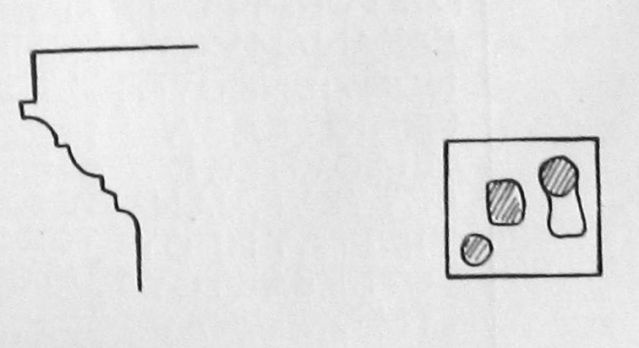
Rectangular base with its lower portion still buried, with moulding at the top; H (visible) 100, W 68, D 58 cm. The moulding is more elaborate on the front face than on the sides; the back face is plain. The front angles are decorated with acroteria. On the top face there are traces of the fixings for a bronze statue.
PROVENANCE AND CURRENT LOCATION
The inscription was first recorded by Paribeni and Romanelli in 1913 on the acropolis, in the ruins of a late Roman or Byzantine house. Kalinka 1944 recorded it among the ruins west of the theatre at the northern margin of the acropolis. There is no recent record of its location; it is possibly still in situ.
HONORAND, AWARDER AND DATE
The honorand was an emperor, a member of an imperial college, as shown by the plural 'δεσπότας, emperors' in line 1). The imperial names beyond line 2 are erased. Our base was certainly for a single statue, so his colleagues were probably honoured with identical monuments standing close by (a common practice for honours to the members of imperial colleges).
The inscription, with its reference to more than one emperor, must date to the period of multiple emperors that begins in 285; it is very unlikely to be later than the 4th century, since the habit of honouring multiple emperors seems to have ended with Theodosius (379-93). The letter forms, as shown on the drawing published by Kalinka 1944, also look to be late antique.
Discussion references
- Paribeni, R.& P. Romanelli, Studi e Ricerche Archeologiche nell'Anatolia Meridionale, Monumenti antichi XXIII, 1915, 5-274, 185 no. 132
Cite: Last Statues of Antiquity, LSA-627 (Ulrich Gehn).