
LSA-628
Base for statue of Diocletian, emperor. Nicomedia (Bithynia). 284-305.
Record details
Photographs
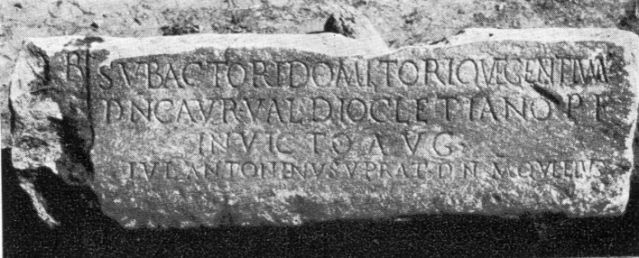
Inscription
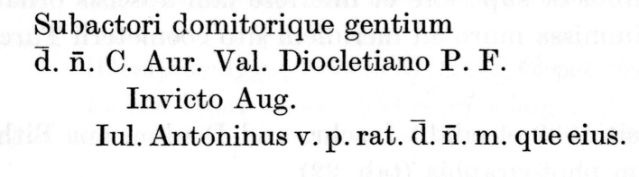
Subactori domitorique gentium, / d(omino) n(ostro) C(aio) Aur(elio) Val(erio) Diocletiano, p(io), f(elici), / invicto Aug(usto), / Iul(ius) Antoninus, v(ir) p(erfectissimus), rat(ionalis), d(evotus) n(umini) m(aiestati)que eius.
Inscription translation
To the conqueror and tamer of peoples, our lord Gaius Aurelius Valerius Diocletianus, pious, fortunate, unconquered Augustus. Julius Antoninus, of perfectissimus rank, rationalis, devoted to his divine spirit and majesty, [set this up].
Bibliography
- Dörner, K. F., Inschriften und Denkmäler aus Bithynien, Berlin 1941, p. 70 no. 48 pl. 26
- Dörner, K. F. (ed.), Tituli Asiae Minoris, IV. Tituli Bithyniae linguis Graeca et Latina conscripti, 1. Paeninsula Bithynica praeter Chalcedonem. Nicomedia et ager Nicomedensis cum septentrionali meridianoque litore sinus Astaceni et cum lacu Sumonensi, Vienna 1978, p. 14 no. 28
- L'Année épigraphique, , 1947, 186
Discussion
INSCRIPTION
In four lines:
Subactori domitorique gentium, / d(omino) n(ostro) C(aio) Aur(elio) Val(erio) Diocletiano, p(io), f(elici), / invicto Aug(usto), / Iul(ius) Antoninus, v(ir) p(erfectissimus), rat(ionalis), d(evotus) n(umini) m(aiestati)que eius.
'To the conqueror and tamer of peoples, our lord Gaius Aurelius Valerius Diocletianus, pious, fortunate, unconquered Augustus. Julius Antoninus, of perfectissimus rank, rationalis, devoted to his divine spirit and majesty, [set this up].'
Letter height 3.5 - 4 cm. Dörner 1941 recorded traces of red colour in lines 1, 3, and 4.
On the margin, at the left end of the block, an additional letter B appears before line 1.
DESCRIPTION (from Dörner 1941, Dörner 1978, and the published photo)
Long and narrow rectangular marble block broken on all edges: H 26, W 94, D 42 cm. At the left end there is a margin, slightly indented. On the back face, there are mouldings (Dörner 1941).
PROVENANCE AND LOCATION
The inscription was found in Izmit before 1941 during construction work for a paper mill (Dörner 1941); it was still on this site when recorded by Dörner 1978.
HONORAND, AWARDER AND DATE
Diocletian, the honorand (full name Caius Aurelius Valerius Diocletianus, as in our inscription) was Augustus 284-305.
Julius Antoninus (PLRE I, 76, Iulius Antoninus 10), the awarder, was a rationalis (line 4); this brief title had come into use in the course of the 3rd century to denote the highest ranking official (procurator a rationibus) of the imperial treasury, the fiscus (Hirschfeld 1905, 34-38, Delmaire 1989, 25). In the tetrarchic period it was also used to refer to the head of the central treasury and to the heads of the diocesan treasuries (Delmaire 1989, 25). Julius Antoninus also set up a dedication to Maximian in Nicomedia (LSA-630), and another one to Diocletian in Ephesus (LSA-715).
The date of this dedication is determined by the dates of Diocletian’s reign.
FURTHER DISCUSSION
The wording of the inscription, and its urban location, are entirely typical of statue dedications of the later third and fourth centuries; the long, narrow shape of the block is, however, unusual. Perhaps the explanation is that this was for a statue set on or within a larger structure, such as a gate (where a long narrow block could well have been used).
Discussion references
- Delmaire, R., Largesses sacrées et 'res privata'. L'aerarium impérial et son administration du IVe au VIe siècle, Rome 1989
- Hirschfeld, O., Die kaiserlichen Verwaltungsbeamten bis auf Diokletian, 2nd edition, Berlin 1905
- Jones, A. H. M. et al., The Prosopography of the Later Roman Empire. Vol. I 260-395, Cambridge et al. 1971 (1975)
Cite: Last Statues of Antiquity, LSA-628 (Ulrich Gehn).