
LSA-629
Base for statue of Diocletian, emperor. Nicomedia (Bithynia). 284-305.
Record details
Photographs
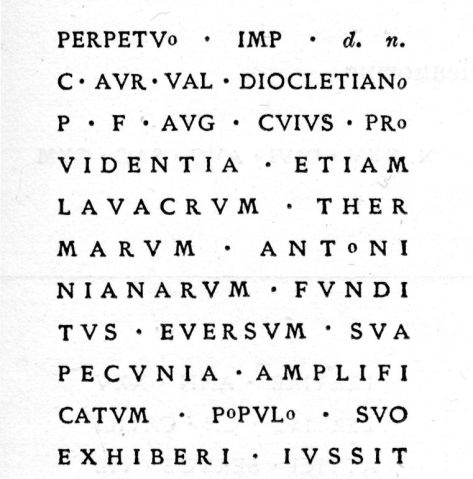
Inscription
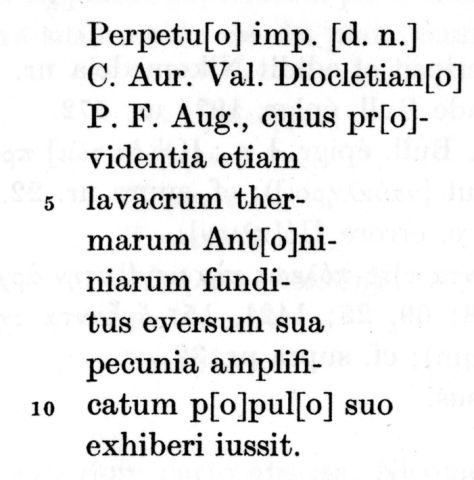
Perpetu[o] imp(eratori), [d(omino) n(ostro)] / C(aio) Aur(elio) Val(erio) Diocletian[o], / p(io), f(elici) Aug(usto), cuius pr[o]/videntia etiam /(5) lavacrum ther/marum Ant[o]ni/niarum fundi/tus eversum, sua /(9) pecunia amplifi/catum p[o]pul[o] suo / exhiberi iussit.
Inscription translation
To the eternal emperor, our lord Gaius Aurelius Valerius Diocletianus, pious, fortunate Augustus, whose providence ordered that the wholly destroyed bath of the Antonine Thermae, enlarged with his money, should be presented to his people.
Bibliography
- Corpus Inscriptionum Latinarum; , III, 324 and addenda p. 976
- Dörner, K. F. (ed.), Tituli Asiae Minoris, IV. Tituli Bithyniae linguis Graeca et Latina conscripti, 1. Paeninsula Bithynica praeter Chalcedonem. Nicomedia et ager Nicomedensis cum septentrionali meridianoque litore sinus Astaceni et cum lacu Sumonensi, Vienna 1978, p. 15 no. 29
Discussion
INSCRIPTION
In eleven lines:
Perpetu[o] imp(eratori), [d(omino) n(ostro)] / C(aio) Aur(elio) Val(erio) Diocletian[o], / p(io), f(elici) Aug(usto), cuius pr[o]/videntia etiam /(5) lavacrum ther/marum Ant[o]ni/niarum fundi/tus eversum, sua /(9) pecunia amplifi/catum p[o]pul[o] suo / exhiberi iussit.
'To the eternal emperor, our lord Gaius Aurelius Valerius Diocletianus, pious, fortunate Augustus, whose providence ordered that the wholly destroyed bath of the Antonine Thermae, enlarged with his money, should bepresented to his people.'
Letter height not recorded.
DESCRIPTION (from CIL III)
Tall rectangular block with mouldings at top and bottom. No measurements and no image have been published.
PROVENANCE AND CURRENT LOCATION
The inscription was recorded in 1555 by the Austrian envoy to the Ottoman Sultan, Augerius Gislenius Busbequius, from whose letters it was published in CIL III (on Busbequius see CIL III, 4). There is no recent record of it.
HONORAND, AWARDER AND DATE
Diocletian, the honorand (full name Caius Aurelius Valerius Diocletianus, as in our inscription) was Augustus 284-305.
It is not explicit, but the awarder was almost certainly the people of Nicomedia, grateful for the restoration of the Antonine baths (line 10).
FURTHER DISCUSSION
Diocletian was responsible for large building projects in his new capital Nicomedia, as testified to by Lactantius (De Morte Persecutorum, ch. 7), and Aurelius Victor (Epitome de Caesaribus, 39, 44). The Antonine baths restored by Diocletian were so large that In the 6th century Procopius considered their restoration impossible (De Aedificiis, V, 3, 7). Remnants of the baths may have been unearthed by excavations in 1938 (Dörner 1939, 158 figs. 27-8, and p. 163; Mayer 2002, 29-31).
Discussion references
- Dörner, K. F., Archäologische Funde aus der Türkei 1934-1938, 6. Funde hellenistischer und römischer Zeit, Archäologischer Anzeiger 1939, 144-76
- Mayer, E., Rom ist dort, wo der Kaiser ist, Mainz 2002
Cite: Last Statues of Antiquity, LSA-629 (Ulrich Gehn).