
LSA-63
Columnar block, probably statue base, with dedication to Maximian, emperor. Gortyna (Creta). 293-305
Record details
Photographs
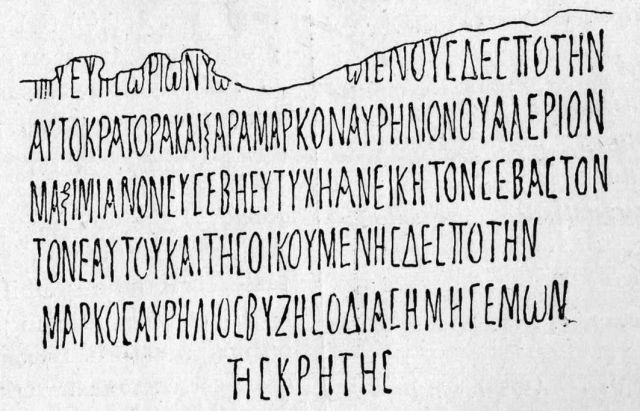
Inscription
--- / π̣α̣ν̣τὸς [ἀνθ]ρώπων ἐ̣̣ν̣ κ̣ό̣σ̣μ̣ῳ̣ γ̣ένους δεσπότην / Αὐτοκράτορα Καίσαρα Μᾶρκον Αὐρήλιον Οὐαλέριον / Μαξιμιανὸν Εὐσεβῆ Εὐτυχῆ Ἀνείκητον Σεβαστόν, / τὸν ἑαυτοῦ καὶ της οικουμένης δεσπότην, /(5) Μᾶρκος Αὐρήλιος Βύζης ὁ διασημότατος ἡγεμὼν / τῆς Κρήτης.
Inscription translation
... the ruler of all human people in the world, the emperor and Caesar Marcus Aurelius Valerius Maximinianus, pious, fortunate and unconquered Augustus. Marcus Aurelius Byzes, of perfectissimus rank, governor (praeses) of Crete, [honours him].
Bibliography
- Guarducci, M., Inscriptiones Creticae. Vol 4. Tituli Gortynii, Roma 1950, no. 282
Discussion
INSCRIPTION
Partly preserved in six lines:
--- / π̣α̣ν̣τὸς [ἀνθ]ρώπων ἐ̣̣ν̣ κ̣ό̣σ̣μ̣ῳ̣ γ̣ένους δεσπότην / Αὐτοκράτορα Καίσαρα Μᾶρκον Αὐρήλιον Οὐαλέριον / Μαξιμιανὸν Εὐσεβῆ Εὐτυχῆ Ἀνείκητον Σεβαστόν, / τὸν ἑαυτοῦ καὶ της οικουμένης δεσπότην, /(5) Μᾶρκος Αὐρήλιος Βύζης ὁ διασημότατος ἡγεμὼν / τῆς Κρήτης.
' ... the ruler of all human people in the world, the emperor and Caesar Marcus Aurelius Valerius Maximinianus, pious, fortunate and unconquered Augustus. Marcus Aurelius Byzes, of perfectissimus rank, governor (praeses) of Crete, [honours him].'
Letter height: 5 - 6 cm.
DESCRIPTION (from Guarducci 1950)
Fragment of a column of bluish marble. The top is missing.
PROVENANCE AND CURRENT LOCATION
Found in the area of the temple of Apollo Pytheos in Gortyna. Present location not recorded.
HONORAND AND DATE
The honorand, Maximian, was Augustus 286-305.
In the wake of the tetrarchic provincial reforms, the proconsular province of Creta et Cyrenaica was divided, Crete now being governed by a praeses of perfectissimus rank (it was re-elevated to be under a consularis<i/> later in the 4th century). The division of the earlier province had occurred by 295/7 (Guarducci 1950, p. 231 no. 281). The terminus ante quem is given by Maximian's retirement in 305.
FURTHER DISCUSSION
This is certainly a pair with a very similar dedication by the same governor, found close-by, to the emperor Galerius (LSA-89). The existence of two contemporary dedications to tetrarchs strongly suggests that once four dedications existed, to all the members of the imperial college (for instance, it is very implausible that the eastern Augustus, Diocletian, would be omitted).
Cite: Last Statues of Antiquity, LSA-63 (Ulrich Gehn).