
LSA-630
Base for statue of Maximian, emperor. Nicomedia (Bithynia). 286-305.
Record details
Photographs
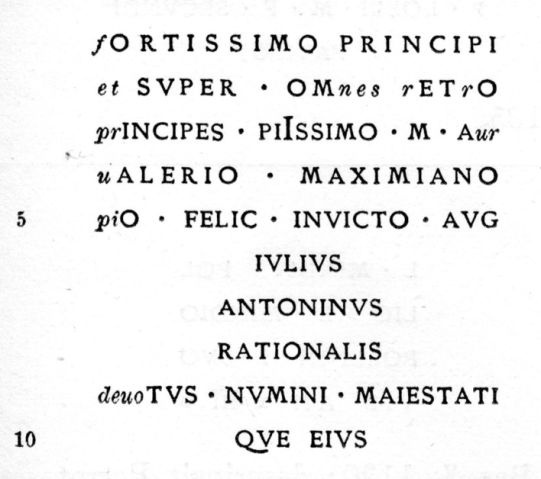
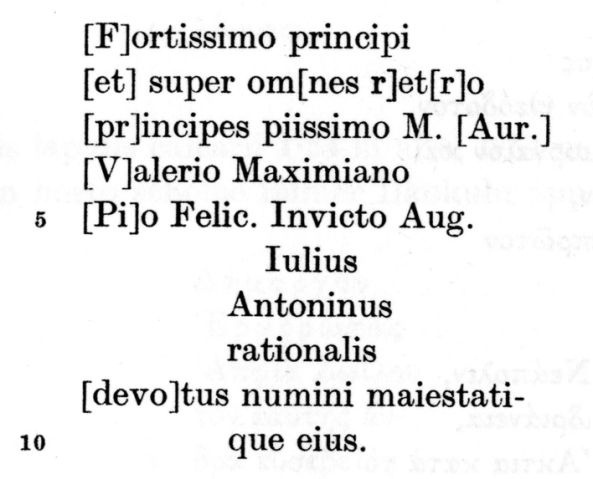
Inscription
[F]ortissimo principi / [et] super om[nes r]et[r]o / [pr]incipes piissimo, M(arco) [Aur(elio)] / [V]alerio Maximiano, /(5) [pi]o, felic[i] Aug(usto), / Iulius / Antoninus / rationalis / [devo]tus numini maiestati/que eius.
Inscription translation
To the most powerful ruler and the most pious, above all earlier emperors, Marcus Aurelius Valerius Maximianus, pious, fortunate Augustus. Julius Antoninus, rationalis, devoted to his divinity and majesty [set this up].
Bibliography
- Corpus Inscriptionum Latinarum; , III, 325
- Dörner, K. F. (ed.), Tituli Asiae Minoris, IV. Tituli Bithyniae linguis Graeca et Latina conscripti, 1. Paeninsula Bithynica praeter Chalcedonem. Nicomedia et ager Nicomedensis cum septentrionali meridianoque litore sinus Astaceni et cum lacu Sumonensi, Vienna 1978, p. 15 no. 30
Discussion
INSCRIPTION
In ten lines:
[F]ortissimo principi / [et] super om[nes r]et[r]o / [pr]incipes piissimo, M(arco) [Aur(elio)] / [V]alerio Maximiano, /(5) [pi]o, felic[i] Aug(usto), / Iulius / Antoninus / rationalis / [devo]tus numini maiestati/que eius.
'To the most powerful ruler and the most pious, above all earlier emperors, Marcus Aurelius Valerius Maximianus, pious, fortunate Augustus. Julius Antoninus, rationalis, devoted to his divinity and majesty [set this up].'
Letter height not recorded.
DESCRIPTION
No description and no measurements of the block are known, and there is no pubished image.
PROVENANCE AND CURRENT LOCATION
The inscription was recorded in 1555 by the Austrian envoy to the Ottoman Sultan, Augerius Gislenius Busbequius, from whose letters it was published in CIL III (on Busbequius see CIL III, 4). There is no recent record of it.
HONORAND, AWARDER, AND DATE
Maximian, the honorand (full name Marcus Aurelius Valerius Maximianus, as in our inscription) was Augustus 286-305.
Julius Antoninus, the honorand (PLRE I, 76, Iulius Antoninus 10), was rationalis (line 8), the head of either the central or the diocesan imperial treasury (Delmaire 1989, 25). He set up another inscription in Nicomedia, to Diocletian (LSA-628), and a further one, also to Diocletian, in Ephesus (LSA-715).
Discussion references
- Delmaire, R., Les responsables des finances impériales au Bas-Empire romain (IVe-VIe s.). Études prosopographiques, Bruxelles 1989
Cite: Last Statues of Antiquity, LSA-630 (Ulrich Gehn).