
LSA-631
Base for statue of Constantius I, emperor. Nicomedia (Bithynia). 293
Record details
Photographs
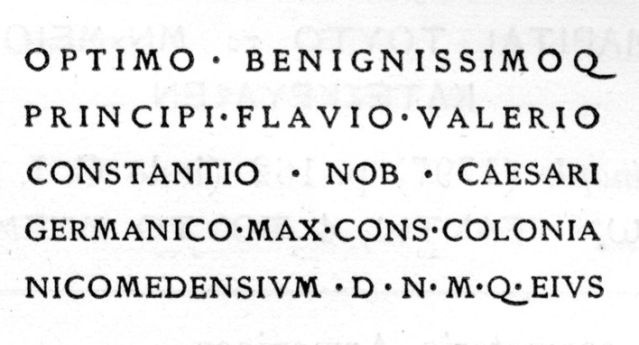
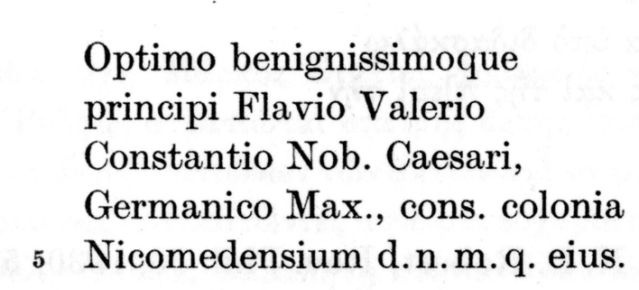
Inscription
Optimo benignissimoque / principi, Flavio Valerio / Constantio, nob(ilissimo) Caesari, / Germanico max(imo), cons(uli), colonia /(5) Nicomedensium d(evota) n(umini) m(aiestati) q(ue) eius.
Inscription translation
To the best and most kindly emperor, Flavius Valerius Constantius, most noble Caesar, greatest victor over the Germans, consul. The colony of Nicomedia, devoted to his divinity and majesty, [set this up].
Bibliography
- Corpus Inscriptionum Latinarum; , III, 326 with addenda p. 976
- Dörner, K. F. (ed.), Tituli Asiae Minoris, IV. Tituli Bithyniae linguis Graeca et Latina conscripti, 1. Paeninsula Bithynica praeter Chalcedonem. Nicomedia et ager Nicomedensis cum septentrionali meridianoque litore sinus Astaceni et cum lacu Sumonensi, Vienna 1978, p. 15 no. 31
Discussion
INSCRIPTION
In five lines:
Optimo benignissimoque / principi, Flavio Valerio / Constantio, nob(ilissimo) Caesari, / Germanico max(imo), cons(uli), colonia /(5) Nicomedensium d(evota) n(umini) m(aiestati) q(ue) eius.
'To the best and most kindly emperor, Flavius Valerius Constantius, most noble Caesar, greatest victor over the Germans, consul. The colony of Nicomedia, devoted to his divinity and majesty, [set this up].'
Letter height not recorded.
According to Ramsay 1941, who saw the base, the inscription has been altered: with the letters IMO in line 4 (from 'maxIMO') being replaced with CONS (for 'CONSuli'). For an explanation of this change, see below, 'Honorand, Awarder, and Date'.
The wording of the inscription, with the honorand in the dative and the awarder in the nominative, and with a standard closing formula of devotion, is typical of late antique statue dedications in Latin.
DESCRIPTION
No description of the block and no measurements have been published, and there is no published image. However, the wording of the inscription shows that this was a statue base.
PROVENANCE AND CURRENT LOCATION
The inscription was first recorded by the late 17th century scholars Stephane Baluze and Charles Du Fresne Du Cange in the atrium of the so-called 'New Mosque' at Izmit. There is no recent record of it.
HONORAND, AWARDER AND DATE
Constantius I, the honorand (full name Flavius Valerius Constantius, as in our inscription) was Caesar 293-305. He acquired the title of Germanicus maximus ('greatest victor over the Germans', line 4) in 293 (Barnes 1982, 255). Since his later title of Sarmaticus maximus acquired in 294 is omitted, the inscription must have been set up in 293.
Constantius I held his first consulship in 294. The consular title (line 4), which is a later addition to the inscription (see above, 'Inscription'), was presumably added in that year (Ramsay 1941).
The inscription was set up by the city of Nicomedia, which had recently been awarded the status of colony by Diocletian (Ramsay 1941).
FURTHER DISCUSSION
It is likely that this inscription to the Caesar Constantius I was originally accompanied by further dedications to the other tetrarchs.
Discussion references
- Barnes, T. D., The New Empire of Diocletian and Constantine, Cambridge (Mass.) 1982
- Ramsay, Sir W. M., The Social Basis of Roman Power in Asia Minor, Aberdeen 1941, p. 301 no. 300
Cite: Last Statues of Antiquity, LSA-631 (Ulrich Gehn).