
LSA-632
Base for statue of Constantius II, emperor. Myra (Lycia). 337-361
Record details
Photographs
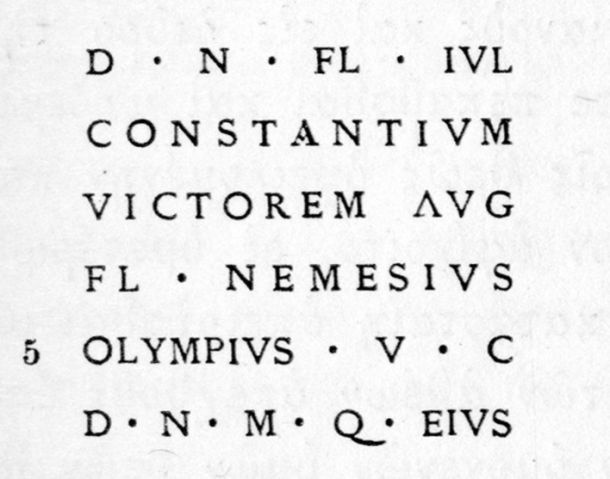
Inscription
D(ominum) n(ostrum) Fl(avium) Iul(ium) / Constantium, / victorem, Aug(ustum), / Fl(avius) Nemesius /(5) Olympius, v(ir) c(larissimus), / d(evotus) n(umini) m(aiestati) / q(ue) eius.
Inscription translation
Our lord Flavius Iulius Constantius, victor, Augustus; Flavius Nemesius Olympius, of clarissimus rank, devoted to his divine spirit and majesty [honours him].
Bibliography
- Corpus Inscriptionum Latinarum; , III no. 12126
Discussion
INSCRIPTION
In seven lines:
D(ominum) n(ostrum) Fl(avium) Iul(ium) / Constantium, / victorem, Aug(ustum), / Fl(avius) Nemesius /(5) Olympius, v(ir) c(larissimus), / d(evotus) n(umini) m(aiestati) / q(ue) eius.
'Our lord Flavius Iulius Constantius, victor, Augustus; Flavius Nemesius Olympius, of clarissimus rank, devoted to his divine spirit and majesty [honours him].'
Letter height not recorded.
The epigraphic formula, with the honorand in the accusative, applies Greek-language practice to Latin (where the honorand would normally be in the dative).
DESCRIPTION (from CIL III)
Rectangular base, H 91, W 42 cm. On the top face, there is a hole (perhaps for the insertion of a plinth). There is no published image.
PROVENANCE AND CURRENT LOCATION
The inscription was recorded by the authors of CIL III in 1902 in Andriake, the harbour city of Myra, about 40 'paces' north of the horrea Hadriani ('in vico Andraki XL pass. a granario Hadriani septentrionem versus'; on Andriake see Borchhardt 1975, 64-75; horrea Hadriani: 66-71) (http://www.trismegistos.org/place/1404).
There is no more recent account of its location; it is possibly still where it was found.
HONORAND, AWARDER AND DATE
Constantius II, the honorand (full name Flavius Iulius Constantius, as in our inscription), was Augustus 337-61.
Flavius Nemesius Olympius, the awarder, is otherwise unknown (PLRE I, 647, Fl. Nemesius Olympius 16). He was certainly of senatorial (clarissimus) rank (line 5). He may well have been the provincial governor: the concluding formula of our inscription would suit an 'official' inscription, and honours to emperors in the provincial cities of Asia Minor were usually set up by governors, in this case the praeses of Lycia. If Olympius was governor of Lycia, this must have been after Lycia's praeses was raised to senatorial (clarissimus), from equestrian, rank, which happened some time around mid-century (Böcking 1839, 131, 144).
Our base can be dated within the long reign of Constantius II as Augustus (337-61), but with no more precision than this.
Discussion references
- Böcking, E., Notitia Dignitatum et administrationum omnium tam civilium quam militarium in partibus Orientis et Occidentis, Bonn 1839
- Borchhardt, J. (ed.), Myra. Eine mlykische Metropole in antiker und byzantinischer Zeit (Istanbuler Forschungen Bd. 30), Berlin 1975
- Jones, A. H. M. et al., The Prosopography of the Later Roman Empire. Vol. I 260-395, Cambridge et al. 1971 (1975)
Cite: Last Statues of Antiquity, LSA-632 (Ulrich Gehn).