
LSA-633
Base for statue of a young boy Octemus. Nicomedia (Bithynia). Fourth to fifth century.
Record details
Photographs
Inscription
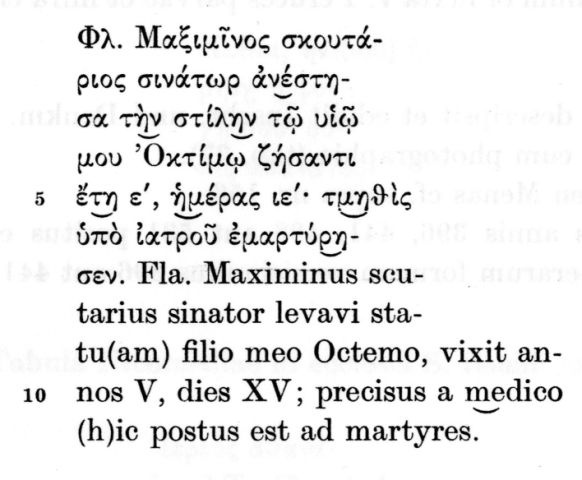
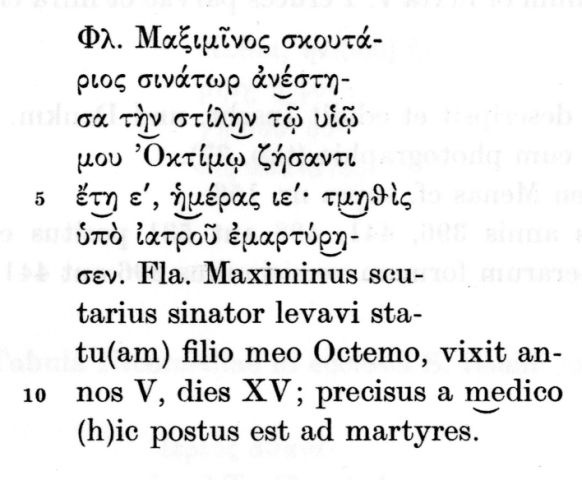
Φλ(άουιος) Μαξιμῖνος, σκουτ[ά]/ριος σινάτωρ, ἀνέστη/σα τὴν στίλην τῷ υἱῷ /μου Ὀκτίμῳ, ζήσαντι / (5) ἔτη εʹ, ἡμέρας ιεʹ·, τμηθὶς / ὑπὸ ἰατροῦ ἐμαρτύρη/σεν. Fla(vius) Maximinus, scu/tarius sinator, levavi sta/tu(am) filio meo Octemo, vixit an/nos V, dies XV; precisus a medico / hic postus (sic) est ad martyres.
Inscription translation
Flavius Maximinus, scutarius of the rank of senator, erected the statue to my son Octemus who lived 5 years, 15 days. Cut by a doctor, he died as a martyr. Flavius Maximinus, scutarius of the rank of senator, erected the statue to my son Octemus who lived 5 years, 15 days. Cut by a doctor, he is placed near the martyrs.
Bibliography
- Corpus Inscriptionum Latinarum; , III suppl. II, 14188
- Dörner, K. F. (ed.), Tituli Asiae Minoris, IV. Tituli Bithyniae linguis Graeca et Latina conscripti, 1. Paeninsula Bithynica praeter Chalcedonem. Nicomedia et ager Nicomedensis cum septentrionali meridianoque litore sinus Astaceni et cum lacu Sumonensi, Vienna 1978, p. 84 no. 367
Discussion
INSCRIPTION
Bilingual inscription in eleven lines, giving the same text in Greek and Latin, except for the Greek verb μαρτυρεῖν (lines 6-7) which takes the place of the Latin 'ponere ad martyres' (line 11). The Greek text is in lines 1-7, the Latin in lines 7-11:
Φλ(άουιος) Μαξιμῖνος, σκουτ[ά]/ριος σινάτωρ, ἀνέστη/σα τὴν στίλην τῷ υἱῷ /μου Ὀκτίμῳ, ζήσαντι / (5) ἔτη εʹ, ἡμέρας ιεʹ·, τμηθὶς / ὑπὸ ἰατροῦ ἐμαρτύρη/σεν. Fla(vius) Maximinus, scu/tarius sinator, levavi sta/tu(am) filio meo Octemo, vixit an/nos V, dies XV; precisus a medico / hic postus (sic) est ad martyres.
'Flavius Maximinus, scutarius of the rank of senator, erected the statue to my son Octemus who lived 5 years, 15 days. Cut by a doctor, he died as a martyr. Flavius Maximinus, scutarius of the rank of senator, erected the statue to my son Octemus who lived 5 years, 15 days. Cut by a doctor, he is placed near the martyrs.'
We reproduce the text here with the completions proposed by Dörner 1978.
Letter height not recorded.
DESCRIPTION (from CIL III)
The block is described as a 'stele' by CIL III: H 83, W 58 cm, dimensions which would be entirely possible for a statue base. The Greek στίλην (line 3, with iotacism for στήλη), as well as the Latin statu- (lines 8-9, completed to 'statuam' by Dörner 1978) could well refer to the statue on top. There is no published image.
PROVENANCE AND CURRENT LOCATION
The inscription was first recorded by Mommsen in 1902 (for CIL III). It was found in the area of Nicomedia on the hill where the saints Dorotheus, Gorgonius, and others were believed to have suffered martyrdom during the persecution under Diocletian ('rep. prope Nicomediam loco antiquo in colle eo, in quo sancti Dorotheus Gorgonius alii creduntur passi esse sub Diocletiano'). There is no recent record of its location.
HONORAND, AWARDER AND DATE
The inscription was set up as an epitaph to Octemus, the son of the awarder Flavius Maximinus, who had died at the age of five after a medical operation. A burial apud martyres, where the martyrs' bodies lay, was considered a privilege. Strangely, the Greek text styles Octemus himself a martyr (ἐμαρτύρησεν, 'he died a martyr', lines 6/7), but this is probably clumsy phrasing; the Latin statement that he was buried ad martyres makes much greater sense.
Flavius Maximinus, the awarder, was a scutarius of the rank of senator (σκουτάριος σινάτωρ, lines 1-2; scutarius sinator, lines 7-8). The scutarii were the imperial life guard who were under the command of the magister officiorum; they were divided into scholae each under a tribunus; the senator was the highest rank within a schola; he was of senatorial (clarissimus) rank by the 5th century (Seeck 1923, 623). Flavius Maximinus possibly served as head of the imperial arms factory in Nicomedia (Schultze 1922, 279; Dörner 1978); arms factories were also under the magister officiorum (Neira Faleiro 2005, 195).
The scutarii were introduced under Constantine and are first mentioned in a law of 333 concerning grain distribution in Constantinople (Mommsen 1910, 231 n. 2); this provides a terminus post quem of c.330 for our inscription.
FURTHER DISCUSSION
This is a most unusual inscription. It comes from a wholly Christian context (the burial site of martyrs), and seems to be unequivocal evidence for a father erecting a funerary statue to his young son. It is puzzling because there is no other evidence of practices of this kind.
Discussion references
- Mommsen, Th., Das römische Militärwesen seit Diocletian, Gesammelte Schriften von Theodor Mommsen, Sechster Band (= Historische Schriften von Theodor Mommsen, Dritter Band), 206-83, Berlin 1910
- Neira Faleiro, C., La notitia dignitatum. Nueva edición crítica y commentario histórico (Nueva Roma 25), Madrid 2005
- Schultze, V., Altchristliche Städte und Landschaften. II. Kleinasien. Erste Hälfte, Gütersloh 1922, pp. 279-80
- Seeck, O., Scholae palatinae, Paulys Realencyclopädie der Classischen Altertumswissenschaft, Zweite Reihe, Zweiter Band, 621-24, Stuttgart 1923
Cite: Last Statues of Antiquity, LSA-633 (Ulrich Gehn).